
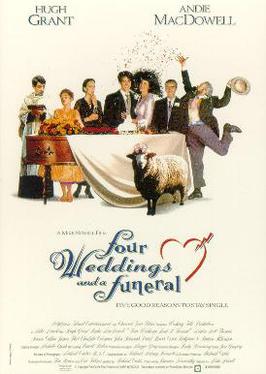
Behind the film
- Year
- 1994
- Director
- Mike Newell
- Writers
- Richard Curtis
- Genres
- Romantic comedy, Drama
- Production
- PolyGram Filmed Entertainment, Working Title Films, Film4 Productions
- Country
- United Kingdom
- Cast
- Hugh Grant, Andie MacDowell, Kristin Scott Thomas, John Hannah, Simon Callow, James Fleet, Charlotte Coleman, Rowan Atkinson
About the film
Contains story spoilers.
Charles meets Carrie at a wedding and they spend the night together, but she returns to America. At another ceremony she reappears with fiancé Hamish; she and Charles reconnect, though his later declaration of love does not stop her marriage. At Carrie's wedding, Fiona reveals her feelings for Charles and Gareth dies after a heart attack. Matthew's tribute at Gareth's funeral makes the friends reconsider what commitment means. Months later Charles prepares to marry Henrietta, only to learn that Carrie and Hamish have separated. His brother David interrupts the ceremony, and Charles admits that he loves someone else. Carrie later accepts his proposal of lifelong partnership without marriage. A closing montage gives the friends further romantic futures and shows Charles and Carrie with a child.
The title's structure turns formal occasions into a way of observing a social group over time. Weddings bring people into the same space while attaching a public meaning to one particular relationship. Everyone else arrives carrying attachments, hopes and grievances that do not fit neatly into that celebration. Richard Curtis's screenplay uses the contrast to make the guests as interesting as the couple being honoured. A ceremony may have a fixed timetable, but private emotion rarely cooperates with it. The film can therefore move between gossip, attraction and anxiety without losing its organising frame. Each gathering becomes a fresh arrangement of people whose lives have continued in the interval.
Hugh Grant's Charles is comfortable enough in this world to belong and awkward enough to keep mishandling it. His hesitation can be charming because it leaves room for embarrassment rather than effortless conquest. Yet the story also asks what that hesitation costs other people. Uncertainty is not automatically harmless when someone else is waiting for a decision. Charles's difficulty is partly a reluctance to choose and partly a hope that the right feeling will make choosing unnecessary. The film's comic situations make that wish recognisable, while the relationships surrounding him show different ways of living with risk. Being agreeable is easier than accepting responsibility for the expectations you create.
Carrie's arrival disturbs a circle whose habits can otherwise feel self-sustaining. Andie MacDowell's character has an appeal connected to the possibility of another life, but she also has plans and decisions that Charles does not control. Their meetings are shaped by timing, making attraction something that can recur without immediately becoming a shared future. The ceremonial structure intensifies that uncertainty: an encounter can take place within a celebration of somebody else's certainty. Charles is repeatedly confronted with the difference between wanting a person and being ready to build a relationship with them. The film lets desire be immediate while commitment remains a more awkward, specific negotiation.
Fiona brings a quieter emotional register to the ensemble. Kristin Scott Thomas's character can belong fully to the friendship group while carrying feelings that the group does not automatically recognise. That gives the comedy a useful depth. A witty response may allow someone to remain socially comfortable without expressing the longing behind it. The film does not make every unspoken feeling equivalent to a future romance waiting to happen; affection can be genuine and still remain unreturned. That distinction gives friendship its own complications. Familiarity may create trust, but it can also make it easier to overlook the person whose composure has become part of the expected arrangement.
Gareth and Matthew change the story's measure of partnership. The relationship played by Simon Callow and John Hannah belongs to the group before it becomes the focus of public mourning. The funeral exposes how much can be taken for granted when affection is woven into ordinary company. It also separates commitment from the prestige and ceremony attached to other relationships. A bond can be central to two people's lives without occupying the position that the surrounding social rituals would usually assign it. The film's emotional shift follows from that recognition. Grief makes the friends reconsider not only whom they love, but how casually they have understood the lives beside their own.
Mike Newell's direction keeps the changes of tone within one recognisable social world. Embarrassing speech, mistimed entrances and ceremonial mistakes can coexist with a sincere emotional disclosure because both arise from people struggling to express themselves in public. Working Title's production account describes a film approached as drama as well as comedy, and that balance explains the ensemble's importance. The characters need more than a comic function for the serious moments to matter. Their shared history supplies a context in which a joke can be affectionate, defensive or unexpectedly hurtful. Laughter becomes a social activity with consequences rather than an isolated interruption of the romance.
The eventual partnership complicates the idea that a romantic comedy must end by reproducing every convention it has used along the way. The story values commitment while allowing characters to question the form through which it should be expressed. That distinction brings the title's occasions together: public celebration can reveal love, but it cannot create it merely by proceeding correctly. Four Weddings and a Funeral remains concerned with the people who gather around those ceremonies, trying to understand their own desires while observing one another's choices. Its warmth comes from treating companionship as a continuing life rather than a reward handed over at the end of a successful courtship.