
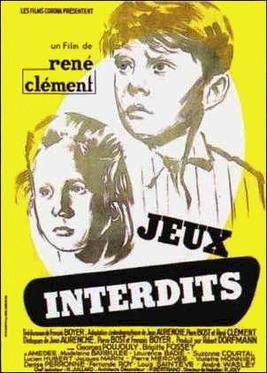
Behind the film
- Year
- 1952
- Director
- René Clément
- Writers
- René Clément, Jean Aurenche, François Boyer, Pierre Bost
- Genres
- War, Drama
- Production
- StudioCanal
- Country
- France
- Cast
- Brigitte Fossey, Georges Poujouly, Philippe de Chérisey, Jacques Marin, Lucien Hubert, Laurence Badie, Madeleine Barbulée, Suzanne Courtal
About the film
Contains story spoilers.
Forbidden Games begins among refugees fleeing Paris in wartime France. A German air attack kills five-year-old Paulette's parents and her dog. Brigitte Fossey plays Paulette; Georges Poujouly plays Michel Dollé, the country boy whose family takes her in. Paulette quickly becomes attached to the older boy. The children bury the dog in an abandoned watermill and make a cemetery for other animals. They decorate it with stolen crosses, including the one from Michel's brother's grave. His father blames a neighbour before discovering who took it.
The story had already changed form several times before René Clément directed it. François Boyer could not sell his screenplay, so he turned it into a novel published in 1947. Clément, Jean Aurenche and Pierre Bost then adapted it for the screen. It was intended as the middle section of a three-part film, until financing collapsed. Producer Robert Dorfmann encouraged Clément to expand the surviving material into a feature. In his Criterion essay, Peter Matthews describes the friction between documentary realism and fairy tale. He places Paulette's passage from the refugee column into the countryside at the arrival of Narciso Yepes's guitar music. The rural adults' broad comedy, in his reading, encloses the children's separate world.
Fossey remembered making those scenes without understanding their tragedy. In a recollection quoted by INA, she said that even the threat of losing her bicycle, used to prompt tears, belonged to a serious game she enjoyed. Clément recalled that she could reduce her crying when asked, surprising the crew. Fossey also remembered affection for Poujouly and a strong friendship with her director. Her later Critikat interview gives a more stubborn picture of the young performer. She disliked the intonations her mother used while rehearsing scenes with her and had her own ideas about Paulette. She remembered resisting the instruction to cry on recovering the dog: finding the animal had made her happy. In her account, a bite from the dog helped bring the required tears. Watching the rushes delighted her so much that she could not concentrate the next day. Clément stopped her attending, and she spent that time playing and making sculptures in the hotel garden instead.
Clément described directing the children as playing with them until they forgot the camera and microphone. He wanted the film's world seen from their level. In his radio interview quoted by INA, he described the camera moving seventy centimetres above the ground. The adults could look ridiculous because, to him, the children were the serious characters. He also explained the dog's burial as Paulette indirectly burying her parents. He contrasted the children's act of love with adult funeral gestures whose original meaning had been lost through habit. Music had its own preparation: INA recounts Yepes's testimony that he watched the film thirty-two times while finding a musical dialogue with its characters. The guitar theme is Romance anonyme, performed for the film by Narciso Yepes. Fossey connected the film's early reception to audiences who still remembered the wartime exodus. She also valued its balance between drama and funny daily routines. Paulette brings the war into a farming household that continues its ordinary business and its quarrels with neighbours. Fossey's casting began with a bet between her aunt and mother; Clément wanted an older girl, but his wife urged him to test her.
Christoph Vatter reads that quarrelling household within France's postwar memory. In his chapter on childhood and trauma in French cinema, Paulette's private loss is connected to a country struggling to remember defeat and occupation. He argues that the documentary appearance of the opening could recall experiences its first audiences had lived through. The children's story also allows an allegorical approach to that past. For Vatter, the film leaves room to question France's comforting image of itself as a nation united in resistance. He reads the fathers' cemetery fight as a displaced version of internal French ideological conflict. Both men fall into the open grave, then emerge united in pursuing Michel over the stolen crosses. In that interpretation, their dispute is briefly buried when they find a child to pursue together. The political meaning belongs to Vatter's reading of the scene.
When gendarmes arrive to collect Paulette, Michel offers to reveal the crosses' hiding place if his father lets her stay. His father breaks the promise. Michel throws the crosses into the stream. Paulette reaches a Red Cross centre and runs into the crowd, calling for Michel, then her mother. Clément filmed a different frame for the story: the children sit together with a storybook, and Michel invents a happier outcome when Paulette cries. Those bookends were excluded from the finished film. Matthews argues that they would have softened the abruptness of its ending. The released version leaves the children separated, without that return to the storybook or the consolation of an invented reunion.