
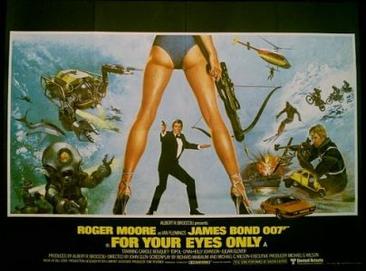
Behind the film
- Year
- 1981
- Director
- John Glen
- Writers
- Richard Maibaum, Michael G. Wilson
- Runtime
- 2h 7m
- Genres
- Thriller, Action, Spy
- Production
- Eon Productions
- Country
- United Kingdom
- Cast
- Roger Moore, Julian Glover, Carole Bouquet, Chaim Topol, Lynn-Holly Johnson, Lois Maxwell, Desmond Llewelyn, Cassandra Harris
About the film
Contains story spoilers.
A British surveillance ship sinks carrying ATAC, a naval communications device coveted by the Soviets. The Havelocks, secretly searching for the wreck, are murdered. Their daughter Melina kills the gunman and joins Bond's pursuit of his employers. Kristatos directs suspicion towards rival Columbo, but Columbo exposes Kristatos's Soviet connection. Bond and Melina recover ATAC underwater, only for Kristatos to seize it; they survive being dragged behind his boat. Their allies locate him in a mountain monastery, which Bond scales. During the assault, Bond prevents Melina executing Kristatos; Columbo kills him when he attempts another attack. As Soviet general Gogol arrives, Bond destroys ATAC, denying it to both sides. The strategic prize disappears, while the people who pursued it must live with what the chase has cost.
Roger Moore's Bond operates here in a world where polished introductions offer very little certainty. Wealth, manners and apparent cooperation can disguise different interests, and judging the people around him becomes part of the physical job of surviving. His ease in conversation remains useful, but it is not an all-purpose answer. The screenplay by Richard Maibaum and Michael G. Wilson surrounds him with characters whose objectives overlap only temporarily. Someone may offer help because doing so suits a rivalry, not because they share his loyalties. That arrangement gives the spy story a human texture: the mission advances through bargains and interpretations as well as force, with the danger often arising from a convincing story told by the wrong person.
Carole Bouquet's Melina gives the film an emotional purpose Bond's assignment cannot contain. Her grief makes retaliation feel urgent, while the official problem is concerned with preventing an imbalance of power. Those interests can point in the same direction without meaning the same thing. Her presence asks what becomes of someone whose entire attention is directed towards an injury that cannot be undone. Bond has professional habits that allow him to move from one objective to another; Melina has a personal history whose consequences do not end when the immediate danger passes. Their partnership therefore includes an argument about proportion. Stopping an enemy and satisfying a desire for revenge can look identical in the moment, yet the reasons behind the act may leave different burdens afterwards.
The opposing alliances make that distinction harder to maintain. Julian Glover's Kristatos presents a controlled surface, while Topol's Columbo offers a more expansive personality. It is tempting to turn manner into evidence: restraint can look trustworthy, and rougher charm can look suspicious. The film uses that temptation to make Bond's judgment fallible without stripping him of competence. He has to revise an understanding rather than simply defend his first impression. Columbo's energy also gives cooperation a particular flavour. An ally who has his own habits, grievances and practical resources feels more substantial than someone created only to agree with the hero. Trust becomes a working arrangement tested under pressure, with room for respect between people whose backgrounds and methods differ.
John Glen's direction gives the mission a strong sense of bodies negotiating difficult places. Open water, steep rock and snow change what movement costs. These environments are attractive, but their beauty does not soften the problem of being exposed inside them. A mountain can turn a small advance into a conspicuous risk; water makes ordinary certainty about movement and breath fragile. The settings consequently provide more than changing scenery between conversations. They give action an immediate physical vocabulary that is readable even when the political stakes require explanation. Bond's resourcefulness matters because the environment does not adjust to his confidence. He must find a way through material obstacles, and the film can make that effort suspenseful without continually enlarging the scale of the threatened destruction.
There is also a useful contrast between the sophistication surrounding Bond and the vulnerability of his body. Formal clothing, expensive leisure and professional connections suggest someone who normally knows how to enter a room. Against the landscape, those signs of status cannot do much by themselves. The action depends on balance, timing, patience and improvised choices. This gives Moore's relaxed persona another dimension: wit exists beside the possibility of being hurt, rather than floating above it. The humour can release pressure without making every opponent harmless. A light conversational touch and a hard response to danger belong to the same character, allowing the film to move between pleasure and severity while keeping the job's consequences visible.
ATAC supplies a straightforward object around which those different appetites gather. Its fictional value is strategic rather than sentimental, so it permits an unusual comparison with Melina's motives. One pursuit concerns an advantage that can be possessed, transferred or denied; the other concerns a loss for which no possession can compensate. Treating them as parallel threads makes the final choices about what is worth keeping especially meaningful. Bond's task is not simply to accumulate the enemy's resources and call that victory. The rivalry between governments gives him reason to think about consequences beyond ownership. The film's Cold War world is a dramatic setting, rather than a technical account of naval systems, and the object matters principally because of the decisions it pressures people to make.
For Your Eyes Only consequently brings several kinds of scale together. A state's calculation can be abstract, a daughter's anger intensely particular, and a climb or dive immediate enough to occupy every thought. The film moves among them without requiring every character to share one understanding of the mission. Its ending can resolve the contest for the device while leaving the personal meaning of violence more unsettled. Melina is not merely another location Bond passes through; her presence makes restraint a live issue inside an adventure otherwise built on decisive action. Beneath the travel, disguises and danger is a question about when taking something further ceases to serve any useful purpose. That gives the spectacle a point of tension beyond whether the hero can overcome the next obstacle.