
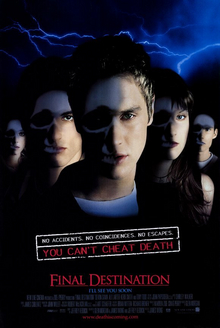
Behind the film
- Year
- 2000
- Director
- James Wong
- Writers
- Jeffrey Reddick, Glen Morgan, James Wong
- Genres
- Horror, Teen, Thriller, Slasher
- Production
- New Line Cinema
- Country
- United States, Canada
- Cast
- Devon Sawa, Ali Larter, Kerr Smith, Tony Todd, Seann William Scott, Kristen Cloke, Chad E. Donella, Amanda Detmer
About the film
Contains story spoilers.
Final Destination finds horror in the difficulty of feeling safe after an escape. Its premise grants the kind of second chance that should end a nightmare, then makes that chance the beginning of another problem. The survivors cannot simply leave a dangerous place because the threat seems able to inhabit any place. That changes the audience’s relationship with ordinary surroundings. A room, a street or a journey can become a collection of possibilities rather than a stable background. The film’s central fear is therefore larger than the prospect of an attack: it concerns the inability to know whether recognising danger gives a person any real control over it. Survival becomes an argument with uncertainty.
Before a school trip to Paris, Alex Browning imagines the destruction of Flight 180 and panics, causing seven people to leave the aircraft. Its subsequent explosion confirms his warning but draws suspicion towards him. After his friend Tod dies, mortician William Bludworth suggests that escaping the disaster disrupted Death’s intended design. More survivors perish, and Alex begins reconstructing the order in which they would have died. He rescues Carter from a car trapped at a railway crossing, only for Billy to be killed by flying wreckage, suggesting intervention merely moves the sequence onwards. Alex then realises that a seat change means Clear, rather than himself, is next. He frees her from a threatened car at the cost of taking an electrical shock. Months later, the remaining three visit Paris, apparently ready to celebrate. Another chain of accidents brings danger back, and Carter saves Alex before a swinging sign returns towards Carter, cutting their reassurance short once again.
Alex’s position gives knowledge an uncomfortable social cost. Being right about an extraordinary danger does not make him easy for others to trust. The warning arrives through him, so fear can attach to its messenger even when he did not cause the event. That creates a familiar emotional problem inside the supernatural premise: somebody who wants to help can become isolated because the help exposes what others would rather deny. The film’s suspense depends partly on that isolation. An explanation is only useful if people can agree on what it means and respond together. Alex’s certainty develops within a group that has different reasons to resist it, making cooperation nearly as fragile as the physical safety they are trying to preserve.
The idea of a sequence gives the story the appeal of a puzzle without the comfort of a dependable solution. Patterns promise understanding. If an order can be reconstructed, perhaps a future event can be anticipated. Yet the more the survivors think they know, the more consequential an error becomes. Their reasoning has to bridge a gap between visible accidents and an invisible intention, and that gap leaves room for doubt. Read through this structure, the film turns rational investigation into a source of additional anxiety. Every answer generates another question about exceptions, missed details or changes in the arrangement. Knowledge can offer a temporary advantage while making the surrounding world feel increasingly organised against them.
Clear’s importance lies in the possibility of believing somebody whose explanation sounds impossible. Trust becomes practical rather than merely sympathetic: it affects what a person is prepared to notice, avoid or do. Her connection with Alex supplies a human counterweight to the film’s impersonal threat. Death, as imagined here, has no interest in reassurance, while relationships depend on the hope that attention and care can matter. That contrast gives the suspense emotional stakes beyond counting survivors. The question is whether one person’s determination to protect another can change anything in a system that appears indifferent. The film repeatedly places that hope under pressure without allowing its characters a reliable authority who can settle the rules for them.
Its horror mechanism rewards attention to small things. A threatening environment does not need to announce itself with an obvious weapon when ordinary objects can become parts of a larger chain. The audience begins to assess possible connections, turning anticipation into an active experience. Something harmless in isolation may become worrying because of what sits beside it or what could happen next. This gives suspense a distinctive texture: the frightening event is partly assembled in the imagination before it occurs. The story makes causal thinking feel dangerous. Viewers are invited to look for the arrangement, while also knowing that seeing several possibilities may be no help in identifying the one that matters in time.
The unresolved threat gives the ending its force. An escape can be genuine without being permanent, and a successful intervention need not explain the larger design. That leaves the survivors suspended between gratitude for the time they have gained and fear about the terms on which they gained it. The film’s world is unsettling because it denies the usual distinction between danger and aftermath. There may be no dependable moment when a person can declare the experience finished and return to ordinary life. Final Destination builds a memorable horror identity from that denial. Its antagonist is expressed through patterns, possibilities and everyday space, leaving the central question open: can a warning change a fate, or only make somebody watch it approach?