
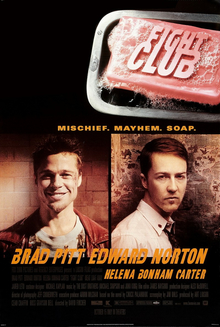
Behind the film
- Year
- 1999
- Director
- David Fincher
- Writers
- Jim Uhls
- Runtime
- 2h 19m
- Genres
- Flashback, Drama, Thriller, Psychological thriller
- Production
- Regency Enterprises, 20th Century Studios
- Country
- United States, Germany
- Cast
- Edward Norton, Brad Pitt, Helena Bonham Carter, Meat Loaf, Jared Leto, Zach Grenier, Holt McCallany, Eion Bailey
About the film
Contains story spoilers.
The unnamed Narrator works as an automobile recall specialist and cannot sleep. He asks a doctor for help, but the doctor suggests he attend a support group to see people experiencing real pain. The meetings let him cry and briefly sleep, though he is pretending to share illnesses he does not have. Then he meets Marla Singer, another impostor, and her presence ruins the private refuge he had found. They negotiate a schedule to divide the groups between them. This arrangement is the first of many attempts by the Narrator to impose rules on a life that feels increasingly unreal.
On a business flight, the Narrator meets Tyler Durden, a soap salesman with an easy confidence and a contempt for consumer routine. After returning home to find his apartment destroyed by an explosion, the Narrator calls Tyler and asks to stay with him. At a bar, Tyler first asks him to throw a punch. Their exchange turns into a fight outside, and the two men discover that physical pain gives them a jolt missing from their ordinary lives. At Tyler’s large, decaying house, they start inviting other men to fight in the basement of the bar. The club begins as a small ritual between people who want to feel something.
The meetings grow, and the Narrator starts to change. Tyler rescues Marla from an overdose and begins a sexual relationship with her, while the Narrator remains distant and promises Tyler not to discuss him with her. At work, the Narrator stages a beating in his boss’s office by hitting himself and uses the resulting settlement to expand Fight Club. Bob Paulsen, whom the Narrator knows from a support group, joins. Tyler then turns the club into Project Mayhem, whose members carry out destructive acts against institutions and property. What began as a place to fight is becoming an organized movement with orders and little room for question.
The Narrator becomes uneasy with the escalating damage and tries to confront Tyler. Tyler admits that he caused the apartment explosion to free the Narrator from the belongings and habits that defined his old life. After the argument, Tyler disappears. When police kill Bob during a Project Mayhem operation, the Narrator tries to stop the group. He discovers that local chapters have spread across the country, and the members give him strange, evasive answers when he asks where Tyler is. At one point, one of them identifies the Narrator as Mr. Durden, a name that seems to belong to Tyler.
The mystery resolves through the Narrator’s conversations with Marla and the members. Marla calls him Tyler, and he realizes he and Tyler are the same person: Tyler takes control during periods the Narrator thinks are lost to sleep. The fight club has not simply developed beyond him; its charismatic leader is another identity within him. The Narrator now understands that Project Mayhem’s direction and his own actions are tied together, though that knowledge does not give him an easy way to regain control. Tyler’s apparent disappearance has been a clue to the Narrator’s fractured view of events.
Project Mayhem’s final plan is to destroy the records of consumer debt by blowing up buildings belonging to credit companies. The Narrator warns Marla to stay away and goes to the police, only to find that some officers are members of the project. They try to castrate him on Tyler’s orders. He escapes and disarms one of the bombs, but Tyler attacks him. The Narrator reasons that Tyler’s gun must actually be in his own hand and shoots himself through the cheek. Tyler disappears, while the Narrator survives. Marla arrives, and they watch buildings collapse together.
The film makes its reveal a change in how earlier scenes should be read. Tyler seems to be an external friend, mentor and antagonist, but the Narrator’s unsteady perception keeps the audience close to the same mistaken understanding. The support groups, the fights, Marla’s relationship with Tyler and the project’s growing reach all become part of the Narrator’s divided life. The story’s fast, sardonic voice makes the violence feel energetic even as the consequences become harder to contain. Its critique of consumerism does not offer the club as a safe answer; it shows a movement turning frustration into another system of control.
The house on Paper Street gives the club a home, but it is no stable refuge: broken fixtures and neglected rooms reflect how far the Narrator has moved from his clean apartment and carefully purchased possessions. The soap Tyler makes from discarded human fat literalizes the film’s interest in waste, bodies and consumer products. Fight Club’s rules promise a boundary around violence, yet Project Mayhem erodes that boundary as members follow commands they do not examine. The final image of Marla beside the Narrator does not promise that he has repaired their relationship or solved his life. It leaves him facing the damage he set in motion.