
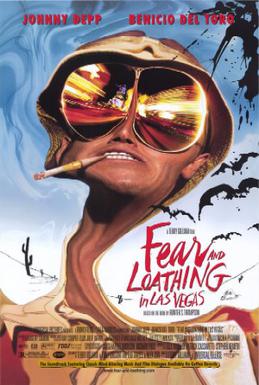
Behind the film
- Year
- 1998
- Director
- Terry Gilliam
- Writers
- Terry Gilliam, Tony Grisoni, Tod Davies, Alex Cox
- Runtime
- 1h 58m
- Genres
- Buddy, Autobiography, Comedy drama, Phantasmagoria
- Production
- Rhino Entertainment Company, Summit Entertainment, Universal Pictures
- Country
- United States
- Cast
- Johnny Depp, Benicio del Toro, Christina Ricci, Ellen Barkin, Tobey Maguire, Gary Busey, Mark Harmon, Cameron Diaz
About the film
Contains story spoilers.
Fear and Loathing in Las Vegas gives a journalist the problem of reporting on a world he can barely perceive consistently. The assignment offers a conventional reason to travel, but the travellers bring their own means of making convention collapse. That contradiction organises the film: the person expected to observe events is also helping transform them into something volatile, frightening and absurd. Terry Gilliam's adaptation makes the altered perspective part of the storytelling rather than keeping it at a safe distance. Las Vegas remains a real destination within the fiction, yet the experience of being there repeatedly overwhelms the practical business of describing what happens.
In 1971, Raoul Duke and Dr. Gonzo drive to Las Vegas to cover a motorcycle race, carrying an extensive drug supply. Hallucinations disrupt the hotel, casino and race itself. Duke tries to leave, then returns for a convention about narcotics. Gonzo brings a young woman, Lucy, into their increasingly disturbing orbit. Their behaviour leaves rooms wrecked and other people threatened. Duke reconstructs events from recordings and memories, takes Gonzo to the airport and finishes his work before returning to Los Angeles. The journey includes reflection on the earlier counterculture, turning present excess into an uneasy encounter with a promise that seems to have receded rather than been fulfilled.
The reporting framework makes the disorder more than a succession of unusual sights. Journalism requires selection: a person has to decide what is relevant, what can be trusted and how an experience becomes an account for somebody else. Duke's situation keeps undermining those decisions. A striking image may be an observation, a distortion or something he has helped cause. The film can therefore be read as a comic attack on the fantasy of a reporter standing completely outside the material. Duke is deeply inside it, carrying appetites and disappointments that shape what becomes visible. His predicament gives the narration an energy that an impartial description could not provide, while also making reliability an open question.
Johnny Depp's Duke and Benicio del Toro's Gonzo supply two bodies through which that uncertainty can move. Their companionship makes escalation easier because each can give the other an audience, an excuse or a fresh impulse. Being together does not make the behaviour safer. The relationship can resemble cooperation while continually increasing the pressure on everyone nearby. That is important to the film's mixture of comedy and menace. The pair's distinctive reactions may make a situation absurd without making its consequences harmless. A stranger who encounters them does not necessarily have access to the private amusement or justification that keeps the journey moving.
Las Vegas offers a fitting environment because its public identity already depends on heightened experience. The city promises an exceptional encounter through spectacle, expenditure and the suspension of everyday limits. The travellers take that invitation beyond the point at which it remains comfortable or commercially manageable. Ordinary hospitality becomes unstable when a customer can no longer agree about what a room or a transaction is. The film's imagined city is consequently both an external world and a collaborator in the disturbance. Its offer of excess meets people who have arrived determined to exceed it, making the supposedly controlled environment less controlled than it wants to appear.
The narcotics convention places the travellers beside an institution trying to explain the condition they are producing for themselves. That contrast can be funny without making their own conduct a credible alternative authority. An official explanation may miss its subject, while the people closest to the experience may also be incapable of accounting for it clearly. The film finds satire in the gap between those positions. It does not need to settle on one dependable spokesman. Instead, it lets the confident description and the chaotic participation expose each other's limitations, leaving the viewer to recognise how easily a simplified account can fail the reality it claims to organise.
Adapted from Hunter S. Thompson's book, the film combines a period setting with the feeling of something already lost. The recollection of countercultural possibility gives the present behaviour an emotional context beyond wanting another sensation. Excess can become a response to disappointment, but that response cannot guarantee a recovery of the original hope. This makes nostalgia uneasy. Remembering a moment of apparent freedom is different from being able to recreate it through another journey or another purchase. Gilliam's approach allows the distorted present to carry that difference, with the comedy repeatedly brushing against a sense that the promised destination was never simply Las Vegas.
The return to writing provides an ending without pretending that the journey has become orderly. A record can be assembled from scattered material, yet assembly does not erase the damage that accompanied it. The film's continuing attraction lies in the tension between an account and an experience too unruly to sit comfortably inside that account. Duke wants something he can carry away from the trip, while the trip keeps showing what cannot be made neat. Fear and Loathing in Las Vegas turns that difficulty into its own form: a travel story whose instability is central to how it encounters desire, spectacle and the distance between a remembered freedom and the present attempt to find it.