
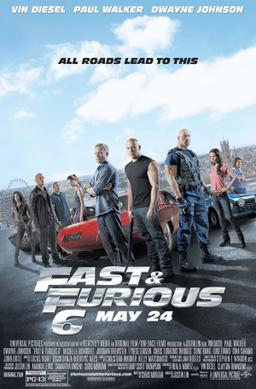
Behind the film
- Year
- 2013
- Director
- Justin Lin
- Writers
- Chris Morgan
- Genres
- Heist, Action, Thriller
- Production
- Universal Pictures, One Race Films
- Country
- United States, Japan, Spain
- Cast
- Vin Diesel, Paul Walker, Dwayne Johnson, Michelle Rodriguez, Jordana Brewster, Tyrese Gibson, Ludacris, Sung Kang
About the film
Contains story spoilers.
Fast & Furious 6 places its drivers in an unusual position for a story built around movement: they have enough money to settle down, yet their homes and relationships remain unfinished. The cars promise freedom, but crossing borders cannot settle the question of where the crew belongs. Dom's physical confidence and his uncertainty about Letty pull the film in different directions. He can commit himself to a chase immediately; he cannot make another person remember their life together. That difference gives the romantic story a slower tempo inside the accelerating mission, with recognition becoming something that requires patience rather than another feat of driving.
The contrast between Dom's crew and Shaw's organization gives the action a second structure. Both groups depend on people with separate technical abilities, but they assign different value to the person behind a useful skill. Dom's idea of family makes loyalty an obligation that survives inconvenience. Shaw's planning treats people as replaceable components, fitting his pursuit of a device assembled from separate parts. Their resemblance makes the conflict more particular than a contest between reckless drivers and disciplined soldiers. The question is what happens when the plan stops working: whether a person becomes expendable, or the mission changes to bring them back.
Letty's missing memories unsettle the series' familiar language of belonging. Other characters can tell her who she was, but those accounts arrive from outside her own experience. Dom's confidence in their history therefore has a limit, even when his attachment is sincere. Michelle Rodriguez gives the character a guarded, physical presence, keeping the uncertainty in the way she meets another person's claim rather than reducing it to a medical explanation. Familiar movement can sit beside unfamiliar feeling. That combination also changes the meaning of the cross necklace: its significance cannot simply be handed over with the object, because recognizing a symbol and accepting its promise are different acts.
The crew is built from different temperaments rather than interchangeable drivers. Brian O’Conner and Mia have a young child, while Roman and Tej turn their new wealth into jokes and bravado. Han and Gisele’s relationship gives the action a quieter line of feeling, since the mission tests their future together. Hobbs and his partner Riley work on the official side but face a threat that requires Dom’s crew. The film’s alliance has a transactional beginning—pardons for help—but its emotional force comes from the fact that each member has something specific to lose.
Director Justin Lin’s action sequences organize vehicles around the shape of the problem. A street race lets Dom reach Letty through a language she still responds to, while a later chase attacks a military convoy carrying the final Nightshade component. The tank sequence is built around unstable weight, speed and rescue: the crew uses cars to overturn the armored vehicle, and Dom dives after Letty when she is thrown free. The action is fantastical, but its geography is clear enough that teamwork remains legible. Each maneuver changes who can reach a person or control a piece of equipment.
Hobbs offers the crew pardons to stop Shaw's attempt to assemble Nightshade, an electromagnetic weapon. Letty, alive but without her memories, works with Shaw; Dom tries to reach her while the operation moves through London and a military convoy. Riley turns out to be Shaw's accomplice, and the capture of Mia forces the crew to release him. The pursuit ends on a runway as Shaw tries to escape aboard a cargo plane. Mia is rescued, Letty kills Riley, and Gisele falls while saving Han and is presumed dead. Dom escapes the crash with the recovered component, securing the promised pardons. Letty stays with him without having recovered her old memories, and Elena leaves. The group returns to the Toretto home. A credits scene places Han in Tokyo, where another driver strikes his car and then calls Dom. That threat lies beyond this mission's resolution, leaving the reunion marked by an absence.
Fast & Furious 6 gives its ensemble a distinctive use of memory. Letty’s amnesia could have reduced her to a puzzle for Dom to solve, but the film lets the missing history affect present choices. She does not immediately become the person he remembers. That tension also applies to the team as a whole: they describe themselves as family, yet their loyalties are tested by grief, distance and conflicting obligations. The concept of family here is not simply a slogan; it is a practical network that has to be rebuilt after rupture. The image of the cross necklace is especially useful because it is both a prop in the plot and an object whose meaning changes with Letty's memory. Dom sees it as a promise from their life together; she first encounters it as unfamiliar evidence, then chooses what it means now. This small shift gives the film a more personal counterpoint to its oversized machines.
The scale of the machines makes the small human objects matter more. A necklace can carry a relationship that a military vehicle cannot explain, and the family table provides an image of arrival after so many contested routes. The action repeatedly requires one person to put their safety in another driver's hands, making trust visible through distance, timing and movement. The crew's wealth does not remove that dependence. Their ability to return home depends on doing something together that none of their individual resources could accomplish. The film ends with a place to gather rather than another destination to conquer, while the missing member keeps that gathering from becoming a simple picture of restored happiness.