
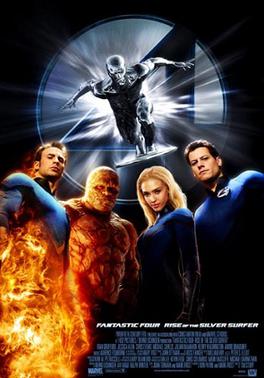
Behind the film
- Year
- 2007
- Director
- Tim Story
- Writers
- Don Payne, Mark Frost
- Genres
- Action, Science fiction, Superhero, Fantasy
- Production
- 20th Century Studios, 1492 Pictures, Constantin Film
- Country
- United States, United Kingdom, Germany
- Cast
- Ioan Gruffudd, Jessica Alba, Chris Evans, Michael Chiklis, Julian McMahon, Kerry Washington, Doug Jones, Andre Braugher
About the film
Contains story spoilers.
Fantastic Four: Rise of the Silver Surfer begins with a superhero team trying to arrange an ordinary milestone. Reed Richards and Sue Storm want a wedding, yet their public responsibilities keep entering the space that might otherwise belong to them. Tim Story's sequel uses that interruption to connect domestic friction with a threat on a much larger scale. The team already knows how to act together, but living together and planning a future require another kind of negotiation. The arrival of the Silver Surfer changes the size of their problem without removing those smaller disagreements, keeping personality and family dynamics visible inside the spectacle.
A mysterious visitor disrupts Reed and Sue's wedding, and Johnny's contact with him allows the team's powers to switch through touch. The Silver Surfer is preparing Earth for Galactus, serving that destructive entity to protect his own world. The military forces the Four to cooperate with Doctor Doom, who steals the Surfer's board after he is captured. The team recovers it following a battle in Shanghai, where Sue is gravely wounded. Moved by her humanity, the Surfer restores her and confronts Galactus, averting Earth's destruction. Reed and Sue marry without leaving the team. A mid-credits scene reveals the Surfer still alive, so his apparent sacrifice does not end his story with a confirmed death.
Ioan Gruffudd's Reed and Jessica Alba's Sue approach the pressure from different directions. Reed's attention can turn toward a technical problem even when the people close to him want a more immediate personal response. Sue gives those neglected priorities a voice, making the relationship something that requires attention rather than an arrangement secured by shared heroism. Their disagreement also gives the wider crisis an everyday scale. Being capable of responding to an extraordinary threat does not mean the pair has mastered the distribution of time and care within a household. The wedding becomes a way of testing whether their public and private lives can coexist.
Chris Evans's Johnny brings a more conspicuous appetite for attention into the family, while Michael Chiklis's Ben supplies a different physical and emotional presence. Their exchanges allow the team to remain argumentative without losing its bonds. The power-switching complication makes those bonds visible in another way: abilities normally associated with a particular body no longer remain securely attached to it. An identity that seems obvious from appearance becomes temporarily unstable. This supplies comedy and practical difficulty, but it also reinforces the team's interdependence. No single member's familiar role can be taken entirely for granted once the circumstances begin rearranging what each person can do.
The Silver Surfer's appearance offers an image of speed and smoothness unlike the group's more varied bodies. Doug Jones's physical performance and Laurence Fishburne's voice give the character a combination of distance and restraint. He arrives with a purpose that other people must interpret before they can respond meaningfully to it. That makes the encounter more than a contest between two sides whose moral positions are obvious from their entrances. The apparent threat also contains someone operating under a terrible bargain. His presence requires the team to distinguish what a person is doing from why he believes he must continue doing it.
Julian McMahon's Doom approaches that encounter through acquisition. Where the Surfer's service is tied to the protection of another world, Doom sees an opportunity to obtain power for himself. Putting those motives beside each other gives the same extraordinary object different meanings. Access to it does not produce a common purpose among the people who seek it. The team's reluctant cooperation with its enemy therefore carries a familiar problem into a new setting: shared necessity does not remove a conflict of intentions. A temporary arrangement can make action possible while leaving the participants' ambitions pointed toward incompatible outcomes.
The cosmic scale of Galactus changes what a successful response could look like. A planet-consuming force cannot be understood simply as another opponent waiting to be defeated in a local confrontation. The film places the team's scientific efforts and personal exchanges against that enormity, making an individual change of purpose consequential within a much bigger danger. Sue's interaction with the Surfer gives human connection a role that equipment alone cannot supply. The resulting action ties spectacle to judgment: how he regards the people on Earth matters alongside the extent of his power. The world is preserved through a decision about whom that power should serve.
The ending returns to the wedding without suggesting that a private life can be protected by permanently refusing public responsibility. Reed and Sue's future remains attached to the group, with the prospect of another interruption built into their arrangement. That gives the romantic conclusion an accepting rather than escapist character. The team has not eliminated the conditions that make ordinary plans difficult; it has chosen to continue living with them. Rise of the Silver Surfer uses its enlarged adventure to ask how a family holds together when circumstances keep exceeding its plans. The final glimpse of the Surfer elsewhere also leaves the larger universe open, placing one completed crisis inside a world that extends beyond the celebration.