
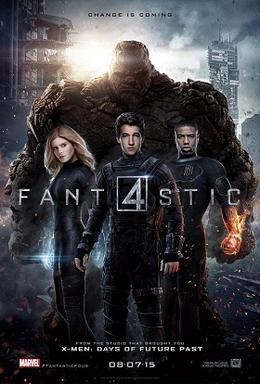
Behind the film
- Year
- 2015
- Director
- Josh Trank
- Writers
- Jeremy Slater, Simon Kinberg, Josh Trank
- Runtime
- 1h 40m
- Genres
- Superhero, Action, Science fiction, Adventure
- Production
- Marvel Entertainment, Marv Studios, 20th Century Studios
- Country
- United States
- Cast
- Miles Teller, Michael B. Jordan, Kate Mara, Jamie Bell, Toby Kebbell, Reg E. Cathey, Tim Blake Nelson
About the film
Contains story spoilers.
Teenage inventors Reed Richards and Ben Grimm attract the Baxter Foundation’s attention with a teleportation project. They join Sue and Johnny Storm and Victor von Doom in developing a dimensional gateway. Reed, Ben, Johnny and Victor make an unsanctioned journey to Planet Zero; a catastrophe alters Reed, Sue, Johnny and Ben, giving each uncontrolled abilities. Reed escapes custody to seek a cure, but the military finds him and forces him to help rebuild the gateway. Victor returns changed and decides to destroy Earth to protect his new world. The four pursue him through the portal and stop the attack, with Ben defeating Victor and Johnny closing the gate. Back on Earth, the group receives a base where they can study their powers, and they choose to work together as the Fantastic Four.
Josh Trank’s Fantastic Four approaches the familiar team origin through a cooler, more contained science-fiction register. The characters begin as gifted young people drawn to a technical problem, and their transformation follows from curiosity and ambition rather than a conventional public-facing superhero mission. That choice shapes the film’s atmosphere. Laboratories, institutional spaces and controlled tests matter as much as the action sequences, because the story is interested in what happens when discovery turns into something that can be measured, owned or weaponised. The genre promise is adventure, but the early emphasis is on the unease of crossing a boundary before anyone knows what lies beyond it.
Reed and Ben’s friendship provides an emotional starting point for the ensemble. Reed’s restless intelligence and Ben’s grounded loyalty make the project feel personal before it becomes institutional. Miles Teller plays Reed as someone whose ideas can outrun his ability to anticipate their consequences, while Jamie Bell brings Ben a quieter steadiness. Their bond carries tension because scientific invention changes more than a research career: it alters the shape of trust between collaborators. The film gives that friendship a serious tone, interested in how people remain connected when their bodies, futures and sense of agency no longer match.
Sue Storm’s intelligence is essential to the team’s scientific and emotional balance. Kate Mara’s Sue is not merely present to complete a roster; she has technical insight and a perspective that changes how the others approach their work. Johnny, played by Michael B. Jordan, introduces a more impulsive relation to authority and risk. The siblings’ differences help the ensemble avoid being four interchangeable origin stories. They bring family history into a setting that might otherwise privilege invention alone, and their distinct responses make the group’s eventual cooperation feel like something that must be built rather than assumed.
Toby Kebbell’s Victor von Doom represents a darker version of the film’s intellectual ambition. The project begins with minds that want to go beyond known limits, but Victor’s investment in recognition and control turns possibility into entitlement. That contrast gives the story a useful thematic line even when the pace shifts sharply. The film asks what responsibility accompanies access to extraordinary knowledge, and whether a person can separate discovery from the desire to dominate its outcome. Doom is not simply a villain who appears from nowhere; he is a warning about ambition severed from the mutual obligations that make collaboration possible.
The transformation premise gives the film room to treat superpowers as disruptions before they become tools. Each ability changes the body in a different way, and the characters do not immediately gain a comfortable identity to match it. That emphasis makes the film’s version of the team feel less like a celebration of instant mastery and more like a story about unwanted visibility, confinement and adaptation. Government interest becomes part of that pressure. The characters are not just learning what they can do; they are also discovering how institutions respond when a person becomes difficult to classify and potentially useful.
Visually, the movie leans into muted colours, industrial settings and a sense of controlled space. The aesthetic distinguishes it from brighter, more openly playful superhero stories, supporting the theme of people being studied or contained. The gate itself is less a magical doorway than an engineered threshold, with the promise and danger of a research experiment that has escaped its safety assumptions. That look gives the film a serious, sometimes austere texture. It encourages viewers to consider the physical and ethical consequences of exploration rather than treating another dimension as simply an exciting backdrop for action.
The ensemble’s final identity matters because it turns isolation into a choice to cooperate. The title is not just a brand attached to four powers; it names a group that can only function when its members accept that they are connected. The film’s route to that point is unevenly paced, but its central concern remains clear: extraordinary abilities do not automatically create a team, and a shared crisis does not guarantee trust. The characters have to move from being individuals shaped by an experiment toward a collective capable of using its differences. That distinction is the most human element in a story built around an impossible scientific event. The idea of a team becomes meaningful only when they treat one another as partners rather than as equipment or evidence.