
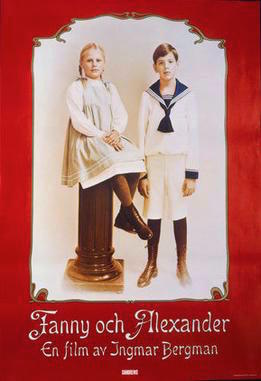
Behind the film
- Year
- 1982
- Director
- Ingmar Bergman
- Writers
- Ingmar Bergman
- Runtime
- 188 minutes (theatrical version)
- Genres
- Drama, Christmas, Historical
- Production
- Gaumont
- Country
- France, Germany, Sweden
- Cast
- Pernilla Allwin, Bertil Guve, Gunn Wållgren, Ewa Fröling, Jan Malmsjö, Allan Edwall, Jarl Kulle, Erland Josephson
About the film
Contains story spoilers.
The theatrical cut follows siblings Fanny and Alexander Ekdahl through the contrasting worlds of their family and a bishop’s household. Their prosperous relatives are connected to a theatre, and the Christmas gathering is full of meals, games and strong personalities. Their father Oscar manages the theatre and performs in its productions, but after his sudden death their mother Emilie marries Bishop Edvard Vergérus. The children move into his strict home, where Alexander’s imagination becomes a source of conflict. Family friend Isak Jacobi helps them escape to his house. Emilie has put a sedative into Edvard’s drink; an overturned lamp starts a fire that kills the bishop. The children return to the Ekdahls, where family life and theatre resume, though Alexander remains troubled by what he has experienced.
The two households are built around different ideas of what a child should be allowed to experience. The Ekdahl world is crowded, theatrical and imperfect; the bishop’s home is controlled by religious discipline and adult authority. Their contrast gives the film a spatial language for freedom and constraint without reducing either place to a simple moral diagram. Warm abundance can include selfishness and secrets, while austerity can present itself as virtue. The children’s wellbeing depends on more than material comfort: it also depends on whether adults permit imagination, disagreement and emotional complexity. Bergman makes domestic architecture part of the drama, so rooms feel like forces shaping the people who inhabit them.
Alexander is a storyteller, and his imagination is both a resource and a risk. Adults may call a child’s invention false, but the film treats it as one way he tries to interpret a world he cannot control. His stories can exaggerate or provoke, yet they also give him a vocabulary for fear and resistance. This does not make every claim he makes literal or turn fantasy into proof. It means that the boundary between a child’s inner life and adult reality is unstable, especially when authority demands obedience without explanation. Alexander’s point of view gives the film room for ghosts and uncanny coincidences while keeping the emotional source grounded in a boy’s attempt to make sense of loss and power.
Fanny’s relative quietness is a meaningful counterpoint to her brother’s verbal inventiveness. The film does not require her to compete with Alexander’s imagination to make her presence matter. She shares the upheaval and carries it in a more watchful manner, reminding the audience that children can respond differently to the same adult world. Her name in the title promises equal importance, even though Alexander’s perspective often leads the action. That balance creates an interesting tension: the film is partly about how a family sees its children and partly about the limits of what adults can know about them. Silence is not absence of feeling; it can be a form of attention and self-protection.
The adult ensemble is deliberately messy. Helena holds familial authority but also private longings; Gustav Adolf, Alma, Carl and Lydia each bring appetites, embarrassments and compromises into the household. They do not form a uniformly virtuous refuge. Instead, the family’s value lies in its width: several temperaments and moral imperfections can coexist without one person’s rules becoming absolute. The theatre extends that quality. Performance offers a shared activity while making identity feel changeable and constructed. A family can have roles without being trapped by them, and its stories can be revised as new generations arrive. Against the bishop’s fixed hierarchy, the Ekdahls’ disorder looks less like an ideal than a necessary breathing space.
Bergman’s visual design makes colour and objects carry emotional associations. Christmas abundance fills the screen with fabric, food, candlelight and movement; the bishop’s spare rooms narrow that visual field. A magic lantern and theatrical settings introduce images within images, inviting viewers to consider how stories shape what people believe. These choices connect the film’s historical household to its interest in memory and performance. They also help explain why the film feels like a recollection rather than a fast sequence of plot turns. Details accumulate and later return with altered significance. The theatrical version condenses a longer television work, but still preserves a richly textured sense that family life exceeds the events a summary can list.
The ending restores the Ekdahls’ shared life without pretending that the children have returned unchanged. A proposed play and a new birth gesture toward continuity, while Alexander’s unease keeps the experience of harm present. Art offers the family a way to imagine what comes next, not a guarantee that painful events can be undone. That distinction gives the conclusion its warmth and its shadow. Family affection can repair a sense of belonging, but it cannot command a child’s interior world to reset. The film leaves supernatural possibility open alongside ordinary grief, respecting the fact that both can inhabit a person’s memory. Its hope depends on making room for complexity rather than forcing a neat emotional resolution. A performance can give a community shared language; its value lies in making difficult feelings approachable, not in pretending that stories have erased their consequences.