
Behind the film
- Year
- 2004
- Director
- Michael Moore
- Writers
- Michael Moore
- Genres
- Documentary
- Production
- Dog Eat Dog Films
- Country
- United States
- Cast
- Michael Moore
About the film
Contains story spoilers.
Fahrenheit 9/11 is an openly argumentative documentary, with Michael Moore directing, writing and placing his own voice at the centre of the film. It is organised around his criticism of the Bush administration and the Iraq War, rather than around an attempt to provide a complete, neutral account of American politics. That position matters when approaching its material. Documentary images can carry a powerful impression of direct access to events, but the account formed from those images still depends on selection, sequence and explanation. The film’s subject is political power, and its method is to challenge how that power makes its decisions intelligible to the public.
Moore begins with the disputed 2000 election, then examines the response to September 11. He argues that political and business connections shaped decisions, and that fear helped secure public support for government policy. The film moves towards the Iraq War, contrasting official presentations with recruitment, service and grief. Lila Lipscomb’s loss of her son provides a personal centre for its questions about military sacrifice. These elements form Moore’s case against the administration, rather than a sequence of conclusions independently established by this article. The documentary finishes by asking why some Americans bear the dangers of policy more directly than the people who make it.
The movement from public ceremony to private consequence gives the argument its basic structure. Political language often works at a scale where individuals become a population, an electorate or a military force. A grieving parent cannot be contained comfortably within those categories. The film uses that mismatch to ask what disappears when events are described only through strategic aims and official statements. Its emotional force is connected to a change in distance: a policy can seem manageable from the place where it is announced and devastating from the place where its costs arrive. That contrast is central to how Moore tries to redirect the viewer’s attention.
His commentary also guides the meaning of archive footage. A familiar image may become comic, sinister or embarrassing when placed beside another image or introduced with a pointed question. That is an ordinary power of editing, and recognising it is important to understanding this particular documentary. An excerpt is evidence that something was recorded; the argument created around it requires a further judgement about context and implication. The viewer therefore has two tasks at once: noticing what the material shows and considering how Moore uses it. The distinction does not make documentary storytelling illegitimate. It makes its construction something to examine rather than something the camera automatically settles.
Satire gives the film another route into political criticism. Humour can puncture the solemnity that surrounds an office or a public statement, making powerful people available to scrutiny instead of treating their status as protection from it. Yet ridicule is persuasive in a different way from a documented causal argument. A person can look absurd in a selected moment without that moment proving every claim attached to them. The film’s shifts between comedy and serious suffering make that difference particularly important. Its sharpness can draw attention to a question, while the question still needs to be distinguished from an answer. Emotional and comic effectiveness are parts of the rhetoric, not substitutes for verification.
Moore’s on-screen presence makes the process of asking questions visible. Rather than presenting a voice with no body or position, he becomes a participant in the encounters through which his argument develops. That approach can give institutional resistance a concrete form: a person is trying to obtain a response, and another person decides whether to provide one. It also means the filmmaker’s own choices belong to the material under consideration. The situations he sets up and the questions he selects direct what becomes possible within an encounter. Understanding his role helps explain the film’s character as advocacy, with a recognisable author actively working to move an audience towards his conclusion.
The passages about military service bring that advocacy into contact with uneven opportunity and obligation. The film asks who is encouraged to take on physical danger and who remains insulated from it. That is a question about the organisation of sacrifice as well as the justification offered for a particular war. Lipscomb’s presence gives the inquiry a person whose grief cannot be reduced to a debating point without losing something essential. The documentary’s emotional pressure comes partly from asking political argument to remain answerable to that grief. It invites attention to lives affected by decisions while also requiring care about how those lives are used within a persuasive work.
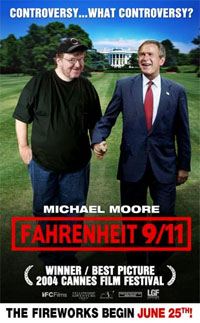
The Cannes Palme d’Or connects Fahrenheit 9/11 with a major moment of recognition for Moore’s filmmaking, but an award is not a verdict on every claim the film makes. Its value as an object of discussion lies in the way political footage, personal testimony, satire and an author’s argument are brought together. Viewers can examine both the questions it raises and the force of the methods used to raise them. The documentary offers a pointed account of its political moment, not an exhaustive history that closes further inquiry. Approaching it that way allows its anger and compassion to remain visible without confusing a powerful presentation with the final word on the events it addresses.