
Behind the film
- Year
- 1997
- Director
- John Woo
- Writers
- Mike Werb, Michael Colleary
- Genres
- Action, Thriller, Crime, Action thriller
- Production
- Paramount Pictures, Touchstone Pictures
- Country
- United States
- Cast
- John Travolta, Nicolas Cage, Joan Allen, Gina Gershon, Dominique Swain, Alessandro Nivola, Nick Cassavetes, Robert Wisdom
About the film
Contains story spoilers.
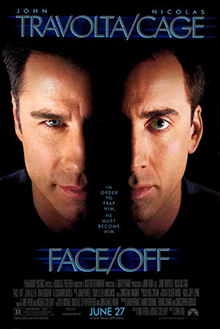
Face/Off gives an action thriller a premise that turns recognition against the people relying on it. John Travolta and Nicolas Cage play Sean Archer and Castor Troy, an FBI agent and a terrorist whose conflict becomes a literal exchange of appearances. John Woo directs from a screenplay by Mike Werb and Michael Colleary. The impossible procedure is a device for putting identity under pressure, rather than an invitation to think of the story as plausible surgery. If a face can be borrowed, the signs by which colleagues and family recognise someone become unsafe. The film builds its extravagant action around the fear of being known incorrectly.
Archer’s pursuit of Troy follows the killing of his son. With Troy in a coma, Archer takes his appearance to extract a bomb’s location from Troy’s imprisoned brother. Troy wakes, acquires Archer’s face and eliminates the people who know about the procedure. Archer escapes prison and eventually convinces his wife Eve to verify the deception through blood evidence. Their struggle culminates in a church confrontation and a boat chase, after which Archer kills Troy and recovers his own appearance. Keeping a promise to the dying Sasha, Archer and Eve adopt Troy’s son Adam. The ending joins restored identity with a new responsibility towards his enemy’s child.
The dual performances make that exchange more than a visual trick. Each actor has to present a character whose outward appearance belongs to the other performer’s original role. Gesture, rhythm and appetite become clues to the person beneath the borrowed face. The viewer is asked to track a continuity that other characters cannot easily recognise. That creates a particularly charged form of suspense: a conversation can be dangerous even before a weapon appears because one participant misunderstands who is speaking. The actors’ contrasting energies also let the swap expose what a familiar body can conceal. Looking right and behaving right no longer mean the same thing.
Archer’s professional mission already carries a private grief, so taking Troy’s place puts him inside the identity most closely associated with that grief. It is a deeply hostile disguise. His survival requires him to move through a world organised around the man he hates, while his own world is being occupied in his absence. That reversal changes the nature of his pursuit. He cannot simply capture a criminal and return to a stable life; he has to recover the possibility of returning at all. The job has threatened the family before the procedure begins, and the exchange makes that threat into something intimate enough to enter the household wearing his face.
Eve’s position gives the deception an emotional cost beyond the stolen credentials. A loved person is not recognised through a face alone, yet appearance can strongly influence how changes of behaviour are interpreted. The film turns that everyday reliance into a nightmare. Trust becomes difficult because familiar signs seem to certify an unfamiliar personality. Eve’s eventual role also means Archer cannot reclaim himself entirely through force. He needs someone capable of recognising a contradiction and acting on it. Her judgement connects private knowledge with concrete verification, creating a route back to identity that the spectacular technology of the premise has made necessary.
Sasha and Adam complicate the original division between the hero’s world and the villain’s. Entering Troy’s surroundings exposes Archer to people whose attachment to Troy does not make them interchangeable with his crimes. Adam, especially, brings the story towards a responsibility that revenge cannot resolve. A child’s future should not be defined by the identity of his father, and Archer’s own loss gives that possibility an additional emotional pressure. The film allows the hero’s time inside the enemy’s world to produce care as well as danger. He can reject Troy while recognising obligations towards someone Troy has left vulnerable.
Woo’s action gives those emotional stakes an excessive, almost operatic form. Gunfire, bodies in motion and sustained confrontations turn the identity conflict into something physically expansive. The scale is appropriate to a story in which an ordinary assurance has been broken at its root: the person visible before you may be the person pursuing your destruction. The church setting brings another charged environment into the violence, placing weapons and rivalry inside a space associated with protection and ritual. The film’s heightened style does not make the feelings smaller. It gives grief, hatred and the desire to return home a setting large enough to express their extremity.
The adoption at the end changes the shape of restoration. Archer does not simply recover his previous appearance and resume a life untouched by the ordeal. He brings a new person into the family, converting a connection to Troy into an opportunity to care for someone outside the old rivalry. That choice distinguishes recovery from the completion of revenge alone. Face/Off combines its outrageous premise with a persistent question about how identity is demonstrated. A face can be stolen, a reputation can be occupied and a role can be performed. What remains harder to counterfeit is the pattern of commitments through which a person chooses what to do for others.