
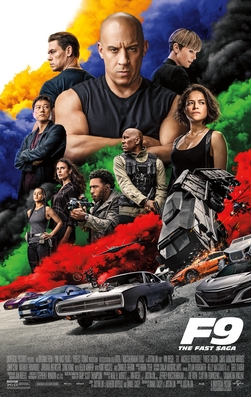
Behind the film
- Year
- 2021
- Director
- Justin Lin
- Writers
- Daniel Casey, Justin Lin
- Runtime
- 2h 23m
- Genres
- Action
- Production
- Universal Pictures, Original Film
- Country
- United States
- Cast
- Vin Diesel, Michelle Rodriguez, Tyrese Gibson, Ludacris, John Cena, Jordana Brewster, Nathalie Emmanuel, Sung Kang
About the film
Contains story spoilers.
Dom and Letty leave retirement when Mr. Nobody's crashed plane reveals a threat involving Dom's brother Jakob and Project Aries, technology capable of commandeering weapons systems. The pursuit leads through Montequinto, London, Edinburgh and Tokyo. Han, whose death was staged, has been protecting Elle, the project's biological activation key. Jakob reveals that their father's fatal racing accident followed his own instruction to sabotage the car for a financial scheme, overturning Dom's belief that Jakob deliberately killed him. Financier Otto betrays Jakob for Cipher; the brothers cooperate to stop Aries. Roman and Tej destroy its satellite using a rocket-powered car, while Dom defeats Cipher's drone. Otto dies, Cipher escapes, and Dom gives Jakob a chance to disappear. The reunited crew returns to a family barbecue.
The word family carries an unusual amount of weight in this series, and F9 puts pressure on who gets to define it. Dom's authority often appears inseparable from loyalty: he knows the people he protects and treats that knowledge as a foundation for certainty. A brother who falls outside the familiar circle complicates that image. The conflict is personal enough to make the international threat feel like an extension of an unfinished argument, but it also raises a less comfortable question about the hero's judgment. Being devoted to a family does not mean understanding every person in it correctly. The film finds room for a distinction between fierce affection and the confidence that your version of the past must be the complete one.
John Cena's Jakob gives that argument a physical shape. He has the size and self-possession to stand opposite Vin Diesel without making the confrontation feel like an encounter between a patriarch and an insignificant challenger. Their similarity is part of the tension. Each projects a determination that can look admirable from one angle and immovable from another. The emotional problem therefore cannot be resolved merely by establishing which brother is stronger. It concerns how pride can harden an interpretation until revisiting it feels like a surrender of identity. Jakob's place in the story asks Dom to distinguish an enduring bond from an enduring verdict. That is a useful complication for a franchise whose heroes often express their deepest convictions with very little room for doubt.
The wider crew keeps the film from becoming a closed conversation between two men. Letty and Mia bring relationships that have their own history and claims on the family, while Roman, Tej and Ramsey contribute different ways of responding to its increasingly extravagant emergencies. The ensemble's familiarity gives the action a shorthand: characters can disagree, joke or take on a specialised role without needing an entirely new introduction. That ease matters because the plot travels quickly and asks the audience to accept a great deal. The crew supplies a human rhythm underneath the machinery. Their sense of belonging is not identical to Dom's authority, even when they support him, and the best way to understand their function is as a network rather than an extension of one man's will.
Han's presence also makes continuity part of the film's emotional material. An established audience brings memories that a returning character can activate immediately; a newcomer instead encounters another person whose relationships matter to the group. Those two ways of watching are different, and the film often works through the distance between them. Its plot must explain enough to support the immediate mission while its reunions rely on accumulated affection. That gives F9 the character of a gathering as well as an adventure. The people on screen carry traces of earlier stories into this one, so belonging can be conveyed through recognition rather than exposition alone. It is worth expecting that cumulative texture without mistaking every familiar face for a necessary piece of prior homework.
The action treats physical possibility as an invitation to escalate rather than a boundary to obey. Cars remain the signature objects, but their function stretches far beyond transport or competitive driving. They become tools for turning a difficult environment into a stunt, with technology offering fresh ways to rearrange the space around them. That makes the spectacle operate by its own comic-book confidence. Its central question is usually how boldly a familiar machine can be repurposed, not whether a viewer could reproduce the manoeuvre. The exaggeration belongs to the film's identity and should be understood as fantasy. Trying to read the sequences as a practical account of mechanics or space travel would miss the terms on which the adventure asks to be followed.
Comedy helps the ensemble negotiate that exaggeration. An anxious observation or an incredulous reaction can acknowledge the scale of a situation without stopping the film to explain it away. Roman's position within the group is particularly useful to that rhythm because absolute confidence would leave less room for a human response to the absurd. The humour also prevents technical vocabulary from becoming the only way into a scene. You do not need to understand an invented weapons programme in detail to understand a friendship, a complaint or the fear of being assigned the most dangerous job. The film's two registers depend on one another: outrageous action supplies the occasion, and the group's conversation keeps the occasion attached to recognisable personalities.
Under all that expansion, F9 remains concerned with a familiar question about second chances. Its heroes can perform enormous feats, but their emotional credibility depends on whether they can revise the stories they tell about one another. Forgiveness becomes more complicated when it asks someone to recognise a mistake in his own certainty. The film's family language makes that recognition possible without presenting the past as irrelevant. Old wounds still matter; what changes is the claim that those wounds must determine every future choice. That connection between an extravagant external mission and an intimate reassessment gives the adventure its basic shape. The spectacle keeps getting bigger, while the central difficulty remains something much smaller and more human: allowing a relationship to become more than its worst remembered moment.