
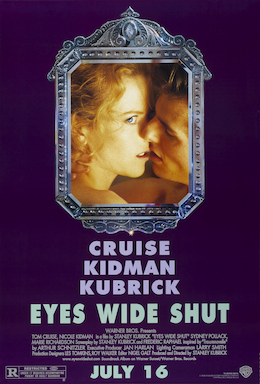
Behind the film
- Year
- 1999
- Director
- Stanley Kubrick
- Writers
- Stanley Kubrick, Frederic Raphael
- Runtime
- 2h 39m
- Genres
- Mystery, Drama, Thriller, Erotic thriller
- Production
- Warner Bros. Entertainment
- Country
- United Kingdom, United States
- Cast
- Tom Cruise, Nicole Kidman, Sydney Pollack, Todd Field, Vinessa Shaw, Marie Richardson, Rade Šerbedžija, Julienne Davis
About the film
Contains story spoilers.
Eyes Wide Shut begins with a marriage that looks comfortable from the outside. Bill Harford is a doctor, Alice has worked in the art world, and they live with their daughter Helena in an apartment where professional success seems to have provided security. A Christmas party at Victor Ziegler's home introduces more private negotiations beneath that surface. Both spouses encounter flirtation, while Bill is called away to help a woman who has overdosed upstairs. His medical usefulness admits him into a room whose circumstances he is expected to keep confidential. The invitation already links his comfortable social position to the discretion richer people require.
The decisive disturbance comes at home, when Alice challenges Bill's assumptions about desire. He believes her fidelity is something he can understand through simple differences between men and women, but she describes a fascination with a naval officer during a holiday that unsettles that certainty. Nothing needed to happen for the thought to matter. Nicole Kidman's pauses and shifts of tone make the conversation difficult to turn into a reassuring confession. Bill hears an imagined alternative life as a threat to the life he occupies, and the images he subsequently constructs become almost as invasive as anything he actually encounters in the city.
Called to the home of a patient who has died, Bill receives an unexpected declaration from the man's daughter. The encounter places desire beside grief rather than giving him the simple adventure his jealousy might encourage. His later walk introduces another possibility when a sex worker named Domino invites him inside, but Alice's telephone call interrupts the visit. Tom Cruise gives Bill a professional politeness that persists even when he has no idea how to behave. His habit of presenting himself as a doctor repeatedly helps him enter places, yet provides no dependable understanding of the people he meets once he is there.
An encounter with his old friend Nick Nightingale takes the night toward a more secretive setting. Nick plays piano at private gatherings and reveals enough about an upcoming engagement for Bill to become curious. A costume hire, a password and a journey out of the city let him cross a threshold he mistakes for a challenge he can manage. The masked ceremony removes ordinary signals of identity while making hierarchy unmistakable. Its controlled movement, music and formal questioning turn spectatorship into exposure when Bill is identified as an intruder. A woman intervenes on his behalf, leaving him with an obligation whose meaning he cannot establish.
The following day does not reliably explain the night. Bill revisits people and places, but each return produces a different uncertainty: Nick has been taken away, the costume shop's apparent scandal has become an arrangement, and Domino's absence brings news that changes the meaning of the risk he nearly took. A written warning tells him to abandon his investigation. These encounters make the city feel less like a route toward revelation than a series of doors closing after him. Christmas lights continue to glow through rooms and streets, maintaining a festive surface while his increasingly repetitive questions expose how little authority he actually possesses.
Ziegler eventually offers an account of the gathering and the woman's fate, presenting the events as less mysterious and less dangerous than Bill believes. His explanation may be reassurance, manipulation or some mixture of the two; the film does not grant him the status of an impartial narrator. Sydney Pollack's relaxed manner gives the scene its pressure, because Ziegler can describe disturbing circumstances as something a sensible person should stop worrying about. Bill's professional access has brought him close to wealth without giving him an equal place within it. Knowing a powerful man's secrets is different from knowing what that man will do with yours.
The mask on the pillow beside the sleeping Alice shifts the crisis back into the marriage. Whatever Bill can establish about the outside world, the concealment at home has become impossible to sustain. His confession and Alice's account of a troubling dream make imagined acts and actual experiences sit beside one another without cancelling their differences. Kubrick's measured pace encourages that uncertainty: a pause or repeated phrase can become more unsettling than a direct threat. The masked gathering is the film's most conspicuous mystery, but the slow encounters around it keep returning to a more ordinary failure to know another person completely.
The final visit to a toy shop places Bill and Alice back among the routines of family life, where the possibility of remaining together requires a more modest kind of certainty. Their conversation does not solve the gathering or erase the night; it acknowledges that surviving their experiences does not mean understanding every part of them. The film's movement from a grand party to this public, ordinary space makes status feel less useful than attention. Beneath its elaborate ritual imagery, Eyes Wide Shut follows a man learning that his wife has an inner life his confidence has not accounted for, and that intimacy cannot be preserved solely through assumptions.