
Behind the film
- Year
- 2014
- Director
- Ridley Scott
- Writers
- Adam Cooper, Bill Collage, Jeffrey Caine, Steven Zaillian
- Genres
- Historical, Fantasy, Sword-and-sandal, Action
- Production
- 20th Century Studios
- Country
- United States, United Kingdom, Spain
- Cast
- Christian Bale, Joel Edgerton, John Turturro, Aaron Paul, Ben Mendelsohn, Sigourney Weaver, Ben Kingsley
About the film
Contains story spoilers.
Exodus: Gods and Kings puts a relationship inside an imperial crisis. Moses and Ramesses begin within the same royal world, but the question of who belongs there eventually divides them. That division gives the story a personal route into a much larger conflict about enslavement and freedom. An appeal to familiarity might ordinarily soften a dispute between two people. Here, familiarity makes the dispute more painful without making the demand less necessary. The film asks what happens when somebody once trusted by a ruler comes to represent people whose liberation would challenge the foundations of that ruler's power and inherited sense of entitlement.
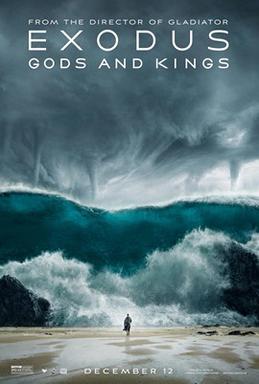
Ridley Scott directs the 2014 biblical epic, with Christian Bale as Moses and Joel Edgerton as Ramesses. Its screenplay is credited to Adam Cooper, Bill Collage, Jeffrey Caine and Steven Zaillian. The source is the biblical Exodus narrative, but this is a particular dramatic adaptation rather than an authoritative account of scripture or ancient Egyptian history. The distinction matters because the film's personal encounters, visual explanations and character motivations belong to its construction. They offer a way to enter this version of the story without requiring a viewer to treat every invention as an element shared by all religious traditions or historical scholarship.
Moses learns of his Hebrew origins, is exiled and builds a family with Zipporah. A divine messenger calls him back to free the enslaved Hebrews. Ramesses refuses, resistance gives way to catastrophic plagues, and the death of Egypt's firstborn finally brings permission to leave. Ramesses then pursues the departing people. A passage through the sea allows their escape before the returning water overwhelms his army. Moses reunites with his family and receives the commandments. The later image of continued travel keeps liberation from being confused with an immediate arrival in a secure and completed future.
The discovery of Moses's origins changes his position without making his earlier life unreal. He has been formed by the household whose authority he will oppose. That gives the confrontation a tension beyond the meeting of two already separate camps. Recognising an injustice can require somebody to revise the loyalties through which they understood themselves, especially when those loyalties supplied comfort and status. The film turns identity into a practical responsibility: knowledge about where Moses came from raises a question about what he will now do. Discovery alone cannot liberate anyone. It must become action, and action creates consequences for the relationships that supported his previous life.
Ramesses's refusal makes political authority difficult to separate from personal humiliation. A demand that subjects be released can look, from the throne, like a challenge to the ruler's right to decide anything. That interpretation gives compromise an additional obstacle. The question is no longer only whether a particular arrangement should change; it becomes whether agreeing to change would expose the ruler as somebody capable of being opposed. The film's conflict can therefore be approached through the narrowing effect of power. A leader with many apparent choices can become trapped by the insistence that only one kind of answer will preserve his position.
The plagues widen the consequences beyond the two central men. An argument conducted by leaders becomes suffering experienced by people who do not control the argument. This is one reason the spectacle needs to be read with attention to scale. Large images can make destruction legible, but they can also encourage a viewer to regard individual losses as components of a dramatic sequence. The family connections resist that simplification. A victory in the larger struggle can remain devastating to a parent inside it. The film's account does not remove that tension by allowing liberation to make every intervening consequence emotionally straightforward or easy to explain.
Moses's departure from domestic life introduces another cost of leadership. His obligations do not belong to only one community, and responding to one can take him away from another. The story does not need that conflict to become a rejection of the liberation itself. It gives the liberation a human scale by showing that a mission can be necessary without becoming simple for everyone connected to the person undertaking it. The movement from household to wilderness also changes what authority looks like. People travelling towards freedom need direction, but their future cannot be reduced to reproducing the certainty and command they have just escaped.
The sea crossing supplies the epic's most direct image of a route appearing where continued movement seemed impossible. It resolves the immediate pursuit while leaving the wider journey open. That combination is central to understanding this adaptation: release from an oppressive arrangement and possession of a settled future are different achievements. Exodus: Gods and Kings works through the friction between personal loyalty, divine instruction and political force. Its world is most intelligible when those pressures remain distinct, allowing the story's grand scale to sit alongside the unresolved work of living after the moment that makes freedom possible.