
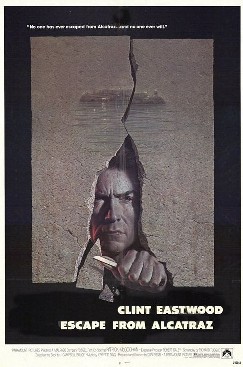
Behind the film
- Year
- 1979
- Director
- Don Siegel
- Writers
- Richard Tuggle
- Genres
- Action, Prison, Drama
- Production
- Paramount Pictures, Malpaso Productions
- Country
- United States
- Cast
- Clint Eastwood, Patrick McGoohan, Fred Ward, Larry Hankin, Jack Thibeau, Roberts Blossom, Bruce M. Fischer, Garry Goodrow
About the film
Contains story spoilers.
Escape from Alcatraz makes attention its principal form of action. Don Siegel's prison drama follows men who must notice what an institution assumes they cannot change. The setting imposes routines, barriers and scrutiny, while the central character begins looking at those same arrangements as things with limits. Clint Eastwood's Frank Morris does not need to explain every observation aloud for the film to establish that he is watching. Small changes become consequential because the audience learns to wait for them. The tension grows from the difference between an institution declaring itself secure and individuals quietly examining how that security actually works.
Morris arrives at Alcatraz in 1960 and meets inmates including English, Litmus and artist Doc. After the warden takes away Doc's painting privileges, Doc injures his own hand; later, Litmus collapses following the destruction of a flower. Morris plans an escape with brothers John and Clarence Anglin and fellow prisoner Butts. They conceal work on their cells and prepare dummies to disguise their absence. On the chosen night, Butts hesitates and stays behind while the other three reach the roof and leave the island. Morning exposes the deception. Debris is found, but no bodies establish their fate; the final images challenge the warden's certainty without confirming what happened to the fugitives after their departure.
Eastwood gives Morris a reserve that suits a story built around observation. Silence can suggest caution, calculation or resistance without settling which feeling is uppermost. That restraint also changes how the prison's authority reaches him. A demand for compliance may produce an outwardly manageable response while revealing little about what he intends. The audience consequently spends time reading behaviour rather than waiting for a declaration of purpose. His presence remains human in scale: the character's advantage is not unlimited physical power, but an ability to keep attending to details when the setting encourages everyone to accept its rules as permanent facts.
Patrick McGoohan's warden gives those rules a personal representative. Authority appears in speech, inspection and decisions about privileges, with administrative control shaping the inmates' days as surely as walls do. His certainty makes the prison's reputation part of the conflict. To concede a vulnerability would threaten the image through which he understands his own power. McGoohan's composure can therefore feel oppressive even when the exchange is quiet. The film places that confidence beside Morris's watchfulness, creating a struggle over what each man believes he knows. One treats the system as settled; the other keeps looking for something that the settled account has overlooked.
The supporting inmates make confinement more than a puzzle about getting through a barrier. Paul Benjamin's English, Roberts Blossom's Doc and Frank Ronzio's Litmus bring different habits and forms of companionship into the institution. Painting and tending to a small living thing acquire weight in a setting that controls so much of ordinary life. These activities do not have to produce an immediate practical advantage to matter. They give a person something to care about beyond the next order. When that limited space is attacked, the cruelty lies partly in how small the concession already was. The film locates dignity in these modest forms of attachment.
The escape planning depends on cooperation without making trust effortless. Fred Ward and Jack Thibeau's Anglin brothers join Morris in a shared undertaking, while Larry Hankin's Butts makes hesitation part of the story. Each person's response can affect the others, and preparation cannot guarantee that everyone will make the same decision when the moment arrives. That uncertainty gives the group a different shape from a smoothly functioning unit. They are individuals agreeing to risk something together under pressure. The film can build suspense from their dependence on one another, because an action that seems manageable in advance may acquire another emotional meaning when it becomes immediate.
Ordinary objects carry an unusual dramatic burden. Something that appears unimportant within the prison's routines can become significant once the camera attends to what an inmate might do with it. This changes the viewer's sense of scale: a small alteration can feel as consequential as a large movement in a more openly spectacular thriller. Siegel sustains that relationship through sequences in which time and interruption matter. Progress must remain concealed, and the surrounding routines continue whether the work has succeeded or failed. The suspense comes from that coexistence, with the visible order of the prison running beside an undertaking that depends on remaining outside its notice.
Leaving the island does not give the film a conventional image of secure freedom. The bay opens the story into uncertainty after the prison has made certainty its defining claim. The difference matters: evidence that the system was penetrated is not evidence that everyone survived what followed. Keeping those questions separate gives the ending its force. The warden's account can be challenged without a new all-knowing account taking its place. Escape from Alcatraz is a dramatization rather than a confirmation of the fugitives' later lives, and its closing ambiguity belongs to that dramatic design. The men have acted against confinement, while the audience is left facing the distance between a departure it has witnessed and a future it cannot see.