
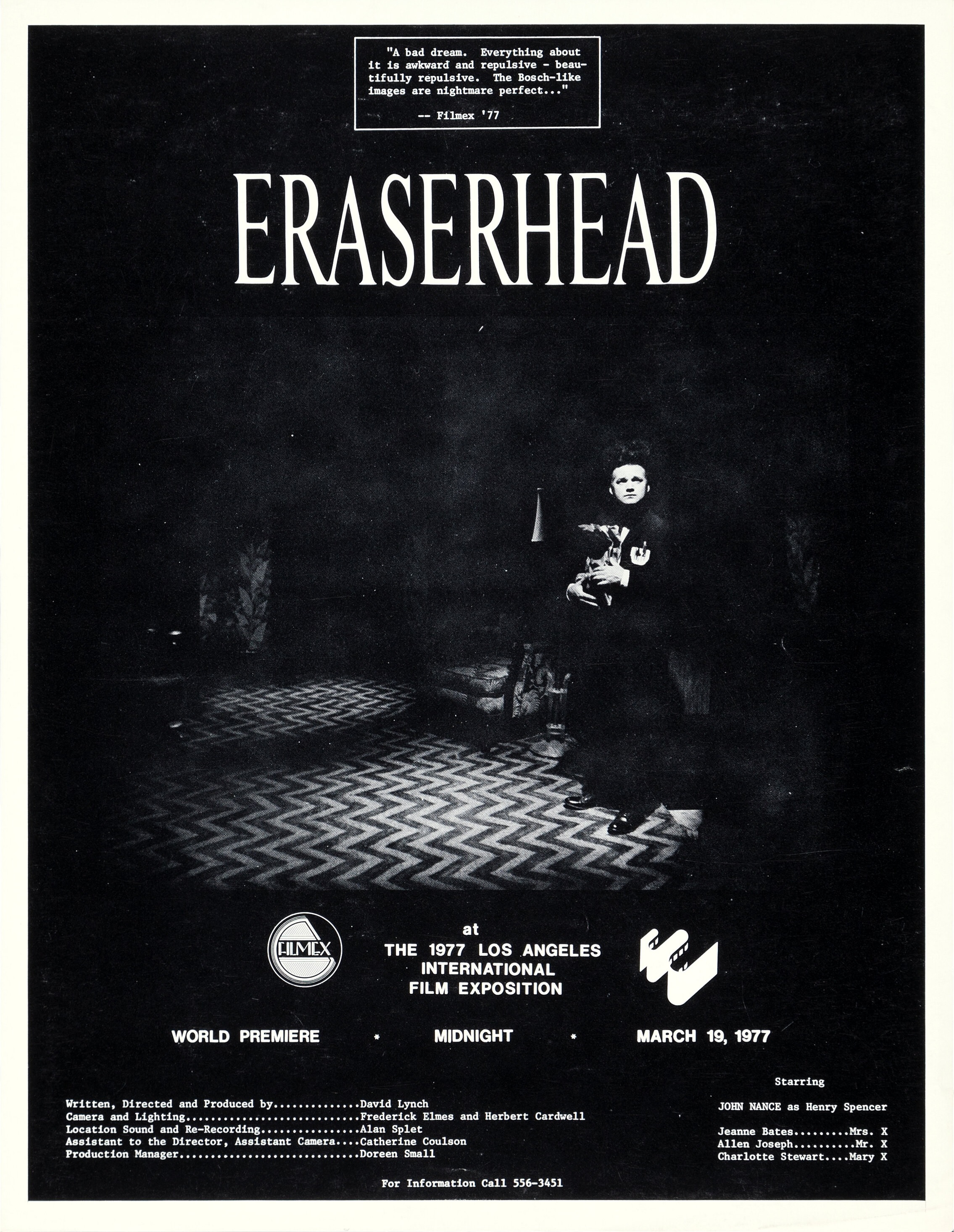
Behind the film
- Year
- 1977
- Director
- David Lynch
- Writers
- David Lynch
- Runtime
- 1h 29m
- Genres
- Body horror, Independent, Experimental, Thriller
- Production
- American Film Institute
- Country
- United States
- Cast
- Jack Nance, Charlotte Stewart, Jeanne Bates, Allen Joseph, Judith Anna Roberts, Laurel Near, Jack Fisk
About the film
Contains story spoilers.
Henry Spencer visits Mary X's family and learns she has borne a child of uncertain human form. They marry and care for it in his cramped apartment, but its ceaseless cries drive Mary away. Henry remains with the sick infant while visions interrupt his life: a woman in a radiator, creatures under her feet, and a dream in which his severed head becomes material for pencil erasers. An encounter with his neighbour offers no lasting escape. Henry cuts the child's bandages, exposing its organs, then wounds it with scissors. The room's power fails amid grotesque transformations, and a figure inside a planet struggles with sparking levers. The film ends with Henry embraced by the radiator woman in a white void, leaving the meaning of that apparent release unsettled.
The industrial setting gives the story a pressure that cannot be reduced to one immediate danger. Henry's surroundings seem hostile before anyone has explained why he should be afraid. That is crucial to the film's way of working: unease does not wait for a clearly identified antagonist. It can reside in the relation between a person and a room, or in the sense that ordinary activity requires an effort no one else acknowledges. The world feels difficult to inhabit rather than merely difficult to escape. Jack Nance's central figure is useful within that environment because his uncertain presence gives the strangeness somewhere to register. Henry often seems to be responding to expectations he cannot quite understand, even when those expectations concern supposedly ordinary adult life.
The black-and-white images make that uncertainty tangible. Texture, darkness and the shape of an object matter without needing colour to explain how they should feel. A familiar surface can look depleted or unusually alive; a shadow can deny the reassuring completeness of a room. The result is a visual world in which looking closely does not necessarily make something less disturbing. That is a different pleasure from solving a mystery whose clues all point towards one answer. The film invites attention to the character of an image, to what it does to the space around it and to the person occupying that space. Its craft allows a small environment to feel expansive in its implications while remaining oppressive in its immediate physical limits.
Sound deepens that effect by making the atmosphere difficult to ignore. The credited work of Alan Splet and Lynch gives the film a sonic presence that is part of its construction of space, not simply an accompaniment to action. An environment can continue to press on Henry even when very little visibly happens. That persistent pressure makes silence, interruption and repetition feel consequential. The viewer is encouraged to register the world through the body as well as through narrative understanding. It is possible to recognise anxiety in the sound without assigning every noise a precise symbolic translation. The film's unsettling quality depends partly on that difference between experiencing a thing and being able to offer an orderly explanation of it.
Domestic responsibility becomes especially troubling because it arrives without the emotional reassurance usually attached to family stories. Becoming a parent does not automatically make Henry feel capable, connected or at home. The demands placed upon him exist beside confusion and revulsion, which the film does not tidy away to preserve a comforting image of adulthood. That gives the bodily horror a relationship with ordinary expectation. A life can change through something everyone insists should have a familiar meaning, while the person living it experiences that meaning as unstable. Mary matters to the same tension: the domestic arrangement does not transform either participant into a secure ideal of what they are supposed to be. The film leaves their vulnerability inside the situation rather than outside it.
The visions resist being filed neatly into a separate dream world. Their force comes partly from how they seem to share the emotional material of Henry's surroundings while changing its form. Desire, disgust and the possibility of relief can become inseparable from images that should not coexist in ordinary space. That makes an interpretation based on anxiety about sex, parenthood or identity useful without making it the single permitted reading. The film provides material to think with, but it does not offer a key that cancels the experience once applied. Treating every object as a fixed code would risk making the world less strange than it is. The associations matter because they can remain active and troubling after a concise explanation has run out.
Eraserhead rewards a willingness to let the uncertain remain uncertain. Its disturbing actions are part of a constructed nightmare, and the closing image does not establish a simple moral outcome or a literal account of an afterlife. What connects its world is the persistence of feeling across changes in apparent reality. Henry's predicament becomes legible as vulnerability even when the environment refuses ordinary coherence. That is why the film can feel intensely personal without the viewer having to claim knowledge of Lynch's private intentions. It gives adult fear an unusual physical vocabulary and asks for attention to that vocabulary on its own terms. The lasting question concerns what a person experiences when the promises of intimacy, responsibility and escape no longer arrive in forms he can recognise.