
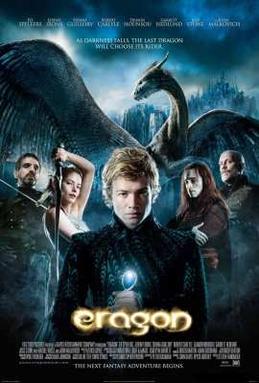
Behind the film
- Year
- 2006
- Director
- Stefen Fangmeier
- Writers
- Peter Buchman
- Genres
- Fantasy, Adventure, Action
- Production
- 20th Century Studios, RatPac-Dune Entertainment, Ingenious Media
- Country
- United Kingdom, United States, Hungary
- Cast
- Ed Speleers, Rachel Weisz, Jeremy Irons, Robert Carlyle, Sienna Guillory, John Malkovich, Alun Armstrong, Djimon Hounsou
About the film
Contains story spoilers.
Eragon begins with a discovery whose importance is much greater than its finder can understand. The egg connects an ordinary young life to a conflict already operating across the kingdom, so becoming exceptional does not give the protagonist control over when danger arrives. The people seeking the discovery understand its possible consequences before he does. That imbalance gives the fantasy adventure its early urgency. Eragon needs time to learn what he has become, while the surrounding powers treat him as somebody whose existence already requires a response, making education and pursuit develop together rather than in comfortable sequence. The uncertainty extends to the audience’s relationship with the landscape, which initially offers the pleasure of discovery while also containing histories and dangers the protagonist has not been taught to recognise. Familiarity must be acquired through relationships rather than assumed from the possession of power.
Stefen Fangmeier directs the 2006 film, with Ed Speleers as Eragon, Jeremy Irons as Brom and Rachel Weisz voicing Saphira. Sienna Guillory plays Arya, Robert Carlyle is Durza and John Malkovich plays Galbatorix. Peter Buchman wrote the screenplay from Christopher Paolini's novel. The film's Alagaësia has a fallen order of Dragon Riders and a resistance called the Varden. This account concerns the screen adaptation's events, which should not be completed through the novels' fuller continuity. Its world establishes enough history to explain the new Rider's significance while leaving him inside an unfinished conflict by the ending.
Arya sends an egg away before Durza captures her. It reaches Eragon and hatches into Saphira, whose bond with him makes him a Dragon Rider. The king's servants kill his uncle, and Brom guides him towards the resistance while teaching him to fight and control magic. Eragon's attempt to rescue Arya leads into a trap; Brom is fatally wounded during their escape. Murtagh helps them reach the Varden. During the attack on the rebels, Eragon and Saphira defeat Durza, and Eragon heals his injured dragon. The victory leaves Galbatorix alive and still possessing a dragon of his own.
The bond with Saphira makes power relational rather than something Eragon simply owns. His new ability depends on a companion who has her own presence within the story, so learning to act as a Rider involves learning how to respond to another being. That changes the conventional pleasure of discovering a special gift. The discovery can promise a larger life while also creating obligations the boy did not anticipate. The film makes the partnership central to its action, giving physical expansion through flight an emotional connection that would be absent if the dragon were merely transport or an impressive weapon.
Brom brings memory into that new relationship. He understands a lost order and the danger surrounding its return, placing Eragon's excitement beside knowledge acquired through earlier conflict. His guidance has to make that knowledge usable for somebody who cannot immediately share its full emotional weight. Training therefore concerns judgment as well as technique. A newly available power can be exercised before its cost has been understood, and the mentor's role is to make the protagonist recognise the difference between being capable of an action and knowing when the action can safely serve its intended purpose.
Arya's importance connects the discovery to another person's effort before Eragon knew the struggle existed. The egg reaches him because somebody has acted under pressure, making his apparent beginning part of an ongoing chain of responsibility. Her predicament later gives his desire to help an immediate object, but it also exposes the limits of enthusiasm without preparation. The rescue becomes a point where personal resolve and the enemy's planning intersect. Wanting to act for somebody does not remove the possibility of being manipulated through that desire, so the adventure makes care consequential without making it automatically wise.
Murtagh's relationship to the resistance introduces another difficulty in deciding whom to trust. A person's family history can shape how others judge him before his own actions have been allowed to carry much weight. The rebels need allies while fearing connections that could expose them, placing caution beside the risk of repeating a judgment based on inheritance alone. That tension gives the supporting character more than a convenient function as guide. His presence makes the story's claims about identity extend beyond the exceptional hero, asking whether other people can also be understood through what they choose to do.
The ending makes the defeat of one enemy a beginning rather than the completion of the world's repair. Eragon and Saphira have demonstrated that their partnership can act within the conflict, but they have not removed the power governing it. The final image of Galbatorix's dragon preserves that difference in scale. Fangmeier's adaptation closes around a first achievement and the losses required to reach it, leaving the hero changed without pretending that change settles the kingdom. The discovery has become a responsibility, and the film's final position is the moment at which its central companions can begin facing that responsibility with experience of their own.