
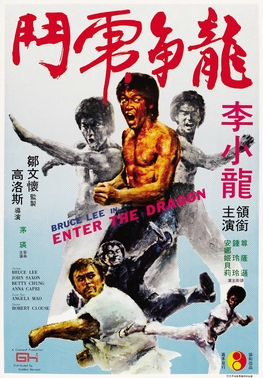
Behind the film
- Year
- 1973
- Director
- Robert Clouse
- Writers
- Michael Allin
- Runtime
- 98–99 minutes
- Genres
- Action, Thriller, Martial arts
- Production
- Warner Bros. Entertainment, Concord Production Inc., Sequoia Pictures
- Country
- United States
- Cast
- John Saxon, Jim Kelly, Ahna Capri, Shih Kien, Robert Wall, Bruce Lee, Bolo Yeung, Angela Mao
About the film
Contains story spoilers.
Enter the Dragon gives a tournament two functions. It provides a public occasion through which people can enter Han's island, and it gives Han a way of placing capable visitors inside a space he controls. The invitation promises competition, but the surrounding arrangements determine more than who will fight whom. Guests have to navigate a host whose wealth and authority can conceal what is happening beyond the event. That makes observation part of the protagonist's task. Being the better fighter will matter, yet he first needs to understand the institution in which the fighting has been invited to take place. The distinction gives the audience two ways to read a performance: as a display offered to the event and as an expression of somebody who may eventually refuse the purpose for which the event has assembled him.
Robert Clouse directs the 1973 film from Michael Allin's screenplay, with Bruce Lee as Lee, John Saxon as Roper and Jim Kelly as Williams. Shih Kien plays Han. The story combines a fictional intelligence assignment with martial-arts action, giving the tournament a mystery beneath its visible contests. Its characters arrive with different needs and vulnerabilities rather than sharing one purpose from the outset. The island brings those differences under a single authority, allowing competition, temptation and coercion to occupy the same setting. The problem is not simply defeating an opponent within the rules; it is discovering who controls the rules and what lies outside them.
Lee accepts a mission to investigate Han's island and learns that Han's bodyguard is connected to his sister's death. Among the visitors are Roper and Williams. Lee uncovers an underground criminal operation, while Han kills Williams and tries to recruit Roper. After Lee is captured, Roper refuses to fight him and defeats Han's enforcer. Mei-Ling releases prisoners who join the uprising. Lee pursues Han into a room of mirrors, breaks the reflections confusing him and kills him. The authorities arrive as Lee and Roper acknowledge one another across the aftermath, having helped turn the island against the man governing it.
Lee's personal grievance gives the investigation an additional urgency without making it identical to revenge. The connection to his family can focus his anger on one opponent, while the mission requires him to recognise a wider structure of harm. The film places both purposes in the same journey, making restraint and attention important alongside the ability to win a confrontation. A successful fight against somebody connected to a past loss would not, by itself, expose everything the island contains. The larger task needs the protagonist to remain aware of people whose suffering is not part of his own history.
Roper's vulnerability makes Han's offer a test of what security could mean. An opportunity supplied by somebody powerful may look useful to a man whose circumstances have left him exposed, but accepting it would bind his abilities to the operation he has begun to understand. His eventual refusal gives the story a different form of resistance from Lee's assignment. He did not arrive intending to investigate the host. He has to decide what to do with the knowledge acquired after entering, making moral action possible even for somebody whose first concern was his own precarious position.
Williams's fate makes the host's apparent hospitality impossible to separate from control. Wanting to leave is not enough when the person offering welcome also commands the means of preventing departure. The tournament's international visitors may appear to bring choice and variety to the island, yet their presence does not restrict Han's willingness to harm them. The film lets the attraction of a privileged environment become part of its danger. A place can display wealth, ceremony and confidence while denying the independence its guests assumed they retained when they accepted the invitation.
The final mirror room turns deception into a visual problem. The antagonist's multiplication through reflections makes perception unreliable at the moment when the protagonist most needs a clear opponent. The setting condenses a larger feature of the island: appearances have repeatedly obscured the source and extent of its violence. Breaking that visual arrangement allows the encounter to become direct. The sequence gives the martial-arts action a relationship to knowledge, showing why the ability to distinguish a real threat from its surrounding images can matter as much as the ability to respond once the threat is found.
The uprising expands the resolution beyond a single duel. People held under the island's authority become participants in its collapse, while Roper's choice and Mei-Ling's action give Lee's victory a collective setting. Han's defeat therefore changes the use of the space rather than simply determining the tournament's strongest competitor. Clouse's film makes its action serve an exposure of power, with the closing recognition between the survivors acknowledging more than their physical endurance. They have acted within different circumstances and arrived at a shared refusal, turning a place designed to subordinate visitors into one where its ruler can no longer define their available choices.