
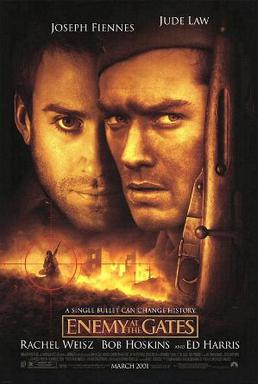
Behind the film
- Year
- 2001
- Director
- Jean-Jacques Annaud
- Writers
- Jean-Jacques Annaud, Alain Godard
- Runtime
- 2h 11m
- Genres
- War, Romance, Drama, Action
- Production
- Paramount Pictures
- Country
- France, Germany, United States, United Kingdom, Ireland
- Cast
- Jude Law, Joseph Fiennes, Rachel Weisz, Ed Harris, Bob Hoskins, Ron Perlman, Eva Mattes, Matthias Habich
About the film
Contains story spoilers.
Jean-Jacques Annaud’s Enemy at the Gates opens with Vassili Zaitsev arriving at Stalingrad as one of many replacement soldiers ferried across the Volga. The crossing and the first assault present a battlefield where survival is shaped by command as much as by enemy fire. Vassili is sent into the first assault with only rifle cartridges, then survives by using the wreckage around him. Political officer Danilov witnesses his skill and turns it into a public story, presenting the young soldier as a symbol who can steady the defenders.
That image brings Vassili attention and a new role. He becomes a sniper, moving through damaged buildings and rubble while Danilov uses newspapers and speeches to make each successful shot part of a larger propaganda effort. The two men become friends, but the relationship carries an imbalance: Danilov helps create Vassili’s reputation, while Vassili’s actual work supplies the evidence behind it. The film treats fame as both protection and exposure, since a celebrated sniper is also a target whose name gives the enemy a reason to seek him out.
The German command sends Major König, a skilled sniper, to eliminate Vassili and break the morale attached to his legend. Their conflict is shaped by patience and observation rather than conventional battlefield spectacle. Rooflines, empty windows, broken masonry and the delay before a shot make the city feel like a maze of possible sightlines. Koulikov, König’s former student, is sent to help Vassili but is killed by his old teacher. Vassili must continue after that attempt to match experience against experience has failed.
Tania, a Soviet soldier and interpreter, draws Vassili and Danilov into a more personal triangle. Vassili and Tania become lovers; Danilov also loves her, though he cannot express that feeling without resentment at his friend’s success. The emotional conflict does not replace the duel, but it complicates the idea that people can be reduced to symbols. Vassili is a hero to a newspaper audience, an adversary to König and a young man trying to build an intimate life inside a city where even rest can be temporary.
The film’s Stalingrad is organized around scarcity and broken infrastructure. A room without a safe exit, a street crossed under fire, or a building with a usable view can decide what a character is able to do. Production design gives the sniper sequences their strongest logic: architecture becomes a network of cover, exposure and misleading openings. The camera repeatedly sets people against broad areas of rubble or dark windows, so waiting itself has visual weight. A duel can advance while its opponents remain almost motionless. Rather than treating every ruined wall as interchangeable scenery, the film gives the sniper scenes recurring visual questions: whether a shape is a person or debris, whether an apparent opening is usable, and how long a character can remain still before that stillness becomes dangerous. Sound helps hold these intervals open; a pause can feel as active as a shot. This restrained pattern gives the central contest a different rhythm from the massed assaults around it.
Annaud also uses the contrast between public narrative and private conduct to frame the story’s politics. Danilov’s printed accounts are purposeful inventions, shaped to make Vassili’s actions legible to an audience far from the street. The film’s own narrative similarly selects and concentrates events, which is why its characters should be understood as fictionalized dramatic figures rather than as documentary evidence about every detail of the historical battle or an actual one-on-one sniper contest. The setting is historical; the personal plot is constructed.
As the contest tightens, Sasha feeds König false information until the sniper discovers the deception, kills the boy and hangs his body as bait. Vassili’s anger becomes another danger the opponent can exploit. Danilov recognizes that his jealousy has harmed his friend and chooses to expose himself as bait. König takes the shot, giving Vassili the opening to kill him. The conclusion separates the survival of the relationship from the scale of the battle: Vassili finds Tania recovering in a hospital after the fighting, but the city’s devastation remains around them.
Jude Law’s performance makes Vassili’s transformation from frightened recruit to public figure visible without suggesting that confidence removes fear. Joseph Fiennes gives Danilov an earnestness that later becomes strained by his own role in Vassili’s success, while Ed Harris plays König as disciplined rather than theatrical. Their differing physical stillness supplies a counterpoint to the film’s large battlefield images. The result is a war drama whose suspense lives in minute choices—where to look, when to move, what to risk—while its broader setting continually reminds the characters how little control they possess. The film’s emphasis on individual attention can make a vast battle feel intimate without pretending that the duel is the whole war. Vassili’s reputation matters because Danilov circulates it, while the danger around them is sustained by forces neither can command. That tension between a singular story and a collective catastrophe is one of the film’s defining choices.