
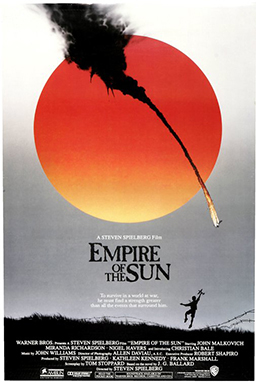
Behind the film
- Year
- 1987
- Director
- Steven Spielberg
- Writers
- Tom Stoppard
- Genres
- War, Coming-of-age, Drama
- Production
- Amblin Entertainment
- Country
- United States, United Kingdom
- Cast
- Christian Bale, John Malkovich, Miranda Richardson, Nigel Havers, Joe Pantoliano, Leslie Phillips, Ben Stiller, Burt Kwouk
About the film
Contains story spoilers.
Empire of the Sun follows a child who can adapt to danger without fully understanding the world that produces it. That distinction gives the war story its unsettling perspective. Jim’s curiosity and excitement remain active in circumstances that an adult might describe only through dread, making his responses emotionally complicated rather than simply innocent. He is learning how to survive while also losing the familiar measures that once explained his life. The film asks what resilience means under those conditions. An ability to keep going can preserve a person physically while changing the memories, loyalties and expectations that made him recognisable to himself. Survival is necessary, but it does not promise continuity.
In 1941 Shanghai, British schoolboy Jamie Graham is separated from his parents as Japanese forces occupy the International Settlement. After waiting alone at home, he searches for food and meets American hustlers Basie and Frank. Their attempt to loot his neighbourhood ends in capture, and the boy, now called Jim, enters an internment camp. He survives through trading and relationships with prisoners, a doctor and a young Japanese pilot beyond the fence. By 1945, an American air attack excites him but also exposes how far his memories of his parents have faded. The camp is evacuated, and the prisoners face a punishing march. Jim later returns to the deserted camp and encounters the pilot, who is killed by one of Basie’s armed associates while offering him food. Jim refuses to leave with Basie. American soldiers eventually find him, and a Red Cross shelter brings a reunion with his parents, though recognition arrives hesitantly after the years that have changed him.
His early privilege matters because it shapes what he initially expects from the world. Security can feel like a natural condition when other people’s work and an insulated household keep its machinery out of sight. Once those arrangements collapse, Jim has to discover how much of ordinary life depended on relationships he did not need to understand. The film turns that discovery into a practical education rather than a single lesson. Asking, bargaining and observing become ways to navigate circumstances that no longer answer to his former assumptions. The child’s curiosity helps him adapt, but it also makes the surrounding danger less straightforward to represent. Something can fascinate him while remaining part of the force that has broken his life apart.
Basie offers a particularly uncertain model of adult capability. He understands opportunities and can make resourcefulness look like a promise of protection, yet understanding a situation does not necessarily mean accepting responsibility for the people within it. Jim’s attraction to that confidence raises a question about what a child can recognise as care when dependable alternatives have disappeared. An adult who seems useful may become important before he has proved trustworthy. The relationship’s emotional force comes from that gap. Jim needs someone to explain the new world, while the person offering an explanation may also be calculating what the boy can provide. Surviving together and being committed to each other remain different possibilities.
The camp gives community a pressured and uneven form. People share confinement without necessarily sharing priorities, resources or the same capacity to help. That makes every connection practical as well as emotional: another person may provide information, protection or a way to remain visible. Jim’s developing place among others can be read as an attempt to build a world inside one he did not choose. The arrangements he creates matter because they give life a rhythm when the larger future is uncertain. Yet the usefulness of those arrangements cannot make the conditions acceptable. The film keeps adaptation from becoming an endorsement of hardship, showing how the ability to function within a damaged environment can coexist with losses that remain difficult to measure.
His fascination with flight makes that coexistence especially vivid. A child can respond to extraordinary movement as wonder while the same movement carries violence and an adult’s understanding of catastrophe. The war setting puts those meanings close together without allowing either to cancel the other. That is part of the film’s distinctive emotional scale: the world can seem immense, beautiful and terrifying within the same experience. Jim’s attention does not provide an objective account of the conflict. It gives access to how a young mind attempts to organise what it encounters, sometimes recognising a possibility before a consequence. The drama’s historical material is filtered through that perspective and through a fictional adaptation, rather than presented as a comprehensive record of war in China.
The reunion makes return a different experience from restoration. Reaching the people once associated with home cannot automatically recover the child who left them, and the years between those moments remain present even when the immediate danger has ended. That gives the conclusion a quieter difficulty than a simple rescue would imply. Jim’s resourcefulness has helped preserve his life, but it has also developed around circumstances his family did not share. Recognition has to cross that distance. Empire of the Sun leaves survival connected to an altered identity, asking what can be brought home from a world that demanded so much change. Its final hope depends on connection while allowing the cost of reaching it to remain visible.