
Behind the film
- Year
- 1998
- Director
- Shekhar Kapur
- Writers
- Michael Hirst
- Genres
- Biographical, Drama
- Production
- PolyGram Filmed Entertainment, Working Title Films
- Country
- United Kingdom
- Cast
- Cate Blanchett, Geoffrey Rush, Joseph Fiennes, Christopher Eccleston, Richard Attenborough, John Gielgud, Kathy Burke, Daniel Craig
About the film
Contains story spoilers.
Elizabeth treats becoming queen as a transformation that a coronation can announce before the person crowned has learned how to sustain it. Authority is formally hers, but the people around her continue to supply conditions under which they think it should operate. Marriage, religion and counsel become ways of shaping the monarch while presenting themselves as ways of securing the kingdom. The film's dramatic movement comes through her growing recognition of that pressure. Possessing a title does not establish control over the meaning others attach to it, and the character's new position makes private uncertainty something that rivals and advisers can interpret as an opportunity to intervene.
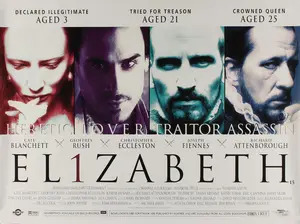
Shekhar Kapur directs the 1998 historical drama, written by Michael Hirst. Cate Blanchett plays Elizabeth, Joseph Fiennes plays Robert Dudley and Geoffrey Rush plays Francis Walsingham, with Richard Attenborough as William Cecil and Christopher Eccleston as Norfolk. The film concentrates the early reign into a heightened account of danger and self-fashioning. Events and relationships are altered and compressed, so its scenes should not be treated as a complete factual record of Tudor politics. The historical setting supplies the court and its conflicts, while the drama shapes them around the question of what a ruler must give up—or decide to conceal—to make a contested position endure.
Elizabeth becomes queen after Mary's death and confronts pressure to marry while maintaining her bond with Dudley. Military failure and conspiracies make her position insecure. Learning Dudley is married damages their intimacy, while Walsingham increasingly acts against threats to her rule. A conspiracy is suppressed, with Dudley spared as a reminder of danger. Elizabeth finally rejects marriage and creates the image of a queen committed to England. The film turns that conclusion into a visible change of identity, presenting authority as something performed and maintained rather than a condition that inheritance alone made secure.
The marriage question makes Elizabeth's body part of a political argument. Advisers can describe a proposed match as a practical solution while overlooking how much it would reorganise the person expected to accept it. The film's tension depends on that double scale. A private decision has consequences for alliances and succession, but those consequences do not make the private person disappear. Her delay can therefore be read by others as indecision while also expressing resistance to being managed through an arrangement they have selected. The drama gives that resistance an increasing force as she begins to assess proposals through their consequences for her own capacity to rule.
Dudley's concealment makes intimacy another place where unequal information matters. Elizabeth's public position does not protect her from being misled within a relationship, and learning the truth damages more than a romantic hope. It changes what she can trust in a world where private closeness may affect public decisions. The film does not need to make every affectionate encounter a calculated political manoeuvre for that problem to be serious. It allows the possibility of genuine feeling to coexist with betrayal, making emotional attachment something she cannot simply classify as safe because it belongs to a person whose familiarity reaches back before the throne.
Walsingham supplies a version of protection whose effectiveness is inseparable from methods the protected person may find disturbing. That makes his presence different from an adviser who merely proposes a future arrangement. He acts within the world of threats, making security something produced through decisions and violence rather than offered as reassuring language. The film's dramatic account should remain separate from claims about what the historical individual literally did in each scene. Within the narrative, his role makes authority costly: eliminating a danger can preserve the ruler while changing the terms through which the ruler has to understand the power being exercised in her name.
The final image gives the transformation a public surface. Appearance becomes a means of telling the court how to understand the person before it, reducing the availability of a private self others might try to direct. That does not establish that presentation replaces political action. It shows presentation becoming part of political action, with visible identity used to make a commitment legible. The film's earlier vulnerability gives that image a cost. A ruler who seems untouchable has arrived there through decisions affecting what ordinary intimacy can remain available, and the reassurance offered to an audience can therefore be considered alongside the withdrawal it requires from the person providing it.
Elizabeth ends by consolidating an identity rather than completing an entire reign. That distinction keeps its focus clear: it is an origin drama about the making of an authoritative image, not a survey of every later achievement or a reliable timeline for the whole historical period. Its court is a world where concern, ambition and coercion can use similar language, requiring the queen to learn what proposed help would actually demand from her. The concluding commitment resolves the film's immediate uncertainty while preserving its central contradiction. Public strength can depend on narrowing the private life through which the person holding power once imagined a different future.