
Behind the film
- Year
- 1990
- Director
- Tim Burton
- Writers
- Caroline Thompson
- Genres
- Romance, Fantasy, Drama, Christmas
- Production
- 20th Century Studios
- Country
- United States
- Cast
- Johnny Depp, Winona Ryder, Dianne Wiest, Anthony Michael Hall, Kathy Baker, Robert Oliveri, Alan Arkin, Vincent Price
About the film
Contains story spoilers.
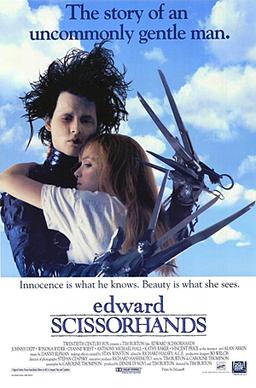
An elderly woman begins the story by explaining to her granddaughter why snow falls over their town. The memory takes her back to when Peg Boggs, an Avon saleswoman, climbs to a Gothic mansion above a pastel suburb. There she finds Edward, a young artificial man whose inventor died before replacing his scissor blades with human hands. Peg takes him home, where her husband Bill and son Kevin try to include him in ordinary family life. Edward struggles with eating, dressing and conversation, but he can shape shrubs into elaborate figures and carefully groom dogs. His physical difference is at once a danger and a source of unexpected artistry.
The neighborhood reacts first with fascination. Peg's neighbors line up for haircuts and hedge sculptures, and Edward's work brings attention to a place whose houses and routines look nearly identical. When Kim returns from a trip, she is frightened by Edward and keeps her distance. Joyce offers to help him open a salon, then spreads a false accusation after her sexual advances frighten him away. The bank refuses the loan he would need. Kim’s boyfriend Jim later exploits Edward’s trusting nature and ability to pick locks, drawing him into a break-in at Jim’s parents’ house. Edward is arrested, but the police recognise how little his isolated upbringing has prepared him to understand the situation. Kim learns he accepted the risk because she asked him to; she knew Jim’s story was a deception, while Edward was willing to help her anyway. The episode marks a turn from novelty to exploitation: residents admire what he can do, but have not learned what he needs.
Kim’s feelings for Edward change as she comes to recognise his devotion and the way Jim has exploited it. He makes an ice sculpture of her, and the falling ice shavings create the snow that frames the story's opening and ending. Kim recognizes that Edward's care is sincere, while Jim becomes increasingly jealous and controlling. At Christmas, the household's warmth does not erase Edward's unease: he can join the family only by moving carefully around the sharp tools that are part of his body. The film makes physical contact a real problem, not an obstacle that affection can simply solve. Kim asks him to hold her, and he cannot do so without risking a cut; she arranges his hands so they can embrace.
The situation breaks when Jim's drunken friend, driving to Kim's house, nearly hits Kevin. Edward pushes the boy out of the way but accidentally cuts him, and the crowd sees only the blades and the injury. Kim's family tries to explain what happened, but the neighbors have already begun treating Edward as dangerous. He runs back to the mansion as the neighborhood follows. Kim follows Edward to the mansion, where their brief reunion is interrupted by Jim’s arrival. Jim follows with a gun and attacks Edward, then strikes Kim when she tries to intervene. Edward finally defends her, stabbing Jim and sending him through a window to his death.
Kim understands that the crowd outside would punish Edward if they knew he had survived. She tells them that he and Jim killed one another, and shows them a scissorhand as proof. She leaves Edward in the mansion and returns to town, carrying a private knowledge the neighbors never share. In the framing story, the granddaughter asks whether Edward is still alive; the older Kim is sure Edward is still alive, and the town's snowfall tells her he continues sculpting ice. The ending closes their romance through separation rather than reunion, while snow becomes a lasting sign of the creativity and affection Edward carried back into isolation. The story never explains how long he lives, leaving Kim's belief tied to the annual weather and her memory.
Tim Burton's direction sets the pointed silhouettes of the mansion against rows of low pastel houses, giving the fantasy a visual split between gothic and ordinary. The contrast is not simply a difference between frightening and safe: the residents' curiosity shifts quickly into suspicion, while the seemingly ominous castle shelters a gentle person. Johnny Depp plays Edward with restrained movement, and the sound and shape of the scissorhands make each gesture feel deliberate. Danny Elfman's score gives the fairy-tale frame musical continuity, particularly as ice shavings transform into snowfall. The ending returns to the beginning's question, letting a remembered story explain the weather without pretending Edward can re-enter the community that rejected him.
The false accusation shows how quickly the neighborhood's fascination can become a judgment made to protect its own standing. Edward had been invited into homes because his hands could entertain or improve them, yet his value never gave him control over how others defined his actions. Once Joyce's account circulates, his neighbors see the blades before the person they had welcomed. This betrayal sharpens the film's pastel suburbia: the threat does not come from the Gothic mansion but from a community that turns rumor into certainty. Edward's tools remain visible, while his reasons and restraint are harder for the crowd to see.