
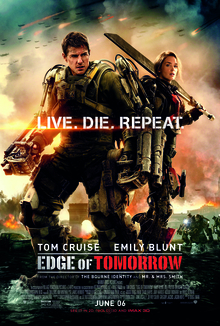
Behind the film
- Year
- 2014
- Director
- Doug Liman
- Writers
- Christopher McQuarrie, Jez Butterworth, John-Henry Butterworth
- Runtime
- 1h 53m
- Genres
- Science fiction, Military science fiction, Science fiction action, Dystopian
- Production
- Legendary Pictures, Village Roadshow Pictures
- Country
- United States
- Cast
- Tom Cruise, Emily Blunt, Bill Paxton, Brendan Gleeson, Noah Taylor, Kick Gurry, Dragomir Mrsic, Charlotte Riley
About the film
Contains story spoilers.
William Cage has no combat experience when he is forced into humanity’s invasion of alien-occupied Europe. Killing an Alpha Mimic exposes him to its blood; his death then resets the day. Rita Vrataski recognises the ability because she once possessed it herself. She trains him while they seek the Omega that controls the creatures and their manipulation of time. A vision draws Cage into a trap, but a device later locates the Omega beneath the Louvre. A transfusion removes his power, making the final assault irreversible. J-Squad helps them reach their target, and Cage destroys the Omega after Rita is killed. Contact with its blood produces another reset: the Mimics are defeated, and Rita is alive without remembering him. Knowledge has survived a history that everyone around Cage has ceased to share.
The time loop makes competence something the viewer can watch being assembled. Most action heroes arrive with abilities already established, leaving the story to test how far those abilities will take them. Cage begins as someone whose fluency has little physical use. Repetition exposes the difference between sounding prepared and being prepared, while allowing failure to become information. That gives the film a practical rhythm: attention, adjustment and timing matter as much as bravery. Its fantasy is not simply having another chance. It is being able to carry forward what an unsuccessful attempt has taught you, even when the surrounding world continues to treat you as the same inexperienced person.
Tom Cruise’s performance makes that process unusually visible. Cage’s early evasiveness gives the actor a character who cannot initially rely on the authority associated with a confident screen presence. The comedy grows from that mismatch, from the gap between a persuasive manner and a body that cannot manage what is being demanded of it. As the manner becomes less useful, observation acquires more value. The change is legible without requiring every intermediate lesson to be spoken aloud. A different response to a familiar situation can show development more economically than a declaration that someone has changed, which suits a story built around returning to recognisable situations.
Emily Blunt’s Rita gives the film a different relationship with expertise. Her reserve suggests the burden of being regarded as an answer to other people’s fear, while her precision makes experience feel tangible. The pairing avoids treating shared capability as shared perspective. Two people can recognise the same problem while approaching its emotional consequences differently. This is especially important in a story where familiarity may be uneven: knowing someone’s reactions does not automatically entitle you to their trust. The film’s relationship develops inside that imbalance, making restraint and uncertainty useful counterweights to the excitement of increasingly coordinated action. Partnership requires more than possessing information about another person.
The world combines a military organisation’s emphasis on procedure with machinery that looks capable of overwhelming its operator. Armour promises strength, yet its weight and complexity keep the body visibly involved in the work. The beach setting then makes that promise feel precarious. An expansive battlefield can still offer very little freedom when movement is constrained by danger from every direction. This contrast keeps the futuristic elements grounded in an immediate physical problem: where to stand, what to notice and how to remain alive long enough to act. Technological scale does not eliminate vulnerability, and the film repeatedly makes its impressive equipment part of the difficulty rather than a guarantee of safety.
Editing is central to making repetition readable. A repeated setup can carry a new meaning because the viewer now knows what it previously concealed. The film can shorten an encounter once its pattern has become familiar, or remain with a moment when an altered response deserves attention. That puts the audience in an active position, learning the shape of a situation alongside its protagonist. Humour and dread can emerge from the same recognisable detail, depending on what the next variation reveals. The rhythm also allows apparent mastery to remain uncertain. Recognising one stretch of a route does not mean understanding the entire system in which that route exists.
Doug Liman’s film, with a screenplay credited to Christopher McQuarrie, Jez Butterworth and John-Henry Butterworth, uses its science-fiction premise to ask what knowledge is for. It can be a means of avoiding discomfort, gaining control or accepting responsibility when certainty is unavailable. Those possibilities give its acceleration an emotional direction. The more efficiently a problem can be approached, the more clearly the story can reveal what efficiency cannot settle. Its ending retains that distinction: continuity is personal, and survival does not produce an equal memory for everyone. The adventure leaves a human asymmetry inside its large-scale resolution, allowing achievement and loneliness to coexist without requiring an elaborate explanation of every mechanism. The familiar action-film reward of greater capability is consequently shadowed by the question of whom that capability can actually reach.