
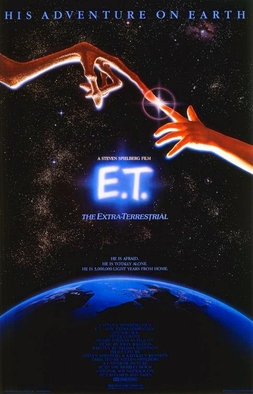
Behind the film
- Year
- 1982
- Director
- Steven Spielberg
- Writers
- Melissa Mathison
- Runtime
- 1h 55m
- Genres
- Science fiction, Drama, Children's, Family
- Production
- Amblin Entertainment, Universal Pictures
- Country
- United States
- Cast
- Dee Wallace, Peter Coyote, Henry Thomas, Drew Barrymore, Erika Eleniak, C. Thomas Howell, Sean Frye, K. C. Martel
About the film
Contains story spoilers.
E.T. the Extra-Terrestrial builds its science-fiction premise around a small domestic discovery. An alien visitor is accidentally left behind when its companions depart Earth, and the creature finds shelter near a suburban home. Elliott, a boy played by Henry Thomas, discovers him and begins to form a private friendship. Steven Spielberg and screenwriter Melissa Mathison keep the opening close to a child's scale: a strange being is frightening, fascinating and vulnerable all at once. Elliott's older brother Michael and younger sister Gertie become part of the secret, while their mother Mary, played by Dee Wallace, remains largely unaware of the visitor. Familiar rooms, toys and neighbourhood streets become the first world E.T. has to navigate, making the fantastic arrival feel attached to everyday family life.
The emotional engine is a bond that makes the alien's difference legible without turning him into a puzzle to solve. E.T. has needs and responses that the children gradually learn to read, and communication grows through gestures, objects and shared attention. The science-fiction details remain approachable: the visitor wants to make contact with home, while Elliott tries to understand what help is possible. Their connection also unsettles the boundary between a child's private imagination and adult reality. Adults are present, but the film often frames them indirectly or from the children's perspective, making authority feel distant before it becomes actively threatening. That point of view gives the friendship room to develop as something the children must protect and explain. It also means viewers learn the alien's world alongside them rather than through technical lectures.
Keeping E.T. hidden creates the middle of the film's practical adventure. Elliott and his siblings improvise around the routines of the house, school and neighbourhood, turning familiar objects and spaces into tools. Their plans are not sophisticated; the pleasure comes from watching children treat a serious problem with the resources they can reach. At the same time, adults searching for the alien bring surveillance and scientific curiosity into the home. Peter Coyote plays Keys, one of the figures involved in the pursuit, and his presence gradually changes the story's temperature. What began as a child's secret cannot stay isolated from institutions that want to find and study something extraordinary. The children must keep adapting their everyday cover while also learning what E.T. needs in order to survive and communicate.
One of Spielberg's major set-pieces is the bicycle flight through the night. The sequence moves from the children's journey through the woods to the cliff edge, then releasing tension into a wide image of the bicycle rising against the moon. It is built with clear visual steps: the scene establishes the riders and their path, then concentrates attention on the moment when the bike takes control of the impossible. John Williams's score is integral to the effect, swelling through anticipation and carrying the lift into a musical climax. The craft is not only spectacle. The flight turns the children's practical escape into an image of what their friendship has made possible, while remaining legible as an action sequence. Its compact construction makes each change of viewpoint build toward the moment when flight becomes possible, connecting the physical journey with the friendship at its centre.
The characters' emotional lives give that wonder a cost. Elliott is not merely a boy who meets an alien; his family has its own strains, and his attachment to E.T. becomes a way of feeling understood. Michael shifts from teasing brother to collaborator, while Gertie's directness makes her a willing participant in the secret. Their mother remains caring but busy, and the gap between what she knows and what the children experience helps explain why they keep the friendship to themselves. As the relationship deepens, the story links closeness with vulnerability: E.T.'s condition affects Elliott, making the bond visible in ways neither can easily control. Empathy brings them together, but it also makes the prospect of separation harder to face. The film treats that emotional link as both a source of comfort and a genuine complication.
The final movement asks the children to turn care into action. As E.T.'s health worsens and authorities close in, the problem is no longer how to keep a secret indefinitely; the children have to help their friend reach a chance of returning home. Spielberg coordinates the chase, bicycles and pursuing adults so the escape feels urgent without losing the human connection at its centre. The goodbye lands because the story has first shown ordinary acts of friendship: making room, sharing discoveries, and trying to communicate across a divide. The famous flight shows how carefully arranged images can give a family adventure a scale larger than its neighbourhood. E.T. balances an alien story with the intimate shape of a friendship that cannot last unchanged. Its wonder depends on the children's willingness to treat a stranger as someone who deserves help.