
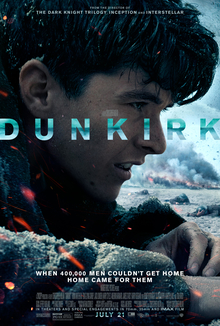
Behind the film
- Year
- 2017
- Director
- Christopher Nolan
- Writers
- Christopher Nolan
- Runtime
- 1h 46m
- Genres
- Drama, War, Historical
- Production
- Syncopy, RatPac-Dune Entertainment
- Country
- United Kingdom, United States
- Cast
- Fionn Whitehead, Tom Hardy, Mark Rylance, Kenneth Branagh, Cillian Murphy, Jack Lowden, Harry Styles, Barry Keoghan
About the film
Contains story spoilers.
Christopher Nolan’s Dunkirk tells the evacuation of Allied troops from France through three groups with different amounts of time to act. On the beach, Tommy and other soldiers wait for a way home while German forces close in. Across the Channel, Mr Dawson takes his small boat toward France with his son Peter and their friend George. Above the water, RAF pilot Farrier and fellow airmen try to protect the ships and men below. The strands cover a week on land, a day at sea and an hour in the air, then cross as the evacuation gathers pace. The separate clocks make events feel both simultaneous and out of step.
Tommy first appears running through a town under fire, the lone survivor of a group of British soldiers. He reaches the beach and finds thousands of men exposed to attack, with the sea at their backs and only a narrow pier available for large ships. The army’s attempt to load soldiers is repeatedly interrupted by bombs and strafing. Tommy meets Gibson, a quiet soldier who has buried another man and attached himself to the group under an assumed identity. Their shared aim is immediate and practical: get onto a ship before the next attack. The film gives little time to explain the wider military retreat, keeping attention on the long wait and sudden danger around them.
A torpedo strike sinks an evacuation ship and throws the men into the water. Gibson opens an escape route for Tommy and Alex, but must keep searching for transport. A beached trawler offers brief shelter, then becomes a target as the tide rises and the men inside argue about whether to leave. Alex’s fear turns into anger at Gibson, whom he suspects of being a German spy. The accusation grows out of panic and uncertainty rather than reliable evidence; the men have almost no control over events and little basis for trusting strangers. Gibson reveals he is French, not German, but drowns when the trawler sinks. Tommy and Alex escape into the water, where survival still depends on someone reaching them.
Dawson’s decision to sail across the Channel gives the sea strand a different rhythm. His son Peter and George come along, and the small civilian vessel joins a growing movement of boats heading toward the beach. They pick up a shell-shocked soldier from a wreck while continuing toward Dunkirk. He understands that the crossing is dangerous and wants to turn around; in the confined cabin his fear becomes violent, and George is fatally injured. Dawson continues toward Dunkirk, while Peter tries to care for George and calm their terrified passenger. The journey shows rescue as a civilian choice that brings its own risks, not a painless answer to the crisis on land.
Farrier’s flight is shaped by dwindling fuel and the need to read the battle from above. He and Collins patrol the coast, engaging enemy aircraft that threaten the evacuation. Collins is forced down into the water after his plane is hit, and Dawson’s boat rescues him. Farrier remains airborne after his fuel gauge fails, relying on judgment and the aircraft’s remaining capacity. The film withholds the enemy pilots’ identities and most of the command-room context, so the audience shares the limited view of the men trying to survive. The sky strand is brief in story time but repeatedly changes what can happen on the beach and water.
As the timelines converge, Tommy and Alex escape the trawler and swim toward another ship, only to find danger spreading across the water around it. Dawson’s Moonstone reaches survivors as burning oil threatens them, bringing the soldiers’ desperate attempts to leave into the same story as the civilians’ crossing. This rescue carries them back to England; it does not undo Gibson’s death or save George, whose injuries prove fatal. Farrier keeps defending the evacuation after his fuel runs out, then lands on the French coast, burns his aircraft and is captured. The different journeys finish with radically different outcomes. The boat reaches home, while the pilot who helped protect its passage remains behind.
Back in England, the rescued soldiers arrive to a welcome that feels uncertain to them. A newspaper account and a civilian’s gesture help Tommy and Alex understand that getting home is not being treated as failure. The film’s measured dialogue and overlapping sound keep exposition sparse; engines, distant impacts and the persistent ticking score carry much of the tension. Its structure asks the viewer to assemble the connection between events before characters can explain them. The civilian boats matter because they reach places larger ships cannot, while the pilots’ actions buy time on the water. The ending grants relief without suggesting that everyone was saved or that the retreat itself was uncomplicated. The men rarely have the full picture, and the film lets the viewer feel that lack instead of filling every gap with explanatory dialogue. This makes the physical act of waiting one of the film’s recurring events: a line forms, a ship appears, then the next attack breaks the possibility of escape. The repeated attempts do not feel interchangeable because each one changes who is present and what risks the survivors are willing to take.