
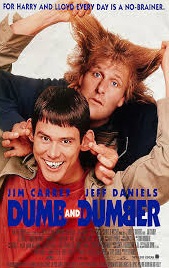
Behind the film
- Year
- 1994
- Director
- Peter Farrelly
- Writers
- Peter Farrelly, Bennett Yellin, Bobby Farrelly
- Runtime
- 1h 46m
- Genres
- Buddy, Comedy, Road movie
- Production
- New Line Cinema
- Country
- United States
- Cast
- Jim Carrey, Jeff Daniels, Lauren Holly, Karen Duffy, Mike Starr, Charles Rocket, Teri Garr, Victoria Rowell
About the film
Contains story spoilers.
Lloyd Christmas sees an abandoned briefcase as a chance to reconnect with Mary Swanson, the passenger he has just driven to the airport. He and roommate Harry Dunne head from Providence to Aspen without knowing that the case contains ransom for Mary's kidnapped husband. A criminal pursuing them dies after their prank and a medication mix-up; a wrong turn nearly ends the trip. In Aspen they discover the cash, spend lavishly and replace it with IOUs. Rivalry over Mary threatens their friendship before kidnapper Nicholas Andre corners them. Harry's apparent shooting is foiled by a protective vest: Beth, whom he met on the road, is an FBI agent. The criminals are arrested and Mary rejoins her husband. Lloyd and Harry leave together, still remarkably capable of missing the opportunity in front of them.
The journey has two completely different explanations operating at once. To the friends, returning a lost possession is a generous act with an exciting romantic possibility attached. To the people following them, it is an interruption of a carefully arranged criminal transaction. That gap gives ordinary exchanges an extra level of danger. A stranger can mean one thing and be understood as something else entirely. The audience is placed between those interpretations, able to see how little the travelers understand while recognizing that the people with a plan are not necessarily in control either. It is a comic world in which knowledge does not reliably produce competence. The simplest objective becomes difficult because nobody is responding to quite the same situation.
Lloyd's romantic imagination also supplies a remarkably flexible defense against disappointment. He can treat a tiny possibility as encouragement and build an entire future around someone he scarcely knows. That enthusiasm has an appealing energy, but it also excludes the other person's actual wishes. The film makes the problem visible through the difference between pursuing an imagined story and paying attention to a person. Mary is not responsible for making his adventure rewarding. His confidence becomes funniest when it outruns every available reason for confidence, because he is so ready to convert wishful thinking into certainty. Underneath the extravagant stupidity is a recognizable human habit: taking an encounter that mattered to you as proof that it must have meant the same thing to somebody else.
Harry gives the friendship a different comic pressure. He is not an endlessly patient caretaker accompanying a chaotic friend; the two men can each become unreasonable, wounded or vindictive. Their closeness gives them an audience that will keep listening when almost anyone else would leave. It also gives jealousy a convenient target. If one appears to have gained an advantage, the other can read it as betrayal rather than luck. The partnership works because neither needs to become respectable to be understood by the other. Its weakness is that understanding does not automatically make them considerate. The movie can therefore use the friendship for warmth and for unpleasant behavior without pretending the two are mutually exclusive. They remain companions partly because their shared world is so difficult for anyone else to inhabit.
Travel is especially useful for this kind of comedy because it keeps supplying systems the characters cannot read. Directions, roadside manners, hotel etiquette and the expectations of a wealthy resort all demand ordinary judgments. The friends approach those demands with an optimism that survives evidence of failure. A road movie usually promises that leaving familiar surroundings will produce discovery or growth. Here the distance traveled becomes much greater than the distance between their starting and ending understanding. They can arrive somewhere entirely new while carrying the same assumptions with them. That makes the landscape more than a collection of places for jokes. Each change of setting creates another opportunity to reveal how completely a person's habits can determine what they see.
The physical comedy depends on a willingness to let embarrassment become extreme. Carrey's animated face and restless delivery contrast with Daniels's more grounded presence, giving the pair distinct rhythms even when both are behaving absurdly. Their bodies often disclose a problem long before they have language to manage it. The humor can be gross, cruel or conspicuously childish, and those qualities are part of the film's texture rather than a promise of refined social satire. The difference between an innocent intention and an ugly result remains crucial. Being unable to foresee harm does not mean harm disappears. The comedy instead asks the audience to hold affection and exasperation together, sometimes with very little comfortable distance between them.
Aspen offers an exaggerated version of the improvement the friends imagine money will buy. A change in clothes and surroundings can alter how they present themselves without supplying the judgment required to sustain the performance. Luxury becomes another costume, as susceptible to misuse as anything else they encounter. There is a useful distinction here between lacking access and lacking understanding: suddenly having access does not solve every problem. The movie's class contrast remains broadly comic rather than a worked-out argument about economics. Its immediate interest is the gap between looking transformed and being transformed. The friends can acquire the outward signs of a new life while preserving the behavior that keeps undoing their attempts to enter it.
The final measure of the adventure is the relationship that survives it. A romance built on a misunderstanding cannot provide the reward Lloyd imagined, and a criminal mystery does not turn either traveler into a detective. Their bond is less ambitious and more durable than those fantasies. That does not require treating their behavior as admirable or claiming that friendship solves the trouble they create. It gives the comedy a reason to continue after the immediate scheme has ended. The possibility of another mistaken interpretation is already waiting wherever they go next. What makes the pair recognizable is their ability to carry disappointment forward together, with enough confidence left over to misunderstand the next invitation as thoroughly as the last.