
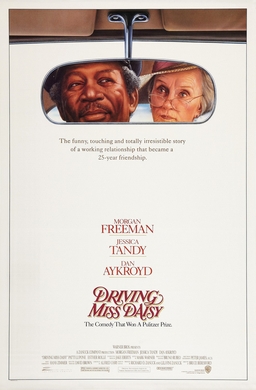
Behind the film
- Year
- 1989
- Director
- Bruce Beresford
- Writers
- Alfred Uhry
- Runtime
- 1h 39m
- Genres
- Buddy, Comedy, Drama
- Production
- Warner Bros. Entertainment, Warner Bros. Pictures
- Country
- United States
- Cast
- Jessica Tandy, Morgan Freeman, Dan Aykroyd, Esther Rolle, Patti LuPone, Joann Havrilla, William Hall Jr., Crystal R. Fox
About the film
Contains story spoilers.
In 1948 Atlanta, retired teacher Daisy Werthan loses the ability to insure herself as a driver after an accident. Her son Boolie hires Hoke Colburn, a Black chauffeur, despite her resistance. Hoke gradually persuades Daisy to accept rides, and their relationship develops over years of errands and family occasions. She helps him learn to read, while he negotiates better pay and challenges the way she treats his needs. They encounter racism during travel, and the bombing of Daisy's synagogue brings antisemitic violence close to her life. Her belated suggestion that Hoke attend a dinner honouring Martin Luther King leaves him listening outside in the car. As Daisy grows confused in old age, she acknowledges Hoke as her closest friend. She moves to a care home, and the retired Hoke later visits with Boolie, gently feeding her pie. Their connection endures as their circumstances change.
Driving Miss Daisy builds its relationship through repetition. A journey, an instruction or a complaint can seem minor on its own, but changes in tone become meaningful when the same people keep encountering one another. Bruce Beresford gives that accumulation time to develop across the story's long span. The audience can notice a habit becoming less rigid without needing every conversation to end in a declaration of progress. This suits a drama about familiarity: understanding grows through attention to someone whose presence has become ordinary. It also leaves room for setbacks. Years of shared experience do not make every assumption disappear, which keeps the relationship more complicated than a steady improvement measured by a calendar.
Jessica Tandy gives Daisy's independence a mixture of dignity and defensiveness. Her desire to control her own life is understandable, yet the ways she exercises control can overlook other people's needs. The performance makes those qualities coexist rather than separating the character into sympathetic and unsympathetic versions. Daisy can be vulnerable to change and still wield considerable authority over the person helping her. Tandy's precise reactions make pride visible in everyday exchanges, where conceding a practical point can feel like conceding a larger claim about who she is. The film's humour often begins in that disproportion, while its emotional pressure comes from what the resistance costs the people around her.
Morgan Freeman gives Hoke a patient manner without making patience an absence of judgment. He pays attention to Daisy, but he also knows what he needs and recognizes when an assumption should be challenged. That distinction is central to the relationship. A person employed to help does not become merely a means of keeping someone else comfortable. Freeman lets firmness emerge through the same measured presence that makes companionship possible, giving Hoke an identity beyond the role Daisy initially assigns him. The film's quieter tensions depend on how much work that steadiness requires. Agreeing to remain in a difficult relationship is an active choice, especially when the other person's authority is backed by money and social expectation.
Boolie occupies another position within those expectations. Dan Aykroyd makes him practical and concerned, but family concern does not remove his interest in keeping daily life manageable. He wants a solution his mother will accept and an employee who can make it work, placing him between people whose understanding of the arrangement differs. The household around them gives care an economic structure. Responsibilities are distributed through employment and family ties, and the film asks us to notice who has the freedom to set their terms. Affection can grow within that structure without making it equal. The relationship's warmth is more convincing when the limits surrounding it remain visible rather than being treated as already resolved.
Atlanta and the passing decades give the private connection a wider setting. Race, religion and class shape which spaces feel available and how the characters expect to be treated in them. The film approaches these pressures through selected encounters, so its account remains narrower than a history of the civil-rights movement. That narrowness matters. Daisy's attachment to Hoke cannot stand as proof that the larger inequalities have been overcome, and prejudice experienced in one form does not guarantee recognition of it in another. The drama finds its difficult moments where private self-understanding meets that limit, showing that a person can think of herself as fair while still expecting someone else to absorb an inconvenience.
The later scenes place care beside the loss of familiar abilities. Age changes what the characters can do, making the relationship's accumulated knowledge useful in ways neither could have fully planned. Beresford keeps the emotional scale modest, allowing an ordinary gesture to carry the weight of years. Driving Miss Daisy adapts Alfred Uhry's play into a story about companionship that remains bound to its unequal circumstances. Its most lasting question is how much recognition can develop within an arrangement that began without mutual understanding. The answer contains warmth, but also unfinished work. Knowing a person's habits is one form of closeness; recognizing their dignity requires attention to the conditions under which those habits have been shared.