
Behind the film
- Year
- 2011
- Director
- Nicolas Winding Refn
- Writers
- Hossein Amini
- Runtime
- 1h 40m
- Genres
- Neo-noir, Crime, Drama, Thriller
- Production
- MWM Studios, Seed Productions
- Country
- United States
- Cast
- Ryan Gosling, Carey Mulligan, Bryan Cranston, Christina Hendricks, Ron Perlman, Oscar Isaac, Albert Brooks, Russ Tamblyn
About the film
Contains story spoilers.
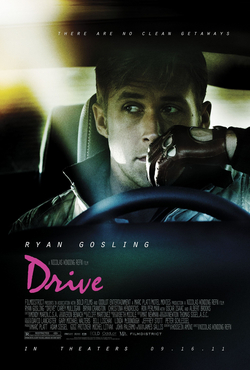
Known only as the Driver, a Los Angeles mechanic and stunt performer also works as a getaway driver. He grows close to neighbor Irene and her son, Benicio, then agrees to drive Irene's recently released husband through a robbery meant to settle a debt. The job turns deadly, and the Driver becomes entangled with the criminal network behind it. As violence reaches his new neighbors, he tries to protect them by confronting the men who organized the crime. Wounded after killing Bernie, he leaves in his car; Irene's knock goes unanswered, and his fate remains uncertain. The vehicle therefore serves as both workplace and shelter, but the framing continually reminds viewers how thin that shelter can be.
Drive makes the car an extension of its protagonist's guarded interior. The Driver is defined by movement and technical control, yet the film often places him inside a cockpit where glass, mirrors and night streets separate him from other people. Driving becomes both a skill and a form of distance. The camera can remain with the route while withholding explanation, letting the city arrive as fragments of light, signage and reflected faces. This visual design gives the film a sense of inwardness without relying on frequent verbal confession. This approach asks the audience to do interpretive work rather than supplying a verbal key for each change in mood.
Silence is not emptiness here; it is a deliberate form of characterization. The Driver speaks sparingly, so attention shifts to pauses, posture and the slight changes that occur when he shares space with Irene and her child. The quiet domestic scenes create a different tempo from the professional routines that first define him. That contrast lets tenderness register without turning into a speech about redemption. It also makes the character difficult to read: viewers must distinguish emotional restraint from moral innocence, especially as the film's violence grows more explicit. The contrast between quiet and violence shapes the viewer's response as much as the violence alone; pacing is part of the film's meaning.
The film's structure begins with genre expectations and then tightens them. The Driver's work as a mechanic, stunt performer and getaway specialist suggests an action story centered on criminal technique, but the plot increasingly focuses on the costs of proximity and the limits of protection. A job that appears manageable becomes a chain of irreversible choices. The change in scale—from controlled driving to close, brutal confrontation—makes a point about competence: being skilled at movement cannot guarantee control over consequences. The film's crime framework supplies momentum while the character drama steadily narrows the exits. Each escalation alters the story's emotional scale, from practiced motion to the consequences that technical mastery cannot reverse.
Nicolas Winding Refn uses color, framing and rhythm to give Los Angeles a stylized emotional geography. Night streets can feel both open and isolating, while interiors frame people in quiet boxes of light. The bright jacket and recurring visual motifs make the Driver instantly legible as an icon, but the surrounding stillness complicates that surface. The film does not attempt ordinary realism in every scene; it builds a heightened world where moments of calm can feel as charged as action. This design supports a protagonist who seems to inhabit a personal code and a cinematic image at once. Refn's stylization encourages attention to compositions and recurring images, not just to the sequence of crime-thriller events.
Sound and music help shape the film's distinctive pacing. Electronic textures, pop songs and stretches of quiet give scenes a deliberate pulse, making routine motion feel suspended or ritualized. When violence arrives, it disrupts this measured flow rather than blending into constant action. The contrast is important: graphic force feels shocking partly because the film has spent time establishing silence and control. The soundtrack can also express an emotional register the central character rarely voices. Music becomes atmosphere, but also a kind of indirect speech that changes how viewers read his stillness. The soundscape keeps the scenes from becoming interchangeable, giving different kinds of motion their own felt tempo.
Hossein Amini's screenplay adapts James Sallis's novel, but the screen story's economy depends on what it leaves unexplained. The lead remains unnamed, and the narrative withholds conventional backstory that might make every gesture easy to decode. That omission is not a puzzle with one hidden solution; it lets the performance and visual pattern carry meaning. The character can be read through professional routines and choices in the present rather than through explanatory flashbacks. The elevator scene makes that economy particularly unsettling: a brief moment of tenderness is followed by brutality that changes Irene's understanding of the man beside her. This restraint makes adaptation visible as selection: the movie builds character through form while leaving much of the source novel outside its frame.
The ending preserves the Driver's isolation even after the immediate criminal threat is confronted. His departure is an action, but not a tidy victory: survival does not grant a place in the family space he hoped to protect. That unresolved exit suits the film's visual language, which has repeatedly made movement both a source of agency and a barrier to intimacy. Drive combines a lean crime plot with a highly designed study of silence, image and violence. Its central tension is not simply whether the Driver can get away, but whether skill and restraint can keep him connected to anyone beyond the car. An uncertain future is consistent with a film that has treated connection as something glimpsed rather than securely possessed.