
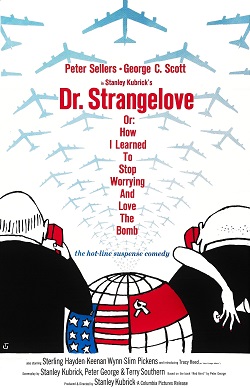
Behind the film
- Year
- 1964
- Director
- Stanley Kubrick
- Writers
- Stanley Kubrick, Terry Southern, Peter George
- Genres
- Black comedy, Comedy, War
- Production
- Hawk Films, Columbia Pictures
- Country
- United States, United Kingdom
- Cast
- Peter Sellers, George C. Scott, Sterling Hayden, Keenan Wynn, Slim Pickens, Peter Bull, James Earl Jones, Jack Creley
About the film
Contains story spoilers.
Stanley Kubrick’s Dr. Strangelove begins with General Jack D. Ripper sealing Burpelson Air Force Base and ordering its B-52 bombers to carry out Plan R against the Soviet Union. His executive officer, RAF exchange officer Lionel Mandrake, realizes the order has not come from the Pentagon, but Ripper locks them in his office. He claims the Soviets are poisoning American water supplies with fluoride, a delusion that turns his authority into a direct threat. The bombers’ communication systems accept only a recall code known to Ripper, so the normal chain of command cannot simply reverse his decision.
At the Pentagon, President Merkin Muffley convenes a war room with generals and the Soviet ambassador. General Buck Turgidson urges the president to exploit the attack and send reinforcements; Muffley rejects the proposal and tells Soviet premier Dimitri Kissov what is happening. The ambassador reveals that the USSR has built a doomsday machine of buried cobalt bombs, set to trigger automatically after a nuclear attack. Dr. Strangelove, the president’s German scientific adviser, points out that the device can deter an enemy only if its existence is publicly known. It has not yet been announced, so the supposed safeguard is also a trap.
The film cuts between these rooms and the bomber commanded by Major T. J. ‘King’ Kong. On board, the crew works through the attack procedure while damage from a Soviet missile disables communications and creates problems with the bomb bay doors. Kubrick gives the military task a matter-of-fact rhythm: checklists and technical repairs continue even as the characters understand what a successful mission means. Meanwhile, Mandrake searches Ripper’s office for the secret code. The absurdity comes from the gap between the precision of the systems and the irrational beliefs and errors that control them.
Army troops eventually take Burpelson. Ripper kills himself rather than be captured, leaving Mandrake to infer the recall code from notes on his desk and get it to the Pentagon. Strategic Air Command recalls nearly all the planes, but Kong’s bomber cannot receive the message. With the earlier missile damage still unresolved, Kong climbs into the bomb bay to repair the wiring. He succeeds, but the bomb drops with him straddling it, as he whoops and waves his hat. The sequence turns the film’s most catastrophic act into a grotesque piece of military slapstick.
In the war room, the consequences of that one bomber become immediate. The doomsday machine will detonate in response, and officials shift from stopping a war to calculating survival in underground shelters. Strangelove proposes a population selected for a long stay below ground, with ten women for each man; Turgidson reacts to the plan as though this is another strategic briefing. The movie closes with mushroom clouds accompanied by Vera Lynn singing ‘We’ll Meet Again.’ The refrain offers no rescue; it sharpens the distance between ordinary optimism and the destruction the characters have failed to prevent.
The black-and-white photography and Ken Adam’s cavernous war-room set give the machinery of decision a theatrical scale. Sellers plays Mandrake, Muffley and Strangelove, shifting among a restrained officer, a conciliatory president and an adviser whose body and speech embody the instability of the room. George C. Scott’s Turgidson and Sterling Hayden’s Ripper make different forms of certainty comic and frightening. The film adapts Peter George’s novel Red Alert, but its black comedy is a fictional scenario, not a documentary account of nuclear command procedures.
The war room’s enormous circular table and map-lit darkness turn policy debate into a contest for space and attention. Muffley remains composed even when the room’s assumptions collapse, while Turgidson repeatedly tries to recast disaster as an opportunity to win. Mandrake’s ordinary task—finding a code and reaching a telephone—becomes as important as the global strategy. The film’s joke is not that the danger is unreal; the danger is that every technical safeguard depends on people who can misunderstand, miscalculate or choose badly.
Mandrake’s effort to make a telephone call becomes a miniature version of the larger crisis. Colonel Bat Guano arrives after the base is taken and initially treats him as another person to arrest. Mandrake has information that could recall the planes, but authority and suspicion prevent him from using it. Even once he reaches a pay phone, he needs coins; persuading Guano to shoot open a drinks machine produces a warning about answering to the corporation that owns it. The sequence puts an ordinary property concern beside the possibility of nuclear annihilation. Meanwhile, Muffley’s call to the Soviet premier has the awkward rhythm of somebody trying to soothe an upset acquaintance. He has to explain that an American commander has launched an attack without making the admission sound like another threat. Both scenes turn communication into physical work, requiring access, money, patience and a willing listener. The world’s most powerful weapons have been set in motion, while the people attempting to stop them struggle with problems as small as reaching a phone or finishing a sentence.