
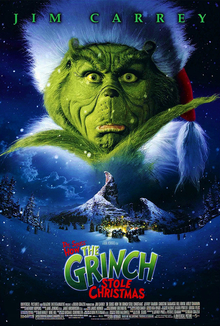
Behind the film
- Year
- 2000
- Director
- Ron Howard
- Writers
- Jeffrey Price, Peter S. Seaman
- Runtime
- 1h 45m
- Genres
- Comedy, Family, Fantasy, Children's
- Production
- Imagine Entertainment
- Country
- United States
- Cast
- Jim Carrey, Taylor Momsen, Jeffrey Tambor, Christine Baranski, Bill Irwin, Molly Shannon, Clint Howard, Anthony Hopkins
About the film
Contains story spoilers.
Ron Howard’s live-action adaptation begins in Whoville, where Cindy Lou Who encounters the Grinch, the green recluse who lives above town on Mount Crumpit. As she asks about him, she learns how childhood humiliation and the Whos’ social life helped shape his hostility. Cindy nominates him for the town’s Holiday Cheermeister, but Mayor MayWho turns the ceremony into another injury, and the Grinch retreats to plan a theft. Disguised as Santa, he removes the town’s decorations, gifts and food. When the Whos sing despite waking to empty homes, he realizes their holiday is not reducible to possessions. He saves the sleigh from falling with Cindy aboard, returns the stolen things, apologizes and is welcomed into the community, where the feast moves to his cave.
Whoville is designed as a culture of conspicuous celebration. Its buildings, clothes, gadgets and rituals make Christmas a public performance, and the town’s residents compete to appear more festive than their neighbors. The density of ornament gives the film a visual language for the Grinch’s complaint that the holiday has become material display. But the story does not simply validate his contempt: the Whos’ attachment to their customs is also genuine, and their songs continue when the objects disappear. This distinction makes the town more than a collection of shallow targets. The satire lands on status-seeking behavior while leaving room for communal warmth to exist beneath it.
Cindy’s curiosity supplies the story’s route between the mountaintop and the town. She does not approach the Grinch as a puzzle to solve or a villain to defeat; she asks the adults what they know, then decides that their explanations are not sufficient. Her optimism is active rather than passive because she takes responsibility for the invitation and for the consequences when the grown-ups blame her. The film’s child perspective also keeps the adult community honest. Cindy can see when authority uses a ceremony to exclude, while adults have learned to treat the town’s habits as normal. Her willingness to keep asking gives the comedy a moral center without making her speak like a miniature lecturer.
The expanded backstory turns the Grinch’s isolation into a social history. He once wanted to fit among the Whos, and the school’s ridicule over his appearance becomes a formative humiliation. The adult Grinch then converts shame into performance: he makes a spectacle of not caring, using jokes and provocation to control how others see him. That behavior can be hurtful, yet the film explains its origins without pretending it excuses everything he does. Carrey’s performance is central to that balance. His mobile face and restless physical timing make the Grinch’s sarcasm seem like armor that is never fully secure. Beneath the bravado, brief pauses and glances reveal a character who remains attuned to rejection.
Mayor MayWho embodies the town’s more coercive side. He does not merely enjoy Christmas; he uses public recognition and material display to reinforce his own place at the center. His antagonism toward the Grinch and his interest in Martha May reveal how status operates in Whoville: gifts become signals, ceremonies become opportunities to command attention, and belonging can be withheld from those who do not perform the expected role. Martha is not just a prize in that contest. Her choices expose how little a grand gesture means when it treats affection as something to purchase. The story’s treatment of the mayor gives the Grinch’s resentment a target more precise than the entire town, even as it shows that resentment widening into a blanket judgment.
The production design builds an exaggerated, tactile world of curled roofs, rounded forms and crowded surfaces. Whoville feels deliberately overfull, while the Grinch’s cave is a contrasting space organized around solitary routines and improvised devices. The shift between these environments gives the adaptation a strong spatial joke: the town’s abundance looks enticing from afar and exhausting up close, while the mountain retreat is harsh but legible to its resident. Costume, makeup and physical performance make the inhabitants part of the same stylized world. The Grinch’s elaborate transformation into Santa lets the film turn disguise into a comic set piece, but it also emphasizes how easily a person can pass through a community when wearing the role it expects.
Max gives the Grinch a relationship that does not depend on shared language or social rules. The dog’s patience and alertness register a form of companionship that survives the master’s moods, and their scenes provide a gentler rhythm alongside the Grinch’s loud comic provocations. The film’s broader expansion from Dr. Seuss’s compact story makes space for childhood, civic hierarchy and romance, but it keeps the core moral problem readable: a holiday built around generosity can still reproduce exclusion if its community values appearances over attention. The resolution is satisfying because welcome becomes an action the Whos extend, not a reward the Grinch earns by becoming conventionally cheerful. The cave can become a shared place without requiring him to erase his oddness.