
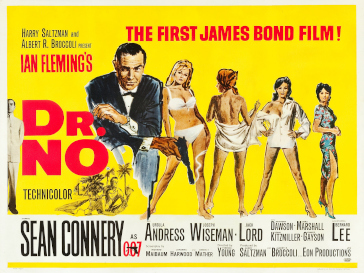
Behind the film
- Year
- 1962
- Director
- Terence Young
- Writers
- Richard Maibaum, Johanna Harwood, Berkely Mather
- Runtime
- 1h 49m (1962 cinema classification)
- Genres
- Spy, Action, Adventure, Thriller
- Production
- Eon Productions
- Country
- United Kingdom
- Cast
- Sean Connery, Ursula Andress, Joseph Wiseman, Jack Lord, John Kitzmiller, Bernard Lee, Anthony Dawson, Eunice Gayson
About the film
Contains story spoilers.
Terence Young’s Dr. No begins with the murder of John Strangways, the British intelligence chief in Jamaica, and his secretary. Strangways had been investigating interference with American rocket launches, so James Bond is sent from London to find out what happened. He arrives in Kingston and starts with the people who last saw the missing agent, including geologist Professor Dent. Bond follows small clues rather than receiving a complete picture at once: a receipt, an old photograph and the uncertain testimony of people connected to Strangways. The island setting makes the investigation feel local and social, with drivers, hotel staff and officials each holding only part of the story.
Bond learns that Quarrel, a local fisherman, helped Strangways collect rock samples from Crab Key, an island controlled by the reclusive Dr. No. CIA agent Felix Leiter is also investigating interference with rocket launches, while Bond’s investigation connects the island to interference with American rocket launches. Professor Dent lies about what he found and later tries to kill Bond with a tarantula. Bond survives, then follows secretary Miss Taro’s suspicious invitation. Once Bond overhears her reporting that she will keep him occupied, he has her arrested. Dent arrives at Taro’s house afterward and fires into a decoy arranged in the bed. Bond confronts him from concealment and kills him when he tries to fire again.
Bond and Quarrel travel to Crab Key at night and meet Honey Ryder, a shell diver who gathers valuable shells from the island. The three move through the jungle while Dr. No’s guards search for them. A flame tank disguised as a dragon terrifies them, and its operators capture the group. Quarrel is killed by the machine’s fire. Bond and Honey are taken to the base, where they are decontaminated and given rooms before meeting their host. Dr. No explains that he is interfering with rocket launches, and his polished manners make the threat feel controlled rather than chaotic. His artificial hands and guarded compound distinguish him from the officials Bond has dealt with in Kingston.
Bond is separated from Honey and held under Dr. No’s watch. He resists interrogation and studies the layout of the facility, eventually escaping through a ventilation route. The underground base turns into a sequence of physical obstacles: security doors, guards, corridors and machinery each create another problem. Dr. No explains that he belongs to SPECTRE and is using a nuclear-powered beam to sabotage American rocket launches; the rock samples and radio jamming are related clues but not the same device. Bond sabotages the launch operation, fights Dr. No near the reactor controls and sends him into the radioactive cooling pool, where he dies. Honey has been bound in a room filling with water, and left to drown. Bond frees her before the flooding becomes fatal, and the two escape by boat as the base is destroyed.
The story resolves Strangways’s disappearance by connecting it to Dr. No’s wider operation, but Bond’s escape does not come from a large force arriving to rescue him. His investigation and improvisation carry him from the Jamaican station to the island base, and his allies each make a difference along the way. Quarrel’s local knowledge allows the crossing to Crab Key; Leiter’s information confirms the link to the rocket jamming; Honey survives capture and becomes Bond’s companion in the escape. The film gives those relationships a practical function inside its adventure plot without pretending that Bond could solve the case alone.
The film introduces a screen world that mixes island landscapes with engineered interiors. The Jamaican coast, the jungle and the secret base each give Bond a different kind of danger, while Ken Adam’s production design makes Dr. No’s lair memorable through severe lines and controlled color. Maurice Binder’s title sequence and Monty Norman’s music establish a stylized opening language that the later Bond films would build upon. Young’s direction keeps the suspense close to Bond’s point of view, often letting the audience learn a clue only when he has pieced it together. The result feels like an espionage story with a pulp adventure’s appetite for unusual locations and set pieces. The island also changes Bond’s ordinary tools. In Kingston he relies on conversations, documents and a hotel room; on Crab Key he needs to cross water, avoid guards and survive equipment designed to keep intruders under control. Dr. No’s base presents technology as the antagonist’s advantage, while Bond’s improvised sabotage turns the facility against its owner.
Dr. No is a 1962 adaptation of Ian Fleming’s novel, but its plot is a distinct film narrative. The screen story makes Jamaica the center of Bond’s investigation and turns Crab Key into a tightly controlled threat to rocket launches. It also establishes a character who can move between official offices, hotel rooms and dangerous hideouts without losing his composure. The ending gives the immediate operation a clear outcome while leaving the larger intelligence world in motion. Bond and Honey escape, the launch threat is stopped, and the film has introduced the pattern of investigation, ingenuity and danger that defines this particular adventure.