
Behind the film
- Year
- 1944
- Director
- Billy Wilder
- Writers
- Billy Wilder, Raymond Chandler
- Genres
- Crime, Flashback, Film noir, Drama
- Production
- Paramount Pictures
- Country
- United States
- Cast
- Fred MacMurray, Barbara Stanwyck, Edward G. Robinson, Porter Hall, Jean Heather, Tom Powers, Byron Barr, Richard Gaines
About the film
Contains story spoilers.
Double Indemnity begins with a man explaining a failure, which changes the kind of suspense its story can offer. The central question is not whether the scheme might become a triumph. A confession has already placed success under suspicion. What matters is how somebody who understands a system comes to believe understanding it will make him exempt from its consequences. Walter's professional knowledge makes the temptation unusually precise. He is not simply hoping that nobody notices; he wants to turn the habits of his own working world against that world, transforming experience into a confidence that increasingly prevents him from seeing what he has joined.
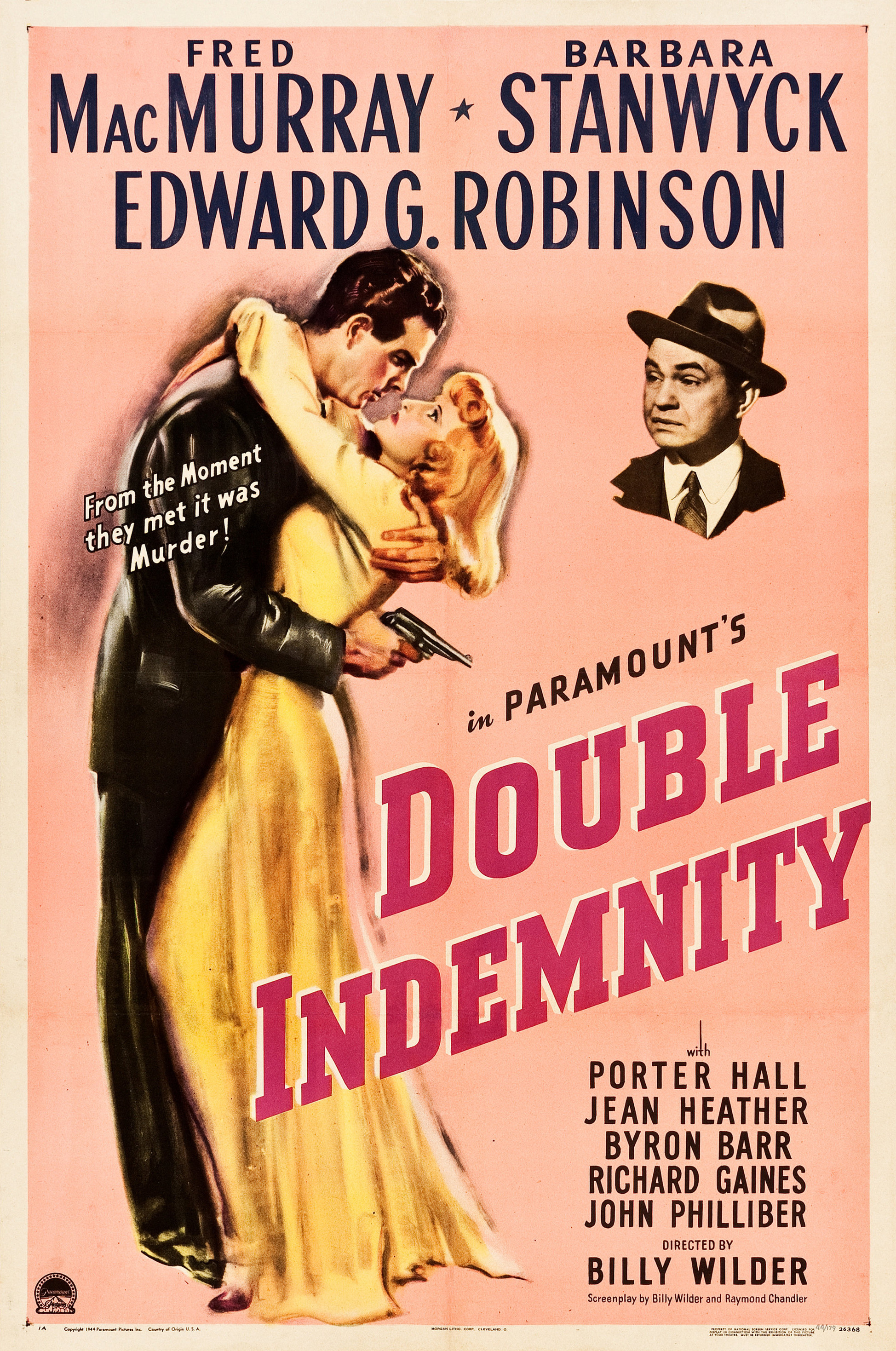
Billy Wilder directs the 1944 film, adapting James M. Cain's novel with Raymond Chandler. Fred MacMurray plays Walter Neff, Barbara Stanwyck plays Phyllis Dietrichson and Edward G. Robinson plays Barton Keyes. The insurance setting gives the crime an ordinary administrative environment. Visits, signatures, files and conversations become connected to an extraordinary intention, allowing danger to occupy activities that usually appear routine. That contrast is central to the film's world. The scheme does not require its participants to abandon respectability at once; it asks them to keep performing it while making its familiar procedures carry a meaning the people around them are not supposed to recognise.
Walter and Phyllis murder her husband and try to obtain an insurance payout by disguising the death as an accident. Keyes suspects a concealed accomplice, while Phyllis's stepdaughter Lola gives Walter reasons to distrust his partner. Suspicion breaks their alliance. Phyllis wounds Walter during their final confrontation, and he kills her. He returns to the office to record his confession, where Keyes hears him and summons help. Walter collapses before escaping. The ending brings the criminal account back to the colleague whose trust he exploited, making exposure personal as well as professional.
Walter's mistake begins with treating another person's proposed crime as an occasion to demonstrate expertise. Attraction matters, but so does the flattering possibility that he can design an exception to rules he knows better than an outsider would. That makes his involvement more than helpless surrender to someone else's manipulation. He becomes a participant who supplies knowledge and accepts the result as something he can manage. The film's retrospective account makes this confidence painful because explanation arrives after its promises have failed. Knowing how a person persuaded himself does not turn persuasion into an excuse, and the confession cannot restore the lives or trust on which his calculation depended.
Phyllis makes alliance unstable because the scheme's shared objective does not guarantee shared intentions. Two people can agree on an action while understanding its future entirely differently. Secrecy intensifies that problem: the connection needs trust, but its basis supplies evidence that trust can be exploited. The film allows suspicion to grow inside the arrangement instead of presenting it only as pressure from outside. What seemed to bind the pair becomes another reason to fear each other. Their knowledge of what the other has been willing to do cannot be set aside once the practical goal stops looking certain and each begins to consider who might become disposable.
Keyes gives scrutiny an emotional dimension. His ability to notice irregularities belongs to his work, but his closeness to Walter makes the investigation more complicated than a contest between criminal and detective. Trust can leave a person vulnerable precisely where their professional intelligence otherwise serves them well. The film makes that vulnerability meaningful without reducing friendship to stupidity. Keyes has reasons to value Walter, and those reasons are part of what Walter uses. The eventual confession therefore addresses somebody whose judgement matters beyond the threat of being caught. It reveals the harm within an ordinary bond that the crime treated as a convenient protection against suspicion.
Lola widens the account beyond the pair's private version of events. Her presence introduces a perspective that does not exist to flatter Walter's ingenuity or sustain his attraction. That matters because a scheme can shrink other people into practical obstacles: a signature needed, a witness avoided, a story made consistent. Someone else's account restores relationships and fears the calculation has excluded. The film's cruelty is not only that a plan destroys its planners. It is that the planners have already arranged their understanding of the world so that harm to others can appear as a necessary component of something imagined as their own escape or advancement.
The return to the office makes confession a form of belated recognition rather than a route to a clean beginning. Walter can explain what happened, but explaining it cannot return him to the position from which he believed it was still manageable. Keyes's presence brings the ending down to an intimate scale after a crime built around payment and concealment. Double Indemnity makes the administrative world frightening by allowing its ordinary knowledge to become an instrument of betrayal. Its final relationship gives that betrayal its clearest measure: a man has tried to defeat the procedures of his profession and discovers that the trust of somebody within it has become what he most needs to address.