
Behind the film
- Year
- 2001
- Director
- Richard Kelly
- Writers
- Richard Kelly
- Runtime
- 1h 53m
- Genres
- Comedy drama, Fantasy, Science fiction, Drama
- Production
- Flower Films
- Country
- United States
- Cast
- Jake Gyllenhaal, Jena Malone, Mary McDonnell, Drew Barrymore, Patrick Swayze, Noah Wyle, Katharine Ross, James Duval
About the film
Contains story spoilers.
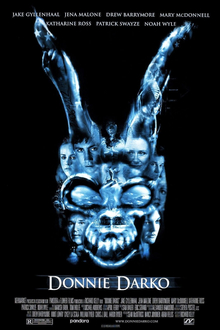
Donnie Darko makes a familiar suburban morning follow an event nobody can properly explain. A jet engine has fallen into the bedroom where Donnie should have been sleeping, but he has spent the night elsewhere after following a voice. The figure who called him out wears a grotesque rabbit costume and predicts an approaching end to the world. Richard Kelly puts that encounter beside family arguments, school routines and the political background of 1988, so the extraordinary never arrives in an empty setting. Donnie still has classes, parents and siblings whose lives proceed around a mystery that has made his own survival feel provisional.
Jake Gyllenhaal plays him with a mixture of sarcasm, vulnerability and sudden intensity. Donnie can be funny or cruel in conversation, and his resistance to adults does not make every suspicion automatically correct. His parents seek help from Dr Thurman, whose sessions provide one framework for understanding his experiences. The film places that framework alongside events that seem to exceed it, leaving the audience to attend to both without resolving every vision into a single explanation. Rose’s concern has particular weight because she must respond as a parent while receiving information she cannot fully test. Family affection remains present even when nobody knows what the appropriate response should be.
The school supplies several competing versions of authority. A teacher’s exercises reduce human behaviour to a simple opposition between fear and love, and motivational speaker Jim Cunningham turns that scheme into a confident public performance. Donnie finds the categories inadequate and refuses to treat the speaker’s assurance as evidence. Other teachers make more room for questions through literature or science, though they also work inside an institution that can limit what they say. The resulting conversations give the film an atmosphere of competing instruction: Donnie is being told how to understand himself by people with very different assumptions about what a person should know or admit.
Gretchen’s arrival gives him a relationship that is less easily governed by those assumptions. She has moved with her mother to escape a violent stepfather, bringing a private fear into the apparently settled neighbourhood. Their growing attachment makes Donnie’s time outside home and school more emotionally specific. He can speak with someone who has reasons of her own to distrust the appearance of safety. Their scenes let awkwardness and tenderness exist alongside the visions, so the approaching deadline threatens something more tangible than an abstract future. The possibility of being understood by another person develops just as Donnie’s understanding of the world becomes harder to communicate.
Frank’s instructions connect the strange experiences to actions with material consequences. The flooding at school creates disruption; the fire at Cunningham’s home exposes concealed evidence of child abuse. These events make it impossible to treat the visions solely as harmless private images. They also complicate any simple account of Frank as a trustworthy guide, since his influence reaches Donnie through menace and coercion. A book by Roberta Sparrow opens the subject of time travel, while the fluid shapes Donnie sees extending from people turn an idea about predetermined movement into a disturbing visual experience. The film gives these possibilities form without making its original theatrical telling function as a complete scientific manual.
Its humour keeps the setting recognisable while the pattern grows darker. The family’s arguments, the dance troupe’s ambitions and the exaggerated confidence of school personalities belong to an ordinary social world that can continue even when something terrible is happening beside it. Music and slow movement through corridors let that world briefly acquire the sensation of a remembered period, with people positioned almost like figures in a dream. The rabbit costume interrupts that familiarity by carrying the appearance of a festive object into an encounter with death. Later revelations about the person wearing it make the image more unsettling because it is attached to someone who also belongs to the same neighbourhood.
The Halloween party gathers circumstances that have been developing separately. With the adults away, Donnie and Elizabeth fill the house with guests while Gretchen arrives frightened about her missing mother. Donnie’s visit to Sparrow’s home then leads to a confrontation outside, where a car kills Gretchen and its driver is revealed as Frank in the rabbit costume. Donnie shoots him, creating the wound associated with the figure he has already encountered. A relationship and an apparition become part of the same sequence of violence. The subsequent storm and the plane carrying his mother and sister bring the falling engine back into the story, connecting the opening’s unexplained disaster to the weeks that followed it.
When those weeks unwind, Donnie remains in his bedroom and dies beneath the engine he previously escaped. The people who would have known him wake with troubled traces of experiences that no longer belong to their visible lives. Gretchen passes the house without having formed the relationship the audience has followed, and her brief exchange with Rose carries a tenderness neither can explain through shared memories. Michael Andrews and Gary Jules’s subdued version of Mad World gives that closing movement a different emotional register from the film’s earlier sarcasm. The ending permits a reading of sacrifice and restored possibility while preserving uncertainty about how much Donnie understood. Its final ache comes from relationships whose significance survives for the audience after their history has disappeared from the characters’ world.