
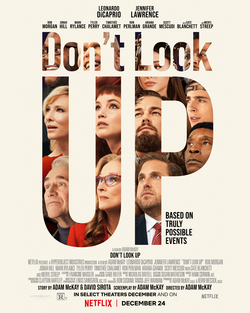
Behind the film
- Year
- 2021
- Director
- Adam McKay
- Writers
- Adam McKay
- Genres
- Comedy, Disaster, Satire, Science fiction
- Country
- United States
- Cast
- Leonardo DiCaprio, Jennifer Lawrence, Meryl Streep, Jonah Hill, Cate Blanchett, Rob Morgan, Mark Rylance, Timothée Chalamet
About the film
Contains story spoilers.
Kate Dibiasky and Randall Mindy discover an extinction-level comet approaching Earth. With Teddy Oglethorpe, they seek action from President Orlean, then take their warning to television. The response becomes a contest of publicity. Orlean launches a diversion mission but cancels it for billionaire Peter Isherwell's plan to mine the comet. Mindy accepts celebrity and influence before rejecting the scheme. As the comet becomes visible, competing campaigns turn looking at it into a political position. Other interception efforts fail, followed by Isherwell's technology. Elites escape on a spaceship while Mindy chooses a last dinner with family, Kate, Teddy and Yule. The comet destroys Earth. Much later, Orlean is killed on the refugees' new planet; a final scene finds her abandoned son Jason alive among the ruins.
The central joke is that the warning is extraordinarily difficult to misunderstand and still manages to become something else. A clear threat enters institutions designed to manage attention, reputation and advantage, and each institution translates it into its own preferred language. That makes the film's world feel less like a population failing one intelligence test than a network of people protecting familiar routines. The danger's scale does not automatically break those habits. It can even become an opportunity to intensify them. Adam McKay's satire uses that mismatch to make delay feel absurd and frightening at the same time. The catastrophe supplies a deadline, but the people responding to it behave as though a deadline must accommodate their existing priorities before becoming real.
Kate and Randall provide two different ways of encountering that world. Jennifer Lawrence's character finds it hard to make the warning sound comfortable, while Leonardo DiCaprio's character is more susceptible to the rewards offered to a useful public figure. Their contrast gives the scientific message an emotional complication without requiring the threat itself to become uncertain. Knowing the facts does not determine how someone will handle approval, frustration or exclusion. Randall's vulnerability to recognition is particularly important because the film does not reserve foolishness for its most obvious targets. Expertise can coexist with vanity. Kate's resistance, meanwhile, does not guarantee that other people will hear what she says. The story separates the reliability of a warning from the social acceptability of the person delivering it.
The television environment sharpens that separation. A message has to compete with the demand for an entertaining atmosphere, so seriousness can appear to be a failure of presentation. Cate Blanchett's Brie belongs to a world where tone is part of the product. The unsettling idea is not that humour must always be inappropriate, but that a preference for lightness can become a way of refusing what a subject requires. If every event must be processed as another comfortable segment, an uncomfortable truth arrives already at a disadvantage. The film gives that problem a personal dimension through the different responses its astronomers receive. Public attention may look like success while leaving the underlying purpose of the appearance almost completely unmet.
President Orlean turns the same problem into a question of political survival. Meryl Streep's character encounters the comet through the usefulness of acknowledging it at a particular moment, rather than through a stable commitment to what the evidence demands. Jonah Hill's Jason adds a relationship in which institutional power and family entitlement reinforce one another. Together, they make the presidency feel less like a place where competing responsibilities are weighed than a setting where the public danger has to earn its place beside private convenience. The exaggeration belongs to the satire, but the emotional mechanism is recognisable: people can remain absorbed in their own standing even when the circumstances seem to make that standing irrelevant. Urgency does not automatically produce humility.
Isherwell offers a different performance of certainty. Mark Rylance's billionaire treats technological confidence as a claim to authority, making immense resources appear equivalent to a reliable judgment. His presence gives the film a way to question the assumption that a powerful person must also possess the most useful solution. A disaster can be reframed as a commercial opportunity without losing any of its destructive potential. The distinction between a persuasive proposal and a tested answer matters throughout the story. What gives the proposal influence is not necessarily what gives it credibility. The film's fictional technology is part of that argument; it should not be treated as a practical account of planetary defence or as evidence about how a real comet mission would operate.
The crowds and campaigns expand those individual failures into a shared problem of belonging. A position can become a badge before it becomes a considered response to the situation. Once that happens, accepting the danger may feel like accepting defeat at the hands of an opposing group. The film's title condenses the absurdity into an instruction about attention itself. Looking seems simple, yet refusing to look can become an affirmation of loyalty. That gives the satire more force than a generic complaint that people are distracted. Its world shows how distraction can be actively defended, rewarded and made into an identity. A person may then reject an obvious fact because the fact threatens the social story that makes them feel secure.
The quieter emotional register matters because an extinction story eventually has to contain more than an escalating series of jokes. Relationships provide a measure of value that public performance cannot easily absorb. The presence of Yule and the people around Randall gives the film room to consider what remains meaningful when influence and ambition lose their apparent purpose. That does not erase the anger of the satire. It gives the anger something to protect. The human stakes are the ordinary lives that the grandiose systems claim to serve but keep treating as secondary. Understanding the film means holding its ridiculous personalities beside that more serious concern: a society can possess information, wealth and astonishing confidence while failing to do the work that would make any of those advantages matter.