
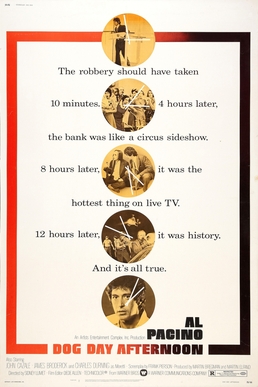
Behind the film
- Year
- 1975
- Director
- Sidney Lumet
- Writers
- Frank Pierson
- Genres
- Heist, Action, Drama, Crime
- Production
- Warner Bros. Pictures
- Country
- United States
- Cast
- Al Pacino, John Cazale, Charles Durning, Chris Sarandon, Penelope Allen, Sully Boyar, James Broderick, Carol Kane
About the film
Contains story spoilers.
Sonny Wortzik, Sal Naturile and Stevie attempt to rob a Brooklyn bank in August 1972. Stevie flees, and the remaining robbers discover most of the cash has already been collected. Smoke from burning records attracts attention, leaving Sonny and Sal trapped with the employees. Sonny negotiates with police and wins cheers from the crowd outside. His demands include transport to an airport and contact with Leon, his transgender partner; paying for Leon's surgery was a motive for the robbery. Leon refuses to join the escape, and Sonny tries to provide for both Leon and his estranged wife Angie. After the FBI takes control, a limousine carries the robbers and hostages to Kennedy Airport. Agents shoot Sal and arrest Sonny, freeing the employees. The story is a dramatization of a real robbery, with renamed characters and changes to the events.
The bank is an unusually ordinary place for a crime movie to spend so much time. It has the routines and cramped working spaces of a business rather than the impressive security architecture of a grand heist. That ordinariness makes the failed plan feel immediate: there is nowhere for the robbers to hide their uncertainty and no glamorous professionalism to carry them through it. The employees have to keep sharing the room with the men threatening them. Lumet gives that proximity weight, letting changes in the mood of a conversation matter alongside changes in the police operation. Suspense depends on people remaining together when they have every reason to fear what someone else might do.
Al Pacino's Sonny is energetic enough to seem capable of improvising his way out of anything, until the film makes clear how little improvisation can secure. His attention moves rapidly between hostages, negotiators and spectators. A gesture intended to calm one audience can excite another, making him responsible for a performance whose consequences he cannot fully predict. Pacino keeps the vulnerability close to the bravado. Sonny needs to believe he can keep directing events, because acknowledging his lack of control would leave him with almost no plan. The result is a character whose capacity to attract attention becomes both a resource and a trap, giving the siege a volatile emotional centre.
John Cazale's Sal occupies a quieter, more alarming space beside him. He is less able to turn pressure into speech, which makes silence another kind of uncertainty in the room. Sonny can negotiate and present a version of himself to the crowd; Sal's presence repeatedly brings attention back to the weapons and the limits of that presentation. Their partnership does not have the easy coordination of experienced criminals. Each has to interpret the other's fear while trying to manage his own. Cazale makes small reactions carry weight, giving the film a second rhythm underneath Pacino's restless movement. This contrast keeps the comedy from making the situation harmless, because a joke does not remove the danger of misunderstanding.
Outside, the street becomes an audience with interests of its own. People respond to Sonny's confrontations with police, but their excitement cannot protect anybody in the bank. The distance between applause and assistance is central to the film's treatment of public attention. A crisis can be turned into an event to watch while remaining a catastrophe for the people experiencing it. Lumet makes the crowd part of the pressure rather than a simple source of support. Sonny can briefly seem to command the street without commanding the situation. The film invites us to enjoy his audacity, then keeps making us notice the fragile basis of the apparent victory.
The conversations about Leon and Angie bring private relationships into an operation that has become painfully public. Sonny cannot explain his motives in a way that neatly reconciles the people in his life, and devotion does not give him the right to decide what another person wants. Chris Sarandon gives Leon an emotional presence independent of Sonny's account. Their exchange complicates the image of the robber as someone acting purely for someone else's benefit. The film makes room for affection, exhaustion and disagreement without treating identity as the answer to every question about the characters. Its concern is how a person is heard when somebody else is making dramatic claims on their behalf.
Changes of authority alter the atmosphere as much as they alter the practical options. Negotiation can seem personal when the same faces keep returning, but the institution behind those faces has priorities Sonny cannot negotiate away. The film's restricted setting makes that shift perceptible through voices, instructions and the narrowing room for uncertainty. It also prevents the story from becoming a complete account of the historical robbery or the society around it. This is a concentrated drama about people caught in a particular crisis. Its force comes from the uneasy coexistence of sympathy and fear: understanding someone's desperation does not make the hostages safe, and condemning the crime does not explain everything about the person committing it.