
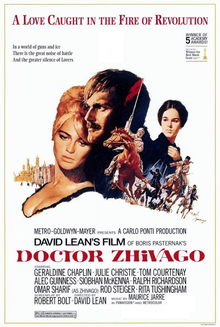
Behind the film
- Year
- 1965
- Director
- David Lean
- Writers
- Robert Bolt
- Genres
- Romance, Drama, War, Melodrama
- Production
- Metro-Goldwyn-Mayer
- Country
- United States, Italy, United Kingdom, Liechtenstein
- Cast
- Omar Sharif, Julie Christie, Geraldine Chaplin, Tom Courtenay, Rod Steiger, Alec Guinness, Ralph Richardson, Rita Tushingham
About the film
Contains story spoilers.
Doctor Zhivago is framed by a search in the Soviet era: General Yevgraf Zhivago speaks with a young dam worker, Tanya, whom he suspects may be the daughter of his half-brother Yuri and Lara. His account moves back to Yuri’s childhood and then across the upheavals that formed his adult life. The structure gives the story the shape of remembered family history rather than a straight chronicle. Yuri’s inherited balalaika, poetry and medical training accompany him through a country where public life changes faster than the people trying to make a home inside it.
As a young doctor in Moscow, Yuri is engaged to Tonya Gromeko, the daughter of the family who raised him. At the same time, Lara is trapped in the orbit of Victor Komarovsky, a wealthy older man connected to her mother. Lara is drawn to the idealistic Pasha Antipov, who is wounded during a peaceful demonstration, and helps him while concealing the gun he picked up. When Komarovsky assaults Lara, she later confronts him at a gathering and shoots him in the arm; Pasha escorts her away and marries her. The film introduces their lives through the pressures of class and power before bringing Yuri and Lara together at the war front.
During the First World War, Yuri serves as a battlefield physician. Lara has enlisted as a nurse in search of Pasha, now missing, and the two work together at a field hospital for months. Their affection grows in the middle of the wounded and the changing political order, but Yuri returns to Tonya and their son rather than abandon his family. By then Moscow has been transformed: their family house has been divided among multiple residents, and his half-brother Yevgraf warns that Yuri’s poems have attracted official suspicion. Yevgraf arranges travel papers for them to reach the Gromeko estate in the Urals, where they hope distance may provide some stability.
The journey itself becomes a passage through civil conflict. Their train crosses contested territory and encounters the armored train of Bolshevik commander Strelnikov, whom Yuri recognizes as Pasha under a new identity. Pasha tells him Lara is in Yuriatin, and the family eventually settles in a small neighboring cottage after finding the estate’s main house sealed. Yuri visits the town and sees Lara again; their relationship becomes an affair even as Tonya is pregnant with their second child. Yuri then breaks with Lara, but the war and politics will not let private decisions remain private for long: Communist partisans forcibly enlist him, taking him away from both households.
After two years, Yuri escapes and returns to Lara in Yuriatin. She tells him Tonya had searched for him and left a sealed letter: Tonya, her father and the children have been deported to Paris. The lovers reunite, but Komarovsky soon appears with an offer to get them out of Russia. They refuse at first and hide at Varykino, where Yuri writes poems about Lara even as security forces watch the area because of her marriage to Pasha. Komarovsky returns with soldiers and explains that Lara’s presence has been used to draw Pasha, whose capture and suicide he reports. Facing the threat of arrest, Yuri persuades Lara to accept passage with Komarovsky by allowing her to believe he will join them, then stays behind.
While riding a tram in Moscow, Yuri spots a woman he believes is Lara in the street and tries to reach her, but his heart gives out before he can reach her. Lara attends his funeral and asks Yevgraf to help find her lost daughter; their search fails, and she subsequently disappears. Yevgraf fears she died in a labor camp. Years later, Yevgraf’s search identifies Tanya as a possible child of Lara and Yuri; the young woman’s skill with the balalaika recalls the instrument Yuri had as a child, but the film leaves the evidence suggestive rather than fully resolved. The story’s landscapes and seasons make political rupture visible through everyday life: a house becomes communal space, a train is both refuge and checkpoint, and a journey across snow can be an act of survival. The film follows a love story, but its final emphasis is on what families retain and lose as history repeatedly displaces them.
The scale of David Lean’s production supports that intimate pattern. Crowded Moscow streets, railway movements and snowbound expanses place individual decisions against a country too large for any one character to control. Maurice Jarre’s recurring musical theme and the balalaika help join the frame story to Yuri’s memories, while the narrative’s shifts in time echo Yevgraf’s act of recollection. Robert Bolt’s screenplay compresses Boris Pasternak’s long novel into the path of Yuri and Lara, with Yevgraf serving as guide through the surrounding history. That choice keeps the emotional thread clear even as revolution and civil war repeatedly redirect the characters’ lives.
The film’s personal scale also depends on contrasts between public ceremony and private interruption. Yuri’s medical work places him beside people injured by the state and war, while his poetry records feelings that official judgments cannot comfortably contain. Tonya’s domestic life, Lara’s survival under Komarovsky’s influence and Pasha’s transformation into Strelnikov each show a different response to upheaval. Those strands keep the love story from belonging only to Yuri: the people around him make choices under pressures that are not solved by romance, and their separations carry the cost of a country remade by force.