
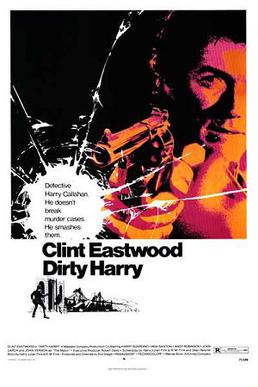
Behind the film
- Year
- 1971
- Director
- Don Siegel
- Writers
- Harry Julian Fink, R. M. Fink, Dean Riesner
- Genres
- Crime thriller, Action thriller, Action, Vigilante
- Production
- Malpaso Productions
- Country
- United States
- Cast
- Clint Eastwood, Andrew Robinson, Harry Guardino, Reni Santoni, John Vernon, Josef Sommer, John Larch
About the film
Contains story spoilers.
Don Siegel's Dirty Harry begins with an exposed view of San Francisco that offers no protection to the person inside it. A sniper fires at a woman in a rooftop pool, making the city a place where height and distance can separate a killer from his victim. Inspector Harry Callahan investigates the murder and finds a demand for money under the name Scorpio. Released in 1971, the film puts Clint Eastwood's detective between an unpredictable attacker and an organization that must answer for how it responds. Harry approaches that arrangement with impatience and a confidence in his own decisions. He sees the immediate threat more clearly than the value of the restrictions placed around his response.
Harry's manner gives that conflict a physical presence before the case reaches its legal crisis. Eastwood uses clipped speech and limited outward reaction, so a glance or a pause can carry an entire calculation. An early bank-robbery confrontation establishes how Harry turns uncertainty into pressure: a wounded robber cannot know whether the detective's gun still contains a round, and Harry makes that uncertainty part of his demand for surrender. The encounter offers a miniature version of the larger struggle. He is willing to put another person inside a decision whose terms he controls, using his reputation and a weapon together. The scene also gives the film an image it can return to later, when a different opponent faces the same uncertainty.
Harry's partnership with Chico gives the investigation a relationship that cannot be reduced to the solitary detective and his prey. Chico is a younger officer brought into a job Harry would rather perform without another inexperienced partner. Their exchanges establish different attitudes toward police work, while their shared movements show the practical value of another person watching an angle Harry cannot cover. Chico's eventual injury attaches a cost to the case that is neither an anonymous casualty nor simply an obstacle to Harry's progress. The partnership exists inside an organization, yet its consequences are intimate. Harry's habit of treating danger as something he should handle himself does not stop that danger reaching somebody assigned to work beside him.
Scorpio claims to have buried teenager Ann Mary Deacon and sends Harry through a payphone-directed ransom run. At their meeting, he beats Harry; Chico intervenes and is shot, and Harry wounds Scorpio before the killer escapes. A hospital lead takes Harry to Kezar Stadium, where he shoots and tortures Scorpio into disclosing the girl's location. She is found dead. The district attorney says Harry's unlawfully obtained evidence cannot be used and Scorpio must be released. Later, Scorpio hijacks a school bus. Harry intercepts it and pursues him to a quarry, where the killer takes a child hostage. Harry kills him after another confrontation over whether his revolver is empty, then throws his badge into the water. The case closes without a return to ordinary duty.
The city's locations make the pursuit depend on access and visibility. A rooftop supplies a firing position, telephone calls direct somebody through streets, and the stadium opens the chase into a space associated with organized public spectatorship. Harry's movements often involve finding a way toward somebody who has chosen where the next encounter will happen. The killer controls the ransom route remotely, but control shifts when Harry finds a place to confront him directly. Siegel gives these spaces different dimensions without allowing them to become interchangeable action backgrounds. The film can move from a crowded street to an almost empty arena and change the relationship between pursuer and target without needing another explanation of what either man wants.
Scorpio also tries to manipulate the appearance of police violence. His attempts to make Harry look like the aggressor exploit an existing weakness: the detective has already treated his own certainty as sufficient reason to cross limits. Andy Robinson's performance turns the killer's demands and evasions into an unstable form of pressure, while Eastwood makes Harry's responses seem controlled by comparison. That contrast belongs to the film's presentation, rather than proving that the calmer man is always entitled to act. The district attorney's refusal interrupts the momentum of the chase and asks what an arrest can establish beyond the officer's conviction. The thriller supplies Harry with a recognizable enemy, but the institution still needs evidence it can lawfully use.
The final hostage situation returns the gun-counting confrontation in a changed setting. Harry's earlier opponent had been a robber already brought to the ground; Scorpio has a child between himself and the detective. Repeating the uncertainty about the weapon connects Harry's opening display of authority to the conclusion of his main case. The water then becomes important in another way, receiving the badge rather than merely surrounding the chase. Throwing it away places Harry at a distance from the institution under whose name he has acted. The gesture has no accompanying explanation that resolves whether it is resignation, disgust or a rejection of its restrictions. The film leaves the physical action visible while withholding an orderly statement of what should follow it.
That ending keeps the story's two measures of success apart. Scorpio can no longer harm another victim, but the detective does not finish by taking a comfortable place within his department. The route between those outcomes has involved surveillance, demands, injuries, unlawful coercion and a release Harry cannot accept. Each institutional decision changes the pursuit, so procedure remains part of the thriller's action rather than a topic discussed outside it. Dirty Harry is a fictional police story, not a reconstruction of the Zodiac investigation or a guide to legal rules. Its particular tension comes from placing decisive physical action beside a badge whose authority is broader than any one officer's judgment, then leaving that badge behind at the moment the danger ends.