
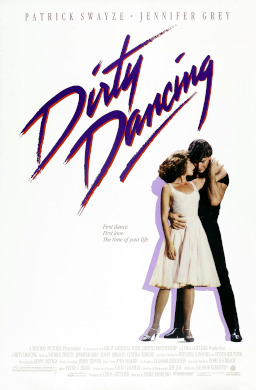
Behind the film
- Year
- 1987
- Director
- Emile Ardolino
- Writers
- Eleanor Bergstein
- Runtime
- 1h 40m
- Genres
- Romance, Musical, Drama, Teen
- Country
- United States
- Cast
- Patrick Swayze, Jennifer Grey, Jerry Orbach, Cynthia Rhodes, Kelly Bishop, Jane Brucker, Jack Weston, Max Cantor
About the film
Contains story spoilers.
Dirty Dancing places the excitement of a holiday inside a resort that sorts people before they ever reach the dance floor. Guests, waiters and entertainers occupy the same setting without receiving the same respect or opportunities. Baby Houseman initially approaches that setting through her family's comfortable position, then discovers a world that the official holiday does not fully acknowledge. Dance becomes a way into it, but the movement is social as well as physical. Learning a routine requires her to trust a person whose status encourages other people to dismiss him. The romance develops alongside a broader change in how she recognises work, vulnerability and authority.
In summer 1963, Baby helps resort dancer Penny pay for an abortion and substitutes for her in a performance with Johnny. When Penny is injured, Baby brings her doctor father to help. He wrongly believes Johnny is responsible and forbids the relationship developing between him and Baby. Johnny is later accused of theft; Baby supplies an alibi, but he is dismissed over their romance anyway. At the closing event, her father learns who was responsible for Penny's pregnancy. Johnny returns to dance with Baby, they complete their practised lift, and her father admits his mistake. The public celebration follows a series of private choices about whose dignity deserves protection.
Baby's willingness to help does not initially give her a complete understanding of the situation. That makes the story's coming-of-age movement more useful than a portrait of a naturally enlightened heroine teaching everybody else. She has resources that others need, yet resources do not remove the need to listen or learn. Jennifer Grey's character becomes more capable by entering relationships that challenge her assumptions. The name Baby suits the starting position without containing the whole person. Growing up here involves discovering that a protective family account of the world can be incomplete, and that disagreement with it can become a form of responsibility rather than simple rebellion.
Johnny's position makes that disagreement consequential. Patrick Swayze's dancer can be valued for what he provides to the resort while still being treated as socially inferior to the people who consume it. Admiration on a dance floor does not guarantee respect elsewhere. The film gives his skill a visible form, making the gap between competence and status hard to ignore. He knows how to do something Baby needs to learn, so their relationship reverses the easy assumption that her more privileged background makes her the person with all the useful knowledge. His insecurity about being judged also shows how class can become something a person carries inside, rather than only a rule imposed from outside.
Penny's situation keeps the romance from becoming the only measure of the holiday. Her need concerns health, work and money at once, exposing conditions that can be overlooked when the staff are treated merely as part of the entertainment. Cynthia Rhodes's role gives Baby a reason to act before the couple's public recognition becomes the central goal. The film's 1963 setting makes the danger of the unsafe procedure part of the story's social world. It is not a medical guide, but a dramatic circumstance in which compassion requires practical assistance. Baby's father provides that assistance even while misunderstanding another part of the situation, allowing care and prejudice to coexist within one person.
Jerry Orbach's Dr. Houseman therefore has more to revise than a rule about whom his daughter can see. His authority has been built partly on her trust that he is fair, and the conflict makes fairness something he must demonstrate again rather than simply claim. Baby can recognise his care while challenging how he distributes judgment. That gives their relationship an emotional tension different from a simple rejection of parents. She is trying to remain accountable to a value he has helped give her, while pointing out where his own behaviour falls short of it. The story allows the parent to learn without making the child's earlier dependence worthless.
Dance makes those changes visible through a shared physical task. A successful partnership depends on attention, timing and confidence in another person, qualities that cannot be supplied by a declaration of love alone. Emile Ardolino's film uses the routines to let practice and pleasure occupy the same space. The work behind a performance becomes part of what the performance means. That is especially useful in a story whose resort has been dividing workers from the people enjoying their work. The dancers' movement eventually creates a public occasion in which that division can be challenged, even if one celebratory evening cannot permanently settle every inequality outside it.
The final lift completes something Baby has learned rather than granting her a sudden transformation without effort. Its significance comes from the earlier uncertainty and from choosing to appear publicly with Johnny after the consequences have become clear. The reunion with her father gives the ending another form of recognition, allowing affection to continue on less unquestioned terms. Written by Eleanor Bergstein, Dirty Dancing makes its romance depend on acts of trust and solidarity as well as attraction. The holiday becomes a remembered threshold: Baby begins to use her own judgment, and the dance gives that new confidence a moment when other people can finally see it.