
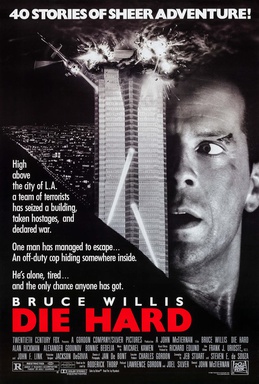
Behind the film
- Year
- 1988
- Director
- John McTiernan
- Writers
- Jeb Stuart, Steven E. de Souza
- Runtime
- 2h 12m
- Genres
- Action, Action thriller, Christmas, Heist
- Production
- Silver Pictures, Gordon Company
- Country
- United States
- Cast
- Bruce Willis, Alan Rickman, Bonnie Bedelia, Reginald VelJohnson, William Atherton, Paul Gleason, Alexander Godunov, Hart Bochner
About the film
Contains story spoilers.
John McClane arrives in Los Angeles on Christmas Eve to visit his estranged wife, Holly, who works for the Nakatomi Corporation. Their marriage has been strained by her career move, and the party at Nakatomi Plaza gives them a chance to speak without resolving the argument. McClane changes clothes in another room as the building is taken by Hans Gruber and his armed crew. The guests become hostages, while McClane slips away and the limousine driver Argyle remains in the garage, unaware of what has happened. The film quickly establishes its central geography: a single unfinished office tower where every floor and shaft can become either a route or a trap.
Gruber presents the takeover as terrorism, but his actual objective is the bearer bonds in the building’s vault. He kills executive Joseph Takagi when Takagi refuses to provide the access code. McClane finds a radio and contacts the LAPD, but his warning initially sounds like a prank. Sergeant Al Powell is sent to check the building; McClane uses a dead terrorist’s body to convince him that the danger is real. A SWAT team attacks and is driven back, while McClane uses explosives to disrupt the crew. Each intervention makes him more visible to Gruber, who knows a hidden adversary is interfering but does not yet know who he is.
McClane moves through service corridors and unfinished floors with little equipment, barefoot and injured. He uses the ventilation shafts to avoid the gunmen, steals weapons and sends messages through the radio. The building’s concrete and glass give the action practical limits: a stairwell can expose him, a locked door can delay an escape, and the open atrium makes every movement visible. Gruber’s team is organized and well armed, but their plan depends on keeping the hostages under control while the safe opens. McClane’s attempts to stop them produce escalating clashes, and the broken glass that cuts his feet turns each step into a reminder that he is not invulnerable.
Gruber kills Holly’s colleague Ellis after he fails to persuade McClane to surrender. Later, Gruber pretends to be an escaped hostage; McClane tests his story by handing him an unloaded gun, which Gruber tries to use against him. As the crew’s timetable tightens, Gruber discovers Holly’s relationship to McClane and takes her hostage. FBI agents arrive, seize command from the LAPD and cut the building’s power, inadvertently opening the final vault. Gruber’s plan is now close to completion, but he still needs the hostages and the authorities to follow his script. McClane tries to frustrate that control with whatever he can carry, including a bag of explosives and detonators. Powell’s radio exchanges also expose the difference between command and knowledge. The LAPD receives reports from outside but cannot see the interior, while McClane knows the hostages and floor plan only in fragments. When he drops a body from a window, Powell has to decide whether the evidence is real before the SWAT response begins. The sequence makes outside procedure part of the suspense: each side acts on incomplete information, and the delay lets Gruber’s crew maintain control longer than a conventional police arrival would allow.
The climax sends the remaining hostages to the roof under the pretense of a helicopter evacuation. McClane recognizes the roof is rigged with explosives and sends the hostages away before the blast. He ties a fire hose around himself and jumps from the roof to escape the explosion, then breaks a window to get back inside. In the garage, Argyle stops Theo’s attempted escape. Gruber holds Holly near the vault as McClane approaches with almost no ammunition left. McClane has taped a gun to his back; he shoots Gruber and the remaining gunman. Gruber falls through a window but catches Holly’s watch, pulling her toward the drop until McClane releases its clasp. Outside, Powell kills Karl when he emerges for a final attack. Argyle drives McClane and Holly away together.
The film’s tension comes from moving between McClane’s physical improvisation and the official response outside. Radio conversations let Powell become a character rather than a distant dispatcher, while Holly’s exchanges with Gruber show how a hostage can read the room and challenge the captor’s authority. The Christmas setting is present in music, decorations and office-party rituals, yet the action treats the building as a worksite with specific engineering and access routes. John McTiernan’s direction keeps the audience oriented enough to understand why McClane chooses each passage, then uses height and distance to make those choices feel dangerous.
Die Hard gives its action hero visible limits: McClane bleeds, runs out of ammunition and makes mistakes, but keeps acting because no one else inside can. Gruber is not seeking political change; the terrorist story is a cover for theft, and the film’s central contest is between an improvised rescuer and a polished criminal plan. McClane and Holly leave together, but their reunion is tentative rather than a complete repair of the problems that brought them apart. The ending resolves the hostage crisis while keeping the marriage as an ordinary relationship that will still require conversation after the sirens fade.