
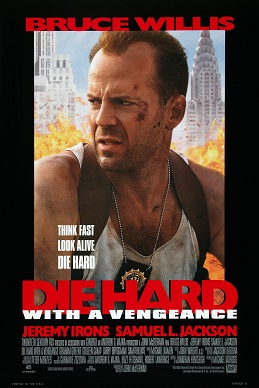
Behind the film
- Year
- 1995
- Director
- John McTiernan
- Writers
- Jonathan Hensleigh
- Runtime
- 2h 8m
- Genres
- Heist, Action, Action thriller, Buddy
- Production
- Cinergi Pictures, 20th Century Studios
- Country
- United States
- Cast
- Bruce Willis, Samuel L. Jackson, Jeremy Irons, Graham Greene, Colleen Camp, Larry Bryggman, Sam Phillips, Nick Wyman
About the film
Contains story spoilers.
Die Hard with a Vengeance takes John McClane out of the enclosed spaces that shaped his earlier battles and sends him across New York, already exhausted before the trouble starts. Bruce Willis plays a policeman whose separation from Holly and heavy drinking have left him angry and unreliable. A department-store explosion brings a caller named Simon into contact with the police, demanding that McClane follow humiliating, dangerous instructions. The detective is no longer simply the person who happens to be present when a crime begins. Someone has deliberately selected him, and the whole city becomes the place where that selection is tested. John McTiernan directs the film around motion, interruptions and sudden changes of destination, so McClane seldom has the luxury of understanding one emergency before the next arrives.
His essential companion is Zeus Carver, a Harlem shopkeeper played by Samuel L. Jackson. Zeus intervenes when Simon's first demand places McClane in immediate danger, an act of practical humanity that draws him into the bomber's demands. He has no wish to become a policeman's assistant and no reason to trust this particular policeman. Their conversations carry irritation about race, authority, responsibility and the assumption that one man can order another into danger. Jackson makes Zeus's intelligence inseparable from his impatience: he notices what McClane misses, questions instructions and refuses the easy role of grateful sidekick. Willis answers with a mixture of wounded pride and grudging recognition. Their partnership develops through the work they perform together, with neither becoming a suddenly agreeable version of himself.
Simon uses telephone calls and timed puzzles to control their movements. A threatened subway bombing turns transport into a race against a clock; a later water-jug problem requires exact reasoning in the middle of a public emergency. These episodes make everyday city objects feel newly consequential. Stations, taxis, phones, road junctions and park fountains become parts of a system whose rules are being supplied by an unseen opponent. McClane's instinct is to improvise through physical danger, while Zeus is often better placed to challenge the logic of a demand. The film allows that difference to shape the action instead of treating the riddles as decorative pauses between fights. Its humour comes partly from how little patience either man has for a villain who expects them to think clearly while frightened, injured and furious.
Jeremy Irons gives Simon the manner of someone enjoying a performance he has rehearsed. The revelation that he is Hans Gruber's brother supplies a personal connection to McClane's past, but the operation has a financial purpose beyond revenge. A threat against an unidentified school directs the police toward protecting children, while the real theft targets the Federal Reserve's gold. McClane begins to see the importance of where the authorities are being sent and what those movements leave unguarded. That is a change in the kind of problem he faces: surviving Simon's instructions is insufficient if compliance keeps helping the robbery. The plot turns on attention being a limited resource. Every urgent call creates an apparently obvious priority, and Simon has arranged those priorities so that concern itself becomes useful to him.
The supporting police characters keep that concern tangible. Larry Bryggman's inspector and the officers played by Graham Greene and Colleen Camp are trying to manage a city-wide threat with incomplete information, not merely waiting for McClane to solve the film. The promised school explosion makes the possibility of failure feel different from a defeat in a private feud: families and children could suffer because a demand was misunderstood. Meanwhile, the gold leaves in trucks, giving the crime a heavy, industrial scale. McTiernan repeatedly places bodies beside infrastructure much larger than themselves, from streets clogged with traffic to enormous underground works. The physical environment determines what the characters can see, reach and survive.
Once McClane enters the water tunnel, the film combines that scale with his familiar habit of continuing after any sensible person would stop. Flooding, pursuit and an eventual reunion with Zeus carry the investigation toward a ship where Simon captures them. His announced intention to destroy the gold is another deception; the pair escape the vessel's explosion, and McClane recognises that the stolen cargo has gone elsewhere. Their survival depends on ordinary acts of cooperation under extraordinary pressure. Zeus is no longer simply someone ordered to accompany McClane, and McClane has had to accept that independent judgment can matter as much as his own refusal to give up. The relationship remains abrasive, but its practical trust is now visible in what each man is willing to risk.
The theatrical ending turns a small object into the clue that breaks Simon's distance from his victims. An aspirin bottle leads McClane toward the criminals' location in Quebec, where the escape operation is interrupted. Simon and Katya try to flee by helicopter, and McClane's shot at an overhead power line helps bring their aircraft down. It is an ending built around noticing and exploiting the surroundings rather than matching the villain's elaborate plan with another elaborate plan. Zeus then encourages McClane to call Holly. That unfinished domestic conversation reconnects the action to the troubled life shown at the start, without pretending that a successful pursuit has automatically repaired his marriage. The day's achievements create an opportunity to speak; they do not supply the answer for him.
Jonathan Hensleigh's screenplay gives the film two simultaneous sources of momentum: Simon's machinery of distraction and the developing rhythm between McClane and Zeus. McTiernan keeps both grounded in a noisy, populated city where a journey can be delayed by the very people the heroes are trying to protect. The changing locations prevent McClane from mastering a single building and steadily taking control of it. That structure gives Jackson's character room to remain indispensable, because the action needs interpretation as well as endurance. The result is a story about reluctant cooperation in which a complicated theft is gradually exposed through arguments, observation and small decisions made under pressure.