
Behind the film
- Year
- 1990
- Director
- Renny Harlin
- Writers
- Steven E. de Souza, Doug Richardson
- Runtime
- 2h 4m
- Genres
- Action thriller, Action, Thriller, Christmas
- Production
- Gordon Company, Silver Pictures
- Country
- United States
- Cast
- Bruce Willis, Bonnie Bedelia, William Sadler, John Amos, Franco Nero, Art Evans, Dennis Franz, William Atherton
About the film
Contains story spoilers.
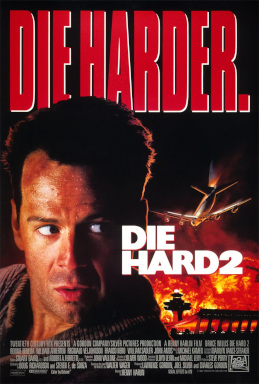
At Dulles Airport during Christmas week, LAPD lieutenant John McClane awaits his wife Holly. Colonel William Stuart’s followers seize airport communications to ensure a plane carrying General Esperanza can land. They hold other aircraft circling with low fuel. McClane alerts airport officials, but distrust and confusion slow the response. With airport engineer Leslie Barnes and janitor Marvin, he tries to restore communication and oppose the attackers. The effort reveals that Major Grant’s security team is working with Stuart. McClane reaches the gang’s waiting 747, prevents its departure, and ignites a fuel trail that destroys the aircraft and marks a safe landing route for the circling planes. He and Holly are reunited as the airport police chief tears up his parking ticket.
The airport gives the sequel a different map from a city tower while preserving the first film’s basic pressure: an ordinary traveler must understand a system faster than the officials around him. Here, runways, control rooms, baggage areas, communications links, and aircraft form a large interdependent machine. An interruption in one part spreads outward, putting people who are nowhere near the attackers at risk. The premise lets the movie turn infrastructure into action geography. McClane’s challenge is not only to reach the villains but to make the airport’s separated groups understand what is happening.
McClane arrives as a visitor waiting for Holly’s plane, which ties the public emergency to a private reason for being there. Bruce Willis keeps the character’s impatience and dry humor intact, but the new setting gives him a different set of obstacles. He is not the person officially in charge of airport operations, and his warnings are easy to dismiss. His persistence comes from seeing a pattern before the people with authority accept it. The film uses this gap between knowledge and rank to move him through the airport while keeping his motive close to a family reunion.
Holly’s position aboard a circling aircraft prevents the wife from becoming a prize waiting in a safe room. She is trapped with passengers and shares the uncertainty of those whose plane cannot land. Meanwhile, Dick Thornburg’s presence reconnects the sequel to the previous story, though his curiosity creates risk for the flight. The people in the air and on the ground have different kinds of information, and the airport’s crisis is partly a problem of who can communicate it. Their parallel situations give the action an emotional center beyond McClane’s own pursuit.
The villains’ plan depends on making a technical system obey their political demand. Stuart’s group does not simply occupy a terminal; it interferes with communications, runway lights, and the procedures pilots rely on. The movie dramatizes the frightening scale of that dependency, though its airport logic is designed for action rather than as a documentary account of aviation. The threat is legible because characters explain how a failure in one system creates danger elsewhere. The audience can follow the stakes without needing to understand every technical detail.
Renny Harlin’s direction emphasizes movement across different airport zones. McClane runs between public spaces, service areas, and mechanical interiors, while the snowy exterior and aircraft interiors continually change the physical challenge. Practical environments make the airport feel like a workplace with hidden corridors rather than a neutral travel hall. The action scenes rely on clear objectives: restore a signal, reach a plane, or stop a departure. This spatial clarity gives the larger set pieces a human scale, even when the camera widens to show multiple aircraft waiting above the runway.
The Christmas setting returns as a texture rather than the story’s whole meaning. Holiday travel explains why Holly and other passengers are in transit, and it sharpens the contrast between family expectation and emergency. McClane’s impatience with airport authority is comic at first, especially in his exchange over the parking ticket, but the detail also defines his outsider position. He enters a system full of rules that do not recognize his urgency. The movie converts that minor irritation into a light thread running through a crisis much larger than the ticket itself.
Harlin gives the airport's scale a recurring human reference point: the people waiting for a journey to finish. They cannot see the whole operation and do not control the systems on which they depend. That separation makes the action more than a succession of fights in interesting spaces. Each movement has to mean something for people elsewhere, and the film keeps bringing those connections into view. McClane's stubbornness supplies a comic counterweight to the machinery's apparent impersonality. He wants someone to listen, take responsibility and act, even when the official response sounds reasonable. The sequel turns that familiar impatience into a large physical contest, then keeps its emotional purpose close to an ordinary expectation of reunion. Its spectacle is grounded in the wish for disrupted lives to resume, making the airport both an action arena and a place people simply want to leave safely.