
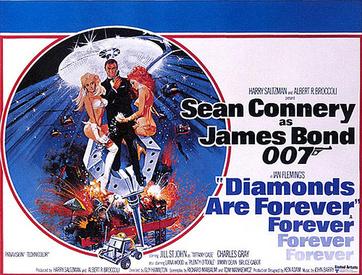
Behind the film
- Year
- 1971
- Director
- Guy Hamilton
- Writers
- Richard Maibaum, Tom Mankiewicz
- Genres
- Spy, Action, Adventure, Thriller
- Production
- Eon Productions, United Artists
- Country
- United Kingdom, Germany, United States
- Cast
- Sean Connery, Jill St. John, Charles Gray, Lana Wood, Jimmy Dean, Bruce Glover, Putter Smith, Bernard Lee
About the film
Contains story spoilers.
Diamonds Are Forever opens with Bond hunting Blofeld through a series of encounters that make identity itself unreliable. A facility producing lookalikes seems to offer the final confrontation, but the apparent resolution will prove deceptive. The next assignment begins more quietly, with disappearing diamonds and concern that someone is manipulating the market. M asks Bond to work his way into the smuggling chain. This is not initially presented as a mission to stop a spectacular weapon: he must discover who is collecting the stones and why. The shift from one problem to the other lets the film move between a criminal investigation and the larger ambitions of a returning adversary.
The chain already has people making sure its participants cannot talk. Mr. Wint and Mr. Kidd move from one contact to another, killing with a detached politeness that makes their exchanges as unsettling as their actions. Bond takes the identity of smuggler Peter Franks and meets Tiffany Case in Amsterdam. Tiffany knows the trade and has her own methods for checking whether a visitor is who he claims to be. When the real Franks arrives, Bond kills him in a cramped struggle and manipulates the identification afterward, persuading Tiffany that the dead man was James Bond. His assumed role survives because he makes the evidence support the story she already expects.
The next stage brings them to America with diamonds hidden in a corpse. Felix Leiter assists the operation, and the trail continues through a Las Vegas funeral establishment where a cremation becomes an attempted murder. Bond survives because the smugglers discover a problem with the stones he has supplied, leaving them needing information rather than another dead courier. The setting captures the film's willingness to turn ordinary commercial services into elaborate criminal machinery. A funeral business, a hotel and a casino are parts of a system in which material moves from hand to hand while the people carrying it are expendable. Following the diamonds requires Bond to keep himself useful long enough to identify the next contact.
Tiffany is neither an uncomplicated ally nor a committed participant in everything behind the smuggling. She initially tries to protect her own share and escape the danger, but the killing of Plenty O'Toole reveals how easily someone can be mistaken for her and removed. The consequences make cooperation with Bond more urgent. His investigation leads toward enterprises belonging to Willard Whyte, an enormously wealthy businessman whose absence from public view allows others to claim they are carrying out his wishes. A research facility turns out to be connected to a satellite project. Bond's escape in a moon buggy gives the discovery an absurd physical form: equipment meant for one controlled environment is suddenly used to flee armed men across the desert.
Las Vegas also gives the film a particular texture. It is a city of lights, entertainment and conspicuous money, well suited to an investigation where appearances are continually being manufactured. Bond and Tiffany's car chase passes through that public spectacle, while the Whyte House suggests that the commanding figure behind it all is inaccessible above the ordinary business below. Reaching its upper floor does not produce the expected meeting with Whyte. Instead, Bond encounters Blofeld and another double, together with technology that can imitate the billionaire's voice. The same trick that made the opening confrontation misleading has been expanded into the impersonation of an entire business authority.
After another attempt to dispose of him, Bond tracks down the genuine Whyte, held at a separate property. Rescuing him restores the distinction between the person whose name authorizes the operation and the person using that name. The stolen diamonds are components in a laser satellite, and Blofeld demonstrates its destructive power against nuclear installations. His ambition is to turn that power into an international auction, giving the highest bidder an overwhelming military advantage. The diamonds therefore never mattered only as wealth. The small valuable objects that began the investigation become the means of threatening states, connecting the smuggling plot to a much greater imbalance of power.
The final confrontation takes place at Blofeld's offshore base. Bond tries to interfere with the satellite controls, but his attempt does not neatly settle the mission; an assault on the installation is still needed. Blofeld attempts to leave in a small submarine, and Bond uses the launching machinery to turn his escape vehicle against the base. Tiffany survives the operation, though the film saves another danger for their journey afterward. Wint and Kidd return disguised as shipboard attendants, presenting an elaborate meal as the cover for their last attempt to kill Bond. His recognition of the deception brings the courier story to its conclusion after the larger blackmail scheme has been broken.
Guy Hamilton directs Sean Connery with a notably playful approach to danger, using Richard Maibaum and Tom Mankiewicz's screenplay to mix investigation with jokes, disguises and exaggerated escapes. Charles Gray's Blofeld relies on urbane delivery as much as menace, while Jill St. John's Tiffany can bargain, improvise and misjudge her position in the same scene. Ken Adam's designs give wealth and technology theatrical spaces, and John Barry's music connects the glittering surfaces to the underlying threat. The resulting world is full of people offering services, identities and pleasures that conceal something else. Bond succeeds by noticing the mismatch between those offers and the evidence in front of him.