
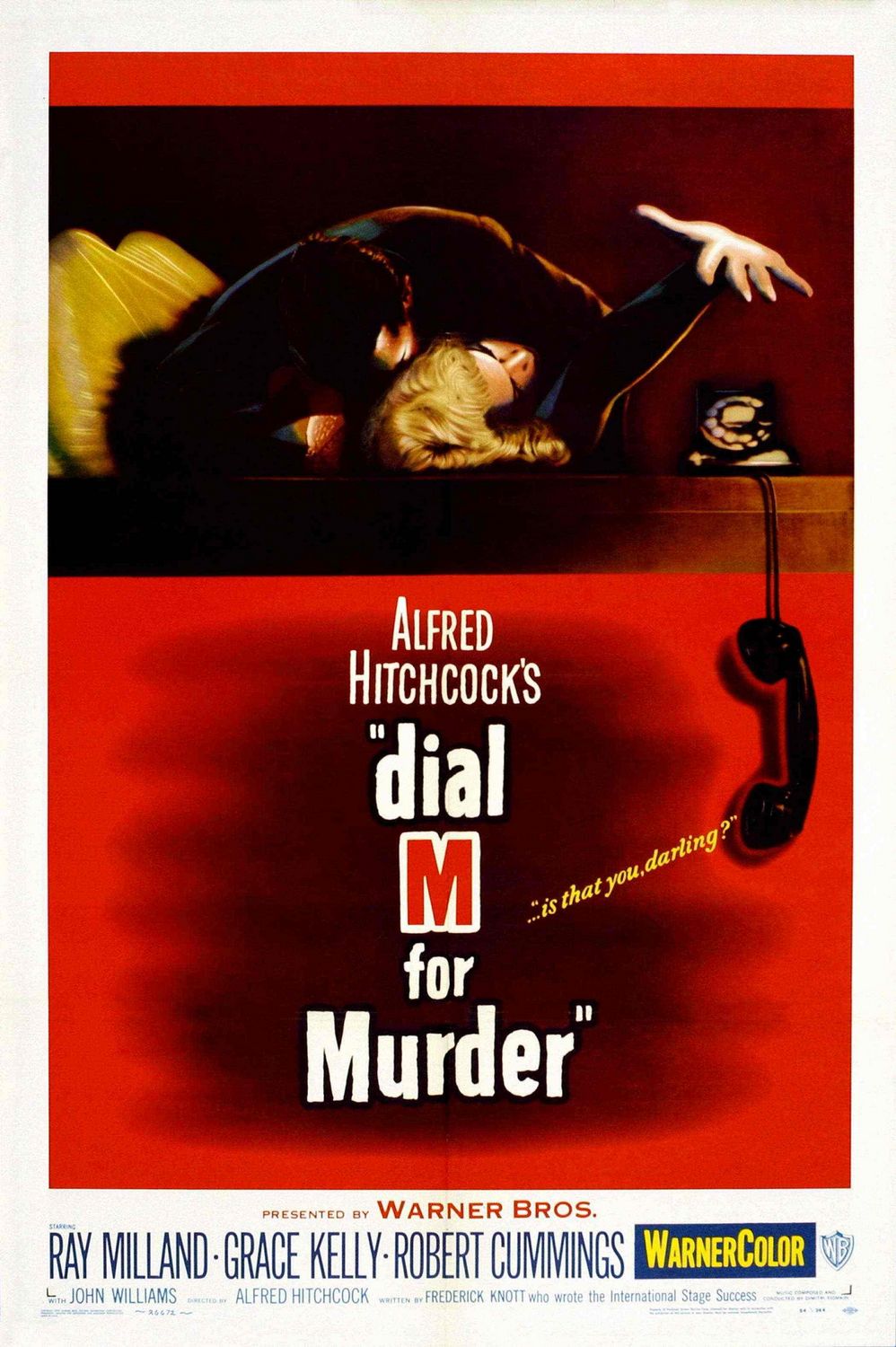
Behind the film
- Year
- 1954
- Director
- Alfred Hitchcock
- Writers
- Frederick Knott
- Runtime
- 105 minutes
- Genres
- Crime, Mystery, Crime thriller, Detective
- Production
- Warner Bros. Entertainment
- Country
- United States
- Cast
- Ray Milland, Grace Kelly, Robert Cummings, John Williams, Anthony Dawson, Patrick Allen
About the film
Contains story spoilers.
Dial M for Murder makes a familiar room into a place where knowledge is distributed unequally. A person can stand beside an ordinary object without understanding what another person intends to do with it. That difference drives the suspense. The viewer is allowed to understand the existence of a plan before the people exposed to it can recognise the danger. The film therefore asks more than who committed a crime. It asks how a convincing account of events gets manufactured, why it can be mistaken for the truth, and what kind of attention is needed to separate an arrangement of evidence from an honest explanation.
Alfred Hitchcock directs the 1954 adaptation of Frederick Knott's play, with Knott also writing the screenplay. Ray Milland plays Tony Wendice, Grace Kelly plays Margot, Robert Cummings plays Mark Halliday, John Williams plays Inspector Hubbard and Anthony Dawson plays the hired attacker. The setting is principally a London apartment, giving the characters a limited physical world in which their competing accounts must operate. That concentration is central to the film's identity. Instead of making uncertainty depend on an endless supply of new locations, it asks the same place to reveal different meanings as people's understanding of what happened there changes.
Tony plans to have Margot murdered after discovering her relationship with Mark. He recruits a criminal acquaintance and arranges an attack while he is away. Margot survives by killing her attacker in self-defence, but Tony manipulates the evidence until she is convicted and condemned. Mark's efforts to save her bring him close to the truth; Hubbard follows the discrepancies in Tony's explanation. The solution turns on a hidden key and Tony's knowledge of where it is. A trap exposes that knowledge, proving the scheme and freeing Margot. The mystery ends through an ordinary object's significance rather than a spectacular pursuit.
Tony's confidence rests partly on his ability to decide what other people will believe. He treats their possible responses as manageable components, as if a persuasive manner could make every uncertainty disappear. That attitude links the scheme to his position within the marriage. Another person's independence becomes a threat to be neutralised rather than a reality to confront honestly. The film makes that logic disturbing without needing to conceal it from the audience. Knowing that a respectable explanation is false can sharpen suspense: the question becomes how long its surface will hold and whether somebody vulnerable will suffer before it breaks.
Margot's predicament exposes the distance between being truthful and being believed. Fear and confusion can make an innocent person's account less orderly than the account prepared by someone who has had time to rehearse. A system that rewards apparent coherence can therefore reach the wrong conclusion. That does not make evidence useless; it makes the interpretation of evidence the essential problem. The story's pressure comes from watching a person's actual experience become subordinate to a version assembled around it. Her vulnerability is not only physical. It includes the possibility that other people will assign her intentions she did not possess and deny her explanation authority.
Mark brings the imagination of a crime writer into a situation with consequences beyond storytelling. Being able to picture a plausible alternative is valuable, but plausibility alone cannot settle the matter. A narrative may explain what could have happened without demonstrating what did. Hubbard's role gives the film a different standard: an account has to survive contact with the details it claims to explain. The distinction makes the investigation more interesting than a contest of clever speeches. Ideas require testing, and a useful theory must remain answerable to information its author cannot simply rearrange. That is what gives observation a force confidence cannot permanently resist.
The apartment's limited geography makes that test legible. A threshold determines entry, an object can move between owners, and a person's familiarity with a place can reveal more than their declared intentions. Domestic space holds habits as well as possessions. What someone notices, overlooks or assumes can therefore become revealing without ceasing to be ordinary. The film turns that familiarity into a source of tension: a room associated with private safety can also support surveillance, deception and unequal control. Its concentration invites sustained attention to small differences, allowing the setting to participate in the explanation rather than serve as a neutral background.
The resolution depends on bringing private knowledge into a situation where it can be recognised by others. That is why the ending belongs to the same world of doors, objects and explanations as the beginning. The story does not need a new kind of threat to conclude; it needs the significance of its existing details to become visible. The pleasure of its construction lies in that relationship between setup and consequence. Hitchcock's film is an enclosed crime drama about a manufactured reality meeting a practical limit, with the emotional stakes kept clear: somebody's life depends on whether people can distinguish a persuasive story from a true one.