
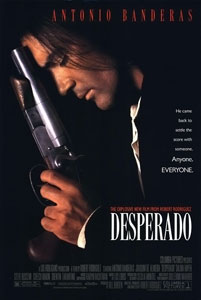
Behind the film
- Year
- 1995
- Director
- Robert Rodriguez
- Writers
- Robert Rodriguez
- Genres
- Action, Thriller, Crime, Contemporary western
- Production
- Columbia Pictures
- Country
- United States
- Cast
- Antonio Banderas, Salma Hayek, Joaquim de Almeida, Steve Buscemi, Cheech Marin, Quentin Tarantino, Carlos Gómez, Tito Larriva
About the film
Contains story spoilers.
Robert Rodriguez’s Desperado follows El Mariachi, a musician turned gunman, seeking drug lord Bucho in a Mexican town. A friend spreads his fearsome reputation. Bookseller Carolina shelters him after a shootout; he also learns that a boy carries drugs inside a guitar. Bucho financed the bookstore as a criminal front, and his men burn it when Carolina hides El Mariachi. The pair escape onto a rooftop, where El Mariachi sees Bucho but refuses to shoot. A later battle kills his musician friends and injures the boy. At Bucho’s compound, the reason for his hesitation emerges: they are brothers. When Bucho threatens Carolina, El Mariachi kills him. After visiting the boy in hospital, the lovers leave together, eventually retrieving the discarded weapons case as a precaution.
The film takes the grammar of a Western and plants it in a modern border town, where a guitar case can work as both an emblem of an old musical identity and a container for violent force. The mismatch is part of Rodriguez’s design. The mariachi remains recognizable through clothing, instrument and solitary movement, yet the streets and businesses around him belong to a contemporary criminal economy. That collision gives the film its compact mythic feel. It does not pause to build a detailed social survey of the region; it turns a few recurring spaces into a stylized arena where reputation travels ahead of the central figure. A person’s legend becomes a practical danger, because enemies act on the story they have heard before meeting the man.
Antonio Banderas builds El Mariachi around physical restraint punctuated by sudden motion. His stillness gives the character a watchful quality, while his injured hand makes the body carry a history of violence without requiring a long explanation. The role is not a simple triumphal fantasy: the protagonist’s skill is inseparable from loss, and the film keeps his musical past in the same visual frame as his armed present. Banderas’s performance allows a wry confidence to coexist with grief. He can appear almost amused by the image others have made of him, yet he is not free of it. The character’s difficulty is that he wants to choose his actions while being pursued by a reputation that keeps narrowing those choices.
Carolina gives the film another centre of gravity. Salma Hayek plays her as observant and self-possessed, someone whose practical confidence complicates the hero’s solitary image. Her attention has a different purpose from the hostile scrutiny that surrounds him: it can acknowledge vulnerability without immediately turning that vulnerability into an advantage. Yet care does not magically remove the constraints of the world both characters inhabit. A shelter can be compromised, and an apparently separate livelihood may already be connected to the power someone hopes to escape. That tension prevents their relationship from becoming a simple promise of safety. Attraction shares space with calculation, uncertainty and the difficult choice of how much another person’s danger to accept. She remains an active participant rather than merely a reward waiting at the end of his pursuit.
The film’s storyteller device gives its mythology a human voice. Steve Buscemi plays a figure whose speech has the relaxed rhythm of a traveler recounting what he has seen, a register that contrasts with El Mariachi’s guarded quiet. A narrator inside the story makes legend feel social: people decide who a stranger is before he enters their space. That device lets the movie treat violence as something shaped by attention and repetition. A name, an instrument or a striking image can become part of a story that circulates beyond its owner. Buscemi’s performance adds a dry conversational texture to a film otherwise drawn toward flamboyant action, keeping the local world from feeling like a succession of props.
Rodriguez also serves as editor, and the action carries the punchy, concentrated rhythm of a filmmaker controlling both staging and assembly. Gunplay is often arranged around clean visual ideas: a doorway, a street line, a body turning, a case opened. The clear shapes make the violence legible even when the pace accelerates. The camera’s attention to props helps the guitar case function almost like a second character, changing meaning as it moves through the film. The result is graphic and knowingly exaggerated, but it retains spatial clarity. The audience can understand where danger is coming from and how the characters are positioned, which allows the action to be stylized without becoming abstract noise.
The score and songs by Los Lobos place another musical layer alongside the protagonist’s identity. The guitar is not simply a source of atmosphere; it signals a life the character has not entirely abandoned. The film’s sound world can move from music to explosive quiet and back again, emphasizing the gap between an imagined performer and a person caught in retaliation. That contrast also shapes the movie’s humor. A comic performance or dry exchange can briefly puncture the hard-edged pose, then make the next violent beat feel more startling. The tonal shifts are deliberately broad, asking the viewer to enjoy the genre machinery while noticing its human cost. Desperado’s central tension rests in that double register: the mariachi is a compelling cinematic image, but the image has been built from real injuries within the story.