
Behind the film
- Year
- 1993
- Director
- Marco Brambilla
- Writers
- Daniel Waters, Robert Reneau, Peter M. Lenkov
- Genres
- Action, Science fiction, Dystopian
- Production
- Silver Pictures
- Country
- United States
- Cast
- Sylvester Stallone, Wesley Snipes, Sandra Bullock, Nigel Hawthorne, Denis Leary, Benjamin Bratt, Bob Gunton, Glenn Shadix
About the film
Contains story spoilers.
Demolition Man sends a familiar kind of action hero into a world that considers him obsolete and then discovers it needs him. That reversal gives the comedy more substance than a collection of jokes about unfamiliar habits. Spartan's experience belongs to conditions the future believes it has overcome, but the return of danger exposes a gap between declaring a problem absent and knowing how to respond when it appears. The city has an account of itself that works only while events conform to it. The arrival of someone who does not conform makes both its attractions and its weaknesses easier to see.
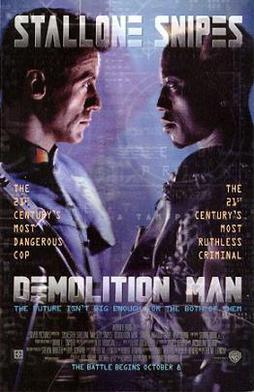
Marco Brambilla directs the 1993 science-fiction action film, with a screenplay by Daniel Waters, Robert Reneau and Peter M. Lenkov. Sylvester Stallone plays John Spartan, Wesley Snipes plays Simon Phoenix and Sandra Bullock plays Lenina Huxley, with Nigel Hawthorne as Raymond Cocteau. The futuristic setting supplies rules that turn ordinary behaviour into a source of comic friction. Huxley's interest in the earlier era gives Spartan somebody who wants to understand him, even when understanding requires confronting the difference between an appealing image of the past and the disruptive person who has actually arrived from it.
Spartan and Phoenix are frozen after a hostage disaster. In 2032, Phoenix escapes, and Spartan is revived to stop him. Huxley helps uncover that Cocteau has enhanced Phoenix to eliminate the underground resistance led by Edgar Friendly. Phoenix reveals he framed Spartan, then arranges Cocteau's death and tries to release more prisoners. Spartan defeats him as the prison is destroyed. He urges the police and the resistance to find a balance between order and freedom. The ending leaves the city's future to negotiation rather than restoring the authority that secretly manufactured its emergency.
San Angeles makes control visible through pleasantness. Behaviour can be regulated without the environment announcing itself as a traditional brutal dictatorship, and an orderly surface can encourage people to equate convenience with fairness. Spartan's irritation provides a comic way into that arrangement, but the underground population gives it a more consequential limit. A society cannot be understood solely through the experience of people it accommodates. Those pushed outside its preferred routines reveal what its description of harmony excludes. The film makes that exclusion part of the setting, so that the future's apparent success has to be considered alongside the people required to disappear for it to remain convincing.
Huxley's enthusiasm for the past creates a second kind of idealisation. A remembered era can become a collection of entertaining references whose unpleasant conditions no longer seem immediate. Meeting Spartan turns admiration into something she has to negotiate with a person. His competence does not make every habit desirable, just as the city's rigidity does not make every form of order worthless. Their partnership gives the film somewhere to develop that distinction. Curiosity becomes useful when it allows learning in both directions, rather than requiring one era to be wholly right so that the other can be dismissed as an elaborate mistake.
Phoenix undermines the claim that the city has simply outgrown violence. His capacity has been cultivated inside the very system presenting itself as peaceful. That makes the threat more disturbing than the accidental return of an old criminal. Force has been preserved for use against people who challenge the arrangement, while the public institutions have been left unable to recognise or contain it. Cocteau's scheme exposes a contradiction between what authority says it rejects and what it is prepared to commission. The resulting loss of control also makes outsourcing violence unstable: a useful instrument can acquire ambitions that the person who enabled it cannot enforce limits upon.
Spartan's own destructiveness prevents him from being a complete political answer. The future needs his practical ability, but importing it does not remove the costs of the approach associated with his nickname. The action comedy can enjoy disruption while still making its ending depend on compromise. That is a useful tension to keep in view when considering the film's satire. Criticising excessive regulation does not establish that every restraint should disappear, and recognising the need to resist a concealed threat does not mean permanent emergency is a good basis for ordinary life. The hero's effectiveness belongs to a crisis the city should not need to reproduce.
The final proposal makes the future unfinished. Order and freedom become things different groups must negotiate, rather than gifts one authority can define and deliver without participation. Demolition Man uses its exaggerated customs to make the unfamiliar funny, then gives the unfamiliar a social structure whose exclusions matter. Its central encounter changes both sides: a man from the past discovers how much a world can change, and that world discovers how much its certainty depends on refusing to see what lies beneath it. The strongest question left by the ending concerns who will take part in defining peace once the person who controlled its meaning has gone.