
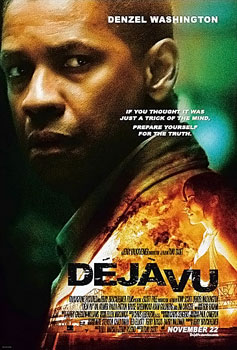
Behind the film
- Year
- 2006
- Director
- Tony Scott
- Writers
- Bill Marsilii, Terry Rossio
- Genres
- Crime thriller, Action, Thriller, Science fiction
- Production
- Touchstone Pictures, Scott Free Productions, Jerry Bruckheimer Films
- Country
- United States, United Kingdom
- Cast
- Denzel Washington, Paula Patton, Val Kilmer, Jim Caviezel, Adam Goldberg, Elden Henson, Erika Alexander, Bruce Greenwood
About the film
Contains story spoilers.
Déjà Vu turns a detective's wish to have arrived sooner into a working part of its fictional machinery. Doug Carlin initially has the familiar job of reconstructing an event from what it has left behind, but the technology placed before him changes the relationship between evidence and action. The past becomes something he can observe with an immediacy that ordinary reconstruction cannot provide. That offers more than a quicker way to identify a suspect. It makes inaction harder to accept, because the people in the images still appear to inhabit a moment when the catastrophe has not yet happened to them.
After a ferry bombing, Doug investigates the earlier murder of Claire Kuchever. A government device views events roughly four days in the past and proves to be a time window. An attempt to send a warning contributes to his partner's death. The bomber is caught, but Doug wants to save the victims, so he travels back. He rescues Claire and pursues the bomb onto the ferry. They drive the vehicle into the river; Claire escapes, while Doug dies in the explosion, saving the passengers. She then meets the Doug belonging to the altered present. The successful intervention preserves lives without giving the traveller an uncomplicated return to his own future.
The surveillance premise creates an unusual form of proximity. Doug can look closely at a person whose fate he already knows, yet knowing the fate does not mean knowing the full life that led towards it. Paula Patton's Claire becomes central to that tension. She first enters the investigation through death and evidence, then becomes visible as someone still acting within her own present. The distinction changes what observation means for Doug. Gathering useful information and recognising an endangered person can happen through the same image, but they produce different obligations. The film draws suspense from his movement towards the second understanding.
Denzel Washington's Doug carries that movement through a character trained to look for connections. The technology amplifies his investigative skill without making judgment unnecessary. A remarkable view can still be misunderstood, and a proposed intervention can still have consequences beyond the intended target. The film therefore avoids making the device simply an answer to every problem. Its usefulness depends on decisions about where to look, what an image means and what risks are acceptable. The human investigator remains part of the mechanism, with conviction and uncertainty contributing to what happens when observation becomes participation.
The first attempt to alter events makes that uncertainty concrete. A warning sounds straightforward until it becomes something that another person encounters under circumstances the sender does not control. The resulting harm challenges the comforting idea that additional information automatically produces a better outcome. In this story, information travels through people, institutions and accidents of timing. Someone must interpret it and act, creating opportunities for a seemingly helpful intervention to lead elsewhere. That is a useful complication for a time-travel thriller because it keeps the past from becoming a puzzle whose correct answer can simply be inserted without cost.
Tony Scott's film combines the investigative premise with the movement of an action thriller. Once Doug can intervene, explanation is no longer enough; he has to reach people and objects within the immediate conditions of the event. The story's momentum comes from that change in responsibility. A fact that would close a case in the original present may do little to prevent the catastrophe in the earlier moment. Screenwriters Bill Marsilii and Terry Rossio give the technology a role that continually changes the objective, shifting the question from who committed an attack to what could actually stop it. Solving and saving become related tasks with different demands.
The ending's altered meeting preserves that difference. Claire's recognition belongs to an experience the present Doug has not shared in the same way, so the final connection carries an asymmetry rather than a simple reunion. The traveller's sacrifice cannot be treated as an ordinary detour that leaves everything else intact. The film's fictional time logic allows another possibility of contact while keeping the completed intervention consequential. Read emotionally, the scene offers a future made available by someone who cannot fully occupy it himself. That is a different reward from returning home with a successful case and a memory everyone can confirm.
New Orleans gives the story a concrete civic setting for its enormous speculative question. The catastrophe affects a community, while Claire gives Doug a particular person through whom its stakes become immediate. Déjà Vu needs both scales: the desire to save someone close cannot exhaust the importance of the many other lives at risk. Its central fantasy asks what knowledge would require from an investigator if knowledge could become a route into the event itself. The answer is costly action rather than perfect understanding. The film lets a future improve while leaving the person who made that improvement possible outside the simple satisfaction of having got there in time.