
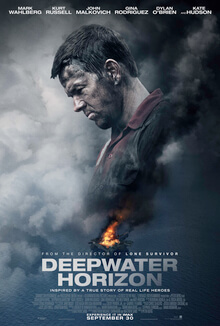
Behind the film
- Year
- 2016
- Director
- Peter Berg
- Writers
- Matthew Michael Carnahan
- Genres
- Drama, Action, Thriller, Disaster
- Production
- Starz Entertainment, Summit Entertainment
- Country
- United States
- Cast
- Mark Wahlberg, Kurt Russell, John Malkovich, Dylan O'Brien, Gina Rodriguez, Kate Hudson, J. D. Evermore, Ethan Suplee
About the film
Contains story spoilers, including the ending.
Peter Berg's Deepwater Horizon follows the crew of a drilling rig through an explosion in the Gulf of Mexico and their efforts to get one another to safety. Much of the film was shot on an eighty-five-percent-scale rig constructed above a shallow water tank in a Louisiana car park. The set had a working heliport, bringing a recognisable arrival point into this large industrial structure. Cinematographer Enrique Chediak used Alexa 65 and Alexa XT cameras, while Industrial Light & Magic handled most of the visual effects. The physical rig and surrounding tank gave the production a built environment for a story that eventually forces its characters to escape into open water.
In the film, Mike Williams and installation manager Jimmy Harrell arrive to discover that a planned cement inspection has been cancelled. Harrell insists on a pressure test, but BP representative Donald Vidrine disputes the troubling result. A second test is accepted and work proceeds. The subsequent blowout turns their workplace into a burning trap. Mike helps the injured Harrell, while floor hand Caleb Holloway survives the drill-floor disaster. Andrea Fleytas tries to summon help from the bridge. When their emergency raft drifts away before they can board, Mike and Andrea jump into the sea and are rescued. The survivors gather aboard the Damon Bankston to mourn. Later, Mike breaks down when a missing worker's parents confront him at a hotel, and his family comforts him. Photographs in the epilogue commemorate the eleven men who died.
Berg described a television interview with Mike Williams as his route into the project. He was drawn to Williams's experience and to meeting people who had lived through extraordinary events. Mark Wahlberg was already attached, and their earlier working relationship helped make the film appealing to him. That interest in the workers also shaped the director's account of the pressure-test confrontation. Berg said factual accuracy mattered when depicting BP's behaviour, presenting the scene as part of his determination to deal directly with the dispute. His stated intention belongs to the film's dramatic approach; the conversation is a staged exchange between performers. For the physical disaster, Berg credited Burt Dalton with bringing in large quantities of mud and oil and a pumping system capable of throwing it around under heavy pressure. The material striking the rig therefore included substantial practical effects. Berg recalled a shoot of roughly sixty days, working amid New Orleans heat and water on a set whose size created its own demands.
Editors Colby Parker Jr. and Gabriel Fleming organised the build-up around the workers and the deteriorating rig. The parallel strands gradually meet at the explosion, linking people's responsibilities to machinery beginning to fail. Parker described wanting the audience to understand where the fire was and which direction danger came from, even while the scene became chaotic. To solve that problem, the editors photographed a model of the rig with their phones and placed those temporary wide shots into the cut. The visual-effects team used the templates to create digital views of the whole structure. Those images supplied geography between closer shots of people trying to survive. The opening also developed through collaboration: Dror Mohar sent the editors an audio track against black, and they placed titles over it. Parker and Fleming each passed scenes to the other for another edit, discussing difficult sequences together. Parker had also met Williams and Holloway before filming and asked about their experiences, with Williams serving as a consultant.
Supervising sound editor Wylie Stateman recalled Berg asking the sound team to concentrate on the people aboard the rig. That instruction had practical consequences for a film full of engines and explosions. Production mixer David Wyman and his small crew first had to capture actors' voices on a crowded, noisy set. Those recordings reached the cutting room with the footage and formed a basic guide for the later soundtrack. Sound designers then developed pressure and liquid-pressure effects, alarms, public-address announcements, fire and falling debris. The water surrounding and supporting the platform also had to be audible within that constructed environment. Stateman described mixing those elements with Steve Jablonsky's music and the dialogue, including the quiet breathing of someone under extreme strain. A distressed breath needed a place alongside the larger sounds of destruction. The mixing work continued for more than six months as new visual effects arrived. The soundtrack therefore changed with the images, balancing the enormous mechanical surroundings against the voices of people caught inside them.
Sound designer and re-recording mixer Dror Mohar worked in the picture cutting room during the first half of the project, exchanging ideas with Berg and the editors. He described a need to establish how the machinery sounded while operating normally before presenting it under overload. Engines, pumps and the navigation system each needed an audible identity, as did the blowout preventer far below the surface. Some material came from field recordings Mohar made around pumping facilities and ships at an Israeli port. Designed layers added weight and movement, while structural vibrations and water displacement conveyed how a mechanical event affected its surroundings. He treated the calm ocean as a counterpoint to the violence on the platform and the water rushing through damaged lower decks. Different failures also received different sounds rather than one repeated blast. Mohar's account describes an expressive soundtrack: some choices favoured the feeling of distance and scale over literal acoustic accuracy. The sound had to explain the unfolding loss of control without exhausting the audience or drowning out the crew.