
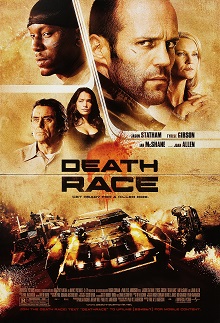
Behind the film
- Year
- 2008
- Director
- Paul W. S. Anderson
- Writers
- Paul W. S. Anderson, Charles B. Griffith
- Genres
- Action, Thriller, Science fiction action, Prison
- Production
- Relativity Media, Cruise/Wagner Productions, Universal Pictures
- Country
- United States, Germany, United Kingdom
- Cast
- Jason Statham, Joan Allen, Tyrese Gibson, Ian McShane, Natalie Martinez, Jacob Vargas, Robin Shou, Benz Antoine
About the film
Contains story spoilers, including the ending.
Death Race imprisons Jensen Ames, played by Jason Statham, in a deadly racing contest controlled by Joan Allen's warden. Director Paul W. S. Anderson described an anti-authoritarian film set in dystopian North America. The criticism of reality television and internet entertainment was intended to remain implicit rather than turn the film into comedy. That distinction matters to Jensen's position: the contest is presented to him as a way out, while his confinement supplies the entertainment being sold. Winning and being allowed to leave are different questions when the same authority runs both the prison and the race.
Jensen's wife Suzy is murdered, their baby Piper goes into foster care, and he is imprisoned for the killing. At Terminal Island, Hennessey makes him replace the dead masked driver Frankenstein. His crew includes Coach, while Case navigates and Machine Gun Joe competes against him. Jensen discovers that fellow driver Pachenko killed Suzy on Hennessey's orders to bring him into the prison. Case admits sabotaging the previous Frankenstein in exchange for release papers. Jensen kills Pachenko, then joins Joe against the Dreadnought tanker sent onto the track to kill drivers and raise ratings. Only the two men survive that stage. Their final race becomes an escape through a weak point and onto the mainland bridge. Coach has removed the bomb planted beneath Jensen's car, so Hennessey cannot detonate it. Jensen and Joe escape by freight train; Case wears Frankenstein's disguise and lets herself be captured. Coach sends the bomb back as a gift, killing Hennessey and Ulrich. Six months later, Jensen and Joe work as mechanics in Mexico, Piper is with her father, and Case rejoins them.
The racers' vehicles give the prison's contest a rough, makeshift appearance. Production designer Paul Austerberry explained that distinct shapes helped people keep track of the cars through rain, gravel and darkness. Bright colour coding would have worked against the grim setting. The production considered expensive exotic cars before choosing more ordinary models that prisoners might plausibly obtain. Frankenstein drives a Mustang GT, and Joe has a Dodge Ram pickup. Several copies were built for filming, including six Mustangs and five Rams, so a damaged vehicle would not stop work. The trucks carried heavy guns high above the road, requiring stronger suspension to cope with the added weight and reduced stability. Their engines remained largely unchanged. Those modifications give the screen vehicles their bulk while explaining why preparing a race involved more than attaching armour to a standard car.
Anderson wanted the collisions to have the physical force he associated with older action films. He told Electric Sheep that preparing the cars and camera rigs took about a year, with the rigs allowing cameras close to the action while protecting the crew. The industrial vehicles had to withstand the demands of those stunts. His emphasis was on making crashes with real machines rather than postponing the action until effects work. The scale also required a repair operation: the Los Angeles Times reported a Montreal shoot lasting fifty days, with thirty-five cars. Anderson's account of the location helps explain the enclosed world around the drivers. An abandoned train factory became the main filming site and production base, with editing rooms on the premises. The prison environment and the work of assembling its races occupied the same industrial location.
Editor Niven Howie was there during filming, cutting while Anderson shot the action. Anderson explained that an elaborate stunt could be performed only once, so the crew covered it from numerous camera positions. That left Howie with many angles of the same event rather than repeated chances to film it differently. More than a million feet of film were shot, and the editing schedule was longer than usual for Anderson because of the amount of material. He described the difficulty of keeping a stunt spectacular while fitting it into a sequence that continued to move. A muted palette of rust and industrial decay surrounds the cars, leaving bright flashes of gunfire and blood to break through. The race's apparent speed therefore depended on selecting and joining views of actions that had required lengthy preparation.
The physical stunts were only part of the finished racing world. Visual effects supervisor Dennis Berardi described digital work on selected large crashes as well as enhancements to practical racing. Gunfire and missiles were added, and close dialogue shots placed actors in cars on moving rigs with the exterior composited around them. Berardi put the effects work at 820 shots, including more than 400 greenscreen effects and composites. Terminal Island's wide views also required digital geography: water, the island itself and the long bridge to the mainland had to belong together. He described the island's scale and believable water as greater challenges than the racing. The department planned major stunts at real-world scale with accurate lenses and models of the cars. Those preparations connected the physical track action to the larger prison landscape, including the bridge that becomes the drivers' escape route.