
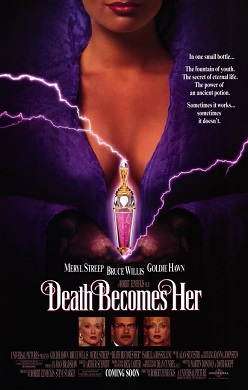
Behind the film
- Year
- 1992
- Director
- Robert Zemeckis
- Writers
- Martin Donovan, David Koepp
- Genres
- Fantasy, Horror, Comedy, Black comedy
- Production
- Universal Pictures
- Country
- United States
- Cast
- Meryl Streep, Bruce Willis, Goldie Hawn, Isabella Rossellini, Adam Storke, Michelle Johnson, Mary Ellen Trainor, Nancy Fish
About the film
Contains story spoilers.
Madeline Ashton, an actress whose fame is fading, once took Helen Sharp’s fiancé, surgeon Ernest Menville, and made him her husband. Years later, Helen returns as a glamorous author, while Madeline’s career and marriage have soured. A mysterious socialite, Lisle von Rhuman, offers Madeline a potion that restores youth and grants immortality; Helen has taken it too. After Madeline survives a broken neck and Helen survives a shotgun blast, the rivals reconcile and try to make Ernest drink the potion so he can keep repairing them. He refuses, escapes and lives a full mortal life. Thirty-seven years later, the women attend his funeral, then tumble down church steps, breaking apart into grotesque pieces. Still trading jokes, they face an eternity together.
The film treats youth as a luxury product, an ideal the characters can buy but never fully possess. Madeline and Helen are promised the version of themselves that once drew attention, yet the potion cannot repair their habits or history. That is the sharpness of its fantasy: their faces may look young, but their old grievances come along intact. Set among Beverly Hills homes, beauty treatments and social parties, the story makes image feel like currency. The characters keep paying into it even when the returns become absurd. Rather than simply asking whether staying young is desirable, the comedy asks what a person is willing to lose to keep looking like someone else’s idea of desirable.
Madeline and Helen are mirror images whose rivalry has lasted long enough to become a way of knowing one another. Meryl Streep plays Madeline with a practiced entitlement to attention; Goldie Hawn lets Helen’s warmth turn sharp when she is threatened. Each knows exactly which insecurity will wound the other because both have spent years measuring themselves against the same standards. Immortality gives that comparison no natural endpoint. Their reconciliation is funny and unexpectedly tender because it arises from shared damage, not a sudden moral conversion. They remain vain, petty and quick with an insult, but they also become the only people who can understand the peculiar burden they have chosen. The potion prolongs their relationship as much as it prolongs their lives.
Ernest gives the story a contrasting idea of what a life can be. He begins by letting attraction redirect his loyalties, then grows into a man who spends his working life repairing bodies. Bruce Willis plays him with a bashful weariness that makes his rejection of immortality feel like a genuine choice. He does not refuse because life has nothing to offer; he refuses to spend eternity serving people who have treated him as useful equipment. His choice leaves room for a future that can become different from the present. That portrait places mortality beside fulfilment rather than defeat. The women have more time than they can use well, while Ernest’s limited years acquire shape through change, family and an ending.
The physical gags make the film’s argument visible. A neck turned the wrong way, a hole in a torso and bodies patched with household materials transform vanity into a repair job that never ends. The effects are playful, but the joke depends on the body refusing to behave like a perfect surface. The characters can cover damage for a while, yet every patch exposes how much effort goes into pretending nothing has changed. Their elegant interiors sharpen the contrast, keeping grotesque reality in the same polished world that created the obsession. This is less a conventional fear-of-death story than a fantasy about the labour required to avoid it. The maintenance is absurd because immortality has removed the deadline without removing decay.
Isabella Rossellini’s Lisle presents the potion as if she were welcoming guests into an exclusive club, which makes the supernatural bargain feel like another social transaction. The film lets glamour and decay share a frame without forcing the women to become respectable before they can be funny. The comedy's verbal energy keeps the characters distinct from the condition of their bodies. Appearance cannot account for everything lively or valuable in a person, however insistently the surrounding world treats it as the decisive measure. That tension gives the fantasy an emotional purpose beyond the pleasure of a grotesque effect. Madeline and Helen escaped the ordinary ending and still cannot escape the question of what made a life worthwhile.
That uneasy blend of elegance and grotesquerie is what lets the comedy keep its bite. The characters are not punished by a moralising narrator; instead, the fantasy simply follows their choices beyond the point where a sensible person might stop. Even their friendship survives in an altered, compromised form, because shared history can be both a bond and a trap. The film’s best ideas emerge from that double edge. Companionship matters, but it cannot substitute for change; beauty can delight, but cannot carry the whole weight of identity. By ending with the women still trading barbs, the story preserves their liveliness while showing how little immortality has taught them.